

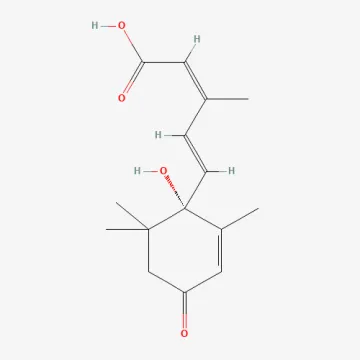
Description
Mode of action
S-abscisic acid (S-ABA) is a naturally occurring phytohormone that acts as the primary signaling molecule in response to adverse environmental conditions. Unlike synthetic alternatives, the S-isomer represents the most biologically active form that directly interacts with specific plant receptors.
The primary mode of action involves the rapid regulation of the stomatal apparatus. When the substance is applied to leaves or accumulated in tissues, potassium ions are released from guard cells, leading to a loss of turgor pressure and the immediate closure of stomata. This significantly reduces moisture loss through transpiration.
The compound triggers the expression of genes involved in adaptive responses, such as the synthesis of stress-protective proteins and osmolytes. This puts the plant into a state of high readiness, which is crucial for survival during periods of water deficit or thermal stress.
S-abscisic acid also regulates fruit and seed maturation processes, promoting the accumulation of sugars, anthocyanins, and other organic compounds. It suppresses excessive vegetative growth, directing energy resources toward generative development.
Unlike conventional growth stimulants, this substance functions as a growth inhibitor that helps plants manage resources rationally during times of drought, high heat, or soil salinity.
What it targets
The application of S-ABA is aimed not at pest control but at enhancing the general resilience of agricultural crops. Its primary utility is the mitigation of abiotic stress impacts.
Preparations based on S-abscisic acid are effective against the following negative conditions:
- Soil and atmospheric drought that threatens plant wilting.
- Thermal stress caused by extreme heat waves.
- Osmotic stress resulting from high soil salinity or poor irrigation water quality.
- Stress during transplantation or seedling establishment.
- Uneven fruit ripening due to weather anomalies.
The substance is widely used in fruit and viticulture, where it is applied to grapevines to improve berry coloration and enhance the commercial quality of the produce.
In greenhouse vegetable production, S-ABA is used to stabilize plant metabolism during periods of extreme temperature fluctuations between day and night.
Ornamental crops and turf grass management utilize this hormone to maintain aesthetic appeal and survive under restricted irrigation regimes.
Rates and timing
Application rates for S-abscisic acid depend directly on the crop stage, the severity of the stress, and the specific commercial formulation. Precision is vital to ensure the stomatal closure effect is achieved without causing unnecessary growth inhibition.
For field crops, preventive treatment is recommended before the predicted onset of stress. The best efficacy is observed when applied during early morning or late evening hours when stomatal activity is most responsive.
When used on vineyards to improve berry color, the substance is applied at the onset of veraison. Strictly adhering to the concentration guidelines provided by the manufacturer is necessary to achieve desired outcomes.
Uniform coverage of the leaf surface is essential. The solution must be distributed evenly to ensure contact with living tissues, which is required to initiate the signal transduction pathway.
Avoid exceeding the recommended dosages, as excessive growth inhibition may negatively impact final yield if the stress period proves to be shorter than anticipated.
Restrictions
S-abscisic acid is a compound with a relatively short half-life within the plant. It is metabolized quickly, meaning the protective effect is temporary and may require repeat applications during prolonged stress events.
Mixing S-ABA with highly alkaline pesticides or fertilizers is prohibited, as this can lead to the chemical degradation of the active ingredient and loss of biological efficacy.
Applications should not be performed if rainfall is expected, as washing the substance off the leaf surface before absorption will render the treatment ineffective.
Storage must be in a cool, dark place away from direct ultraviolet light, as exposure to light facilitates the photochemical destruction of the molecule.
Although it is a naturally occurring compound, standard personal protective equipment (gloves, goggles, respirators) should be used when handling concentrated commercial products to prevent irritation of the skin or mucous membranes.
Regulatory
Status in the European Union
Approved in the EU
- CAS number
- 21293-29-8
- Category (EU)
- PG - Plant growth regulator
- Approved from
- 01.07.2014
- Approval until
- 15.09.2026
- ADI
- 13.6 mg/kg bw/day
- ARfD
- Not appl.
- AOEL
- 6.8 mg/kg bw/day
EU status is for reference only and does not replace national registration in your country.
Content graph
Connections · S-abscisic acid
Most often together:
Marketplace