
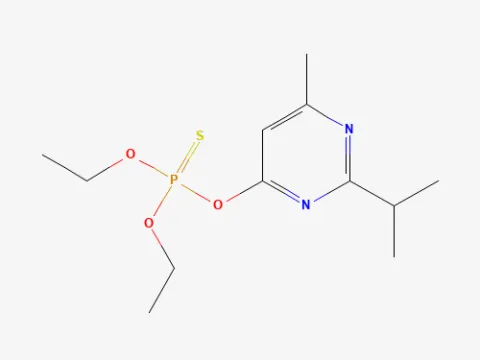
Diazinon
Diazinon belongs to the organophosphate (OP) chemical class. It functions as a highly effective contact, stomach, and systemic insecticide that also exhibits significant fumigant properties.
What the section contains
Diazinon
The mechanism of action involves the inhibition of the enzyme acetylcholinesterase in the insect's nervous system. This disruption prevents the transmission of nerve impulses, leading to paralysis and death within a short period.
Formulations containing diazinon can rapidly penetrate plant tissues and soil substrates, which allows for the control of both surface-dwelling and cryptic pest species.
The substance provides strong initial knockdown activity and maintains long-term protection for crops, as it remains toxic in the soil for several weeks after application.
Diazinon is highly effective against a broad range of pests, including populations that have developed resistance to pyrethroid-based insecticides, making it a valuable tool in resistance management programs.
The active ingredient is highly effective at eliminating various soil-dwelling insects, such as wireworms, false wireworms, and white grubs.
It is commonly used to control agricultural pests on vegetable and cereal crops, including mole crickets, cutworms, seedcorn maggots, and cereal ground beetles.
Diazinon-based products are deployed to manage pest populations on potatoes, cabbage, tomatoes, onions, cucumbers, and various ornamental flowering plants.
The insecticide delivers excellent results in suppressing populations of thrips, aphids, weevils, and various species of bugs that damage the vegetative parts of crops.
Due to its excellent penetrating capacity, the substance performs efficiently even in dense plant canopies, offering comprehensive protection for the entire field.
Application rates for diazinon vary significantly depending on the product formulation (granules, emulsifiable concentrates) and the method of delivery — either soil incorporation or foliar spraying.
For controlling soil pests, granular formulations are typically applied directly into the furrows during planting or at the time of transplanting, followed by immediate soil covering.
When using emulsifiable concentrates for foliar application, it is essential to follow local regulations regarding application frequency, which is typically limited to 1–2 times per season.
Pre-harvest intervals (PHI) range from 20 to 40 days depending on the specific crop type, requiring strict adherence before the harvest and consumption of the produce.
Ensuring uniform distribution of the product across the soil surface or field area is critical for achieving maximum pest coverage and ensuring consistent treatment efficacy.
Diazinon is highly toxic to bees; therefore, its application is strictly prohibited during the active flowering period of entomophilous crops and near apiaries.
The substance poses significant risks to warm-blooded animals and aquatic life, making it vital to prevent any runoff into water bodies or sewage systems.
Personal Protective Equipment (PPE), including respirators, chemical-resistant gloves, goggles, and protective clothing, must be worn to prevent accidental exposure.
Applications should not be conducted during windy weather to avoid drift onto neighboring properties, residential buildings, or areas accessible to the public.
Storage must be strictly controlled, maintaining appropriate temperature and humidity levels, and ensuring that the pesticide is kept away from children and pets at all times.