
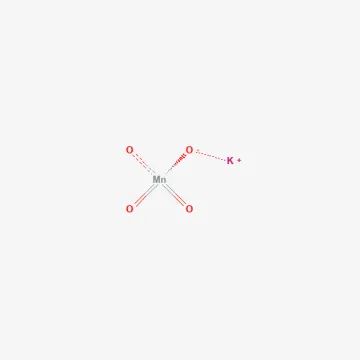
Potassium permanganate
Description
Mode of action
Potassium permanganate acts as a powerful oxidizing agent, exerting its effect by releasing active oxygen upon contact with organic matter.
This chemical reaction causes the denaturation of proteins and the destruction of cellular membranes of pathogenic microorganisms, leading to their rapid inactivation.
The substance possesses strong antiseptic properties, effectively suppressing the activity of bacteria and fungi present on plant surfaces or in the soil substrate.
Following the oxidation process, the compound degrades into manganese dioxide, which is a relatively stable and environmentally neutral byproduct.
As it does not possess systemic activity, the efficacy of the substance is limited to the direct contact area where it is applied.
What it targets
Potassium permanganate is utilized as a fungicide and bactericide to manage diseases such as powdery mildew, gray mold, fusarium wilt, and various bacterial infections.
It is primarily employed for the disinfection of seeds, bulbs, and corms to eliminate pathogens residing on their surfaces before planting or storage.
The agent is effectively used for soil sterilization in greenhouses and cold frames to reduce the overall disease pressure before the growing season starts.
It is also widely used for disinfecting gardening tools and equipment to prevent the cross-contamination of pathogens across the growing area.
Applications are particularly effective in preventing "damping-off" disease in seedlings by sanitizing the growth media and immediate environment.
Rates and timing
For seed treatment, a solution with a concentration between 0.5% and 1% is typically used, with an immersion time ranging from 20 to 30 minutes.
When applying to soil to prevent root rots, a pale-pink solution is used to drench the root zone or the surface of the soil bed.
For foliar applications against powdery mildew, a concentration of 0.3%–0.5% is recommended, repeating the application every 7–10 days if needed.
For the sterilization of equipment and greenhouse surfaces, more concentrated solutions (up to 2–3%) should be applied with an exposure time of at least one hour.
Strict adherence to dosage is essential to avoid potential phytotoxicity or chemical burning of sensitive plant tissues.
Restrictions
Potassium permanganate is incompatible with most organic compounds, which causes the solution to lose its effectiveness rapidly if it contacts dirt or debris.
When handling the concentrated substance, personal protective equipment must be used to prevent severe chemical burns to the skin and mucous membranes.
Excessive use can lead to phytotoxic effects and an accumulation of manganese in the soil, which may inhibit the growth of certain sensitive plant species.
Solutions must be prepared immediately before use, as they degrade quickly when exposed to light and atmospheric air.
Care should be taken to prevent large amounts of the solution from entering water bodies or sewage systems due to potential impacts on water chemistry.
Status in the European Union
Not approved in the EU
- CAS number
- 7722-64-7
- Category (EU)
- BA - Bactericide
EU status is for reference only and does not replace national registration in your country.