

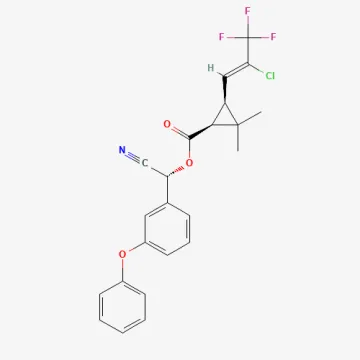
Description
Mode of action
Lambda-cyhalothrin is a synthetic pyrethroid insecticide of the second generation. It acts as a powerful broad-spectrum contact and stomach poison for various agricultural pests.
The mode of action involves disrupting the nervous system of insects. It effectively modulates the sodium channels in nerve cell membranes, leading to rapid neuronal dysfunction.
The primary effect is hyper-excitation followed by paralysis, commonly referred to as the knockdown effect. Insects cease feeding shortly after contact with the chemical substance.
The compound also demonstrates significant repellent properties, which helps prevent re-infestation of treated crops for a certain period of time.
Compared to earlier pyrethroids, lambda-cyhalothrin shows enhanced photostability and superior penetration through the insect cuticle, ensuring consistent performance in field conditions.
What it targets
This substance is highly effective against a wide range of pests, including members of the Lepidoptera, Coleoptera, Hemiptera, and Homoptera orders.
It is widely used to control sucking and chewing pests such as aphids, thrips, weevils, cereal beetles, plant bugs, and various species of cutworms.
The insecticide is suitable for protecting a vast range of crops, including cereals, technical crops, vegetables, and fruit orchards.
It performs exceptionally well against active larvae and adult insects, although it typically has a limited effect on eggs and pupae stages.
In greenhouse environments, it is used to manage populations of whiteflies and spider mites, facilitating quick population density reduction.
Rates and timing
Application rates depend on the specific crop and the severity of pest infestation. Typical dosage rates range from 0.05 to 0.2 liters per hectare.
Treatment timing is determined by field scouting and economic threshold levels. Applications should target young larval stages for the best results.
Achieving thorough and uniform coverage of the crop canopy is essential for effectiveness. Properly calibrated spraying equipment is required to minimize drift.
The number of applications per season is generally restricted to prevent the development of resistance. Rotational use with other chemical classes is recommended.
The pre-harvest interval (PHI) varies by crop but typically ranges between 20 to 30 days to ensure safety for the end consumer.
Restrictions
Lambda-cyhalothrin is highly toxic to bees and beneficial predatory insects. Do not apply when crops are in bloom or when bees are actively foraging.
Avoid applications during peak daylight temperatures exceeding 25°C, as the compound's stability and efficacy can be reduced under extreme heat.
To avoid the build-up of pesticide resistance, it is critical to rotate lambda-cyhalothrin with insecticides that possess different modes of action.
The substance poses risks to aquatic environments. Applications should be avoided near water bodies to prevent runoff into rivers and ponds.
Strict safety precautions are required during handling. Operators must wear full personal protective equipment (PPE), including respirators, goggles, and gloves.
Regulatory
Status in the European Union
Approved in the EU
- CAS number
- 91465-08-6
- Category (EU)
- IN - Insecticide
- Approved from
- 01.04.2016
- Approval until
- 31.08.2026
- ADI
- 0.0025 mg/kg bw/day
- ARfD
- 0.005 mg/kg bw
- AOEL
- 0.00063 mg/kg bw/day
Hazard classification (CLP)
Acute Tox. 2 - H330Acute Tox. 3 - H301Acute Tox. 4 - H312Aquatic Acute 1 - H400Aquatic Chronic 1 - H410
EU legislation
EU status is for reference only and does not replace national registration in your country.
Content graph
Connections · Lambda-cyhalothrin
Most often together:
Marketplace