
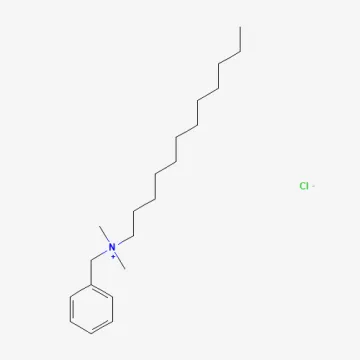
Lauryldimethylbenzylammonium chloride
Description
Mode of action
Lauryldimethylbenzylammonium chloride belongs to the class of quaternary ammonium compounds (QACs), which act as cationic surfactants.
Their primary mechanism involves disrupting the integrity of microbial cell membranes, leading to the leakage of cytoplasm and eventual cell death.
These compounds exhibit strong adsorption properties, allowing them to remain on surfaces for extended periods to provide residual protection.
Unlike systemic crop protection products, this substance functions exclusively through contact action, creating a sterile barrier on treated surfaces.
The efficacy of this substance is highly dependent on the pH of the solution and the presence of organic matter on the treated surface.
What it targets
The compound is widely used in professional agriculture as a potent disinfectant and biocide for maintaining sanitary conditions.
It demonstrates high efficiency in controlling a wide range of phytopathogenic bacteria, fungi, and algal growth in confined spaces.
- Sanitization of greenhouse structures.
- Control of algae in hydroponic and irrigation systems.
- Disinfection of farming tools and equipment.
- Treatment of storage crates to prevent fungal mold.
- General sanitation of nursery propagation areas.
It is specifically valued for preventing outbreaks in high-humidity environments where pathogens spread rapidly.
The substance helps in creating a clean environment for seeds, transplants, and crops, reducing the overall pressure from infectious agents.
Rates and timing
Application rates vary significantly based on the concentration of the commercial formulation and the specific sanitary requirements.
For general greenhouse structure disinfection, solutions with active ingredient concentrations between 0.1% and 0.5% are commonly recommended.
System cleaning in hydroponics requires specific dosing to effectively remove algal films without harming the system hardware.
Equipment disinfection usually involves a short soaking period in the solution followed by thorough rinsing where necessary.
Always verify the manufacturer's label for exact dilution ratios and the required contact time to ensure complete pathogen elimination.
Restrictions
Direct application to green, vegetative plant parts should be avoided as it may cause significant phytotoxicity and tissue damage.
Organic debris, such as soil or plant residues, drastically reduces the biocidal activity, so thorough cleaning is a prerequisite.
The chemical is an irritant to the skin and eyes, necessitating the use of standard personal protective equipment during handling.
Do not mix with anionic detergents or surfactants, as this will lead to chemical neutralization and loss of effectiveness.
Ensure adequate ventilation after treating indoor spaces to dissipate any residual fumes before re-entering the area.
Status in the European Union
Not approved in the EU
- CAS number
- 139-07-1
- Category (EU)
- HB - Herbicide
EU status is for reference only and does not replace national registration in your country.