

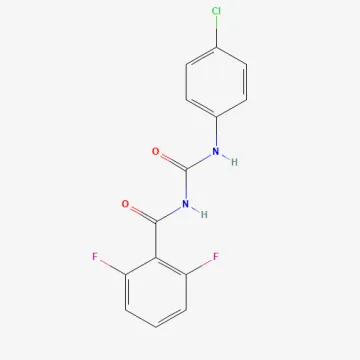
Description
Mode of action
Diflubenzuron belongs to the chemical class of benzoylureas. It is an insecticide classified as an insect growth regulator (IGR), which specifically targets the developmental stages of pests.
The primary mode of action is the inhibition of chitin synthesis within the insect cuticle. The substance blocks the enzymatic processes required for the formation of the larvae's protective shell.
The compound exhibits strong ovicidal and larvicidal activity. Once it enters the insect's system, it disrupts the molting process, leading to the death of individuals at various developmental stages or preventing them from transitioning to the next stage.
The active ingredient acts through both contact and ingestion. It does not cause immediate paralysis, meaning that the death of pests typically occurs within several days following contact with or consumption of the treated surface.
A key feature of this product is its high selectivity. It has virtually no impact on beneficial entomofauna (predatory insects and parasitoids), making it highly suitable for integrated pest management (IPM) programs.
What it targets
Diflubenzuron is effective against a wide range of pests belonging to the orders Lepidoptera, Diptera, and Coleoptera.
The product is successfully used to protect fruit crops against codling moths, leaf rollers, and other moth species. It is also effective against certain types of leaf beetles and sawflies.
In agriculture, it is frequently employed to control pest populations in orchards, vegetable crops, and forestry applications.
Furthermore, the substance is used in livestock management to control fly larvae in animal housing environments.
- Lepidopteran pests (codling moths, loopers).
- Dipteran pests (flies, mosquitoes, gnats).
- Complex of harmful insects in greenhouse and open field conditions.
Rates and timing
Application rates depend on the crop type and the target pest, typically ranging from 0.1 to 0.5 kg of active ingredient per hectare.
Optimal timing is determined by pest monitoring: applications should be conducted during the egg-laying period or at the first instar larval stage.
It is recommended to apply the product uniformly over the entire foliage mass of the plant to ensure maximum coverage of the surface.
When used in orchards, the pre-harvest interval (PHI) is typically between 20 and 30 days, which must be considered during application planning.
The number of treatments per season is strictly regulated by the manufacturer's label to prevent the development of resistance in target pest populations.
Restrictions
When handling diflubenzuron, standard safety precautions must be followed, including the use of personal protective equipment for respiratory and skin protection.
Application is prohibited during the peak flight period of bees due to potential risks to brood development, despite the low toxicity to adult bees.
Drift of the spray solution onto adjacent areas must be avoided, especially near water bodies, as the substance can be toxic to aquatic invertebrates.
The product does not possess systemic activity within the plant; therefore, the quality of foliage coverage during spraying is critical for achieving optimal efficacy.
Storage should be in dry, cool locations inaccessible to children and pets, kept strictly separate from food and feed products.
Regulatory
Status in the European Union
Not approved in the EU
- CAS number
- 35367-38-5
- Category (EU)
- IN - Insecticide
- Approved from
- 01.01.2009
- Approval until
- 31.12.2020
- ADI
- 0.1 mg/kg bw/day
- ARfD
- Not appl.
- AOEL
- 0.033 mg/kg bw/day
EU status is for reference only and does not replace national registration in your country.
Content graph
Connections · Diflubenzuron
Most often together:
Marketplace
Products · 2

Dimilin
Кемарк КФТ, Угорщи (на замовлення Кемтура Корпорейшн, США)на
Insecticides
0
0
·
56
No offers
—
Details