

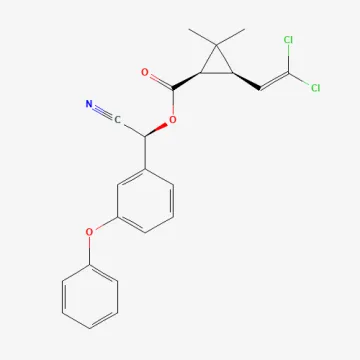
Description
Mode of action
Beta-cypermethrin belongs to the synthetic pyrethroid chemical class and acts as a highly effective broad-spectrum insecticide. It consists of an enriched mixture of isomers, which provides significantly higher biological activity compared to standard cypermethrin.
The mechanism of action involves disrupting the permeability of cell membranes and blocking sodium channels within the nerve cells of the insects. This triggers an immediate paralysis, stopping the insect from feeding and leading to rapid death.
The substance exhibits strong contact and stomach action. Upon contact with the insect or the plant surface, it creates a rapid knockdown effect, which is crucial for controlling high populations of pests in a short timeframe.
Due to its high lipophilicity, the active ingredient quickly penetrates the chitinous exoskeleton of insects. This allows it to work effectively even under challenging weather conditions, such as lower temperatures early in the season.
Beta-cypermethrin does not possess systemic properties, meaning it does not translocate within plant tissues. Therefore, the efficacy of the application is highly dependent on the quality and uniformity of the spray coverage on the foliage.
What it targets
This insecticide effectively manages a wide range of Lepidoptera, Coleoptera, Orthoptera, and Hemiptera species. It is a key tool in controlling the Colorado potato beetle, aphids, armyworms, weevils, and various plant bugs.
It is widely used on numerous crops, including cereals, sugar beets, potatoes, oilseed rape, open-field vegetables, and orchards. Its versatility allows for integration into diverse agricultural protection programs.
The high toxicity towards pests makes it ideal for emergency situations where immediate intervention is required to prevent severe crop damage. It affects all developmental stages, showing high efficiency against both adults and larvae.
Beta-cypermethrin is an essential component in anti-resistance management strategies. It successfully controls pest populations that may have developed resistance to organophosphate-based insecticides.
In addition to field crop protection, it is used in storage facilities to control stored-product pests, proving its reliability and effectiveness across various industrial and agricultural applications.
Rates and timing
Application rates for beta-cypermethrin depend on the target pest, the crop growth stage, and the level of infestation. Typically, the rate ranges from 50 to 150 ml of the formulated product per hectare.
Applications should be performed when the first signs of pest activity are observed, avoiding the exceedance of the economic injury level. It is vital to ensure an even distribution of the spray solution over the entire plant surface.
The working solution must be used shortly after preparation. The optimal time for application is early morning or late evening at moderate temperatures to maximize the stability of the active ingredient.
Spraying should be avoided during peak heat or strong wind to minimize evaporation and spray drift, which can significantly reduce the biological efficacy of the plant protection treatment.
The number of applications per season is generally restricted to two. Pre-harvest intervals typically range from 20 to 30 days, depending on the crop type, which must be strictly followed to ensure food safety.
Restrictions
Beta-cypermethrin is highly toxic to bees and other pollinators; therefore, application during the flowering period is strictly prohibited. Local beekeepers must be notified several days before the treatment is performed.
The substance is dangerous to aquatic organisms. It is prohibited to dispose of spray remains in water bodies or to apply the chemical near stream banks and ponds where buffer zones are established.
Personnel handling the chemical must use full personal protective equipment (PPE), including respirators, gloves, and protective clothing. Contact with skin, eyes, or inhalation of spray mist must be strictly prevented.
To mitigate the risk of resistance development, it is recommended to rotate beta-cypermethrin with insecticides of different modes of action. Continuous use of one chemical class on the same field should be avoided.
Storage should be conducted in specialized, secure warehouses at the temperatures recommended by the manufacturer, keeping the product out of the reach of children, animals, and away from food and feedstuffs.
Regulatory
Status in the European Union
Not approved in the EU
- CAS number
- 65731-84-2
- Category (EU)
- IN - Insecticide
- ADI
- 0.0016 mg/kg bw/day
- ARfD
- 0.0016 mg/kg bw
- AOEL
- 0.0008 mg/kg bw/day
EU legislation
EU status is for reference only and does not replace national registration in your country.
Content graph
Connections · Beta-cypermethrin
Most often together:
Marketplace
Products · 9


