

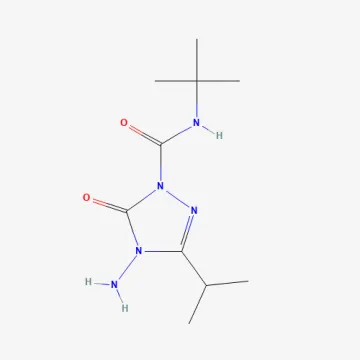
Description
Mode of action
Amicarbazone belongs to the triazolinone chemical class and acts as a potent selective herbicide for crops.
The primary mechanism of action involves the inhibition of photosynthesis by blocking electron transport in photosystem II of target weeds.
Upon absorption, primarily through the root system, the active ingredient translocates within the plant tissues, causing disruption of energy production.
Susceptible plants undergo rapid chlorosis and tissue necrosis, eventually leading to the death of the weed, usually within a few days to weeks.
Crop selectivity is achieved because specific crops, such as corn, metabolize the active ingredient into inactive compounds before it causes significant damage.
What it targets
Amicarbazone is effective against a broad spectrum of annual broadleaf weeds and certain grass species in agricultural fields.
Key target weeds typically include common lambsquarters, pigweed species, smartweed, black nightshade, and ragweed.
The substance is particularly useful for managing weed populations that have developed resistance to other traditional herbicide classes.
It provides long-lasting residual control in the soil, which helps to suppress subsequent flushes of weeds following the initial application.
- Effective on diverse broadleaf weed species.
- Residual soil activity for extended protection.
- Resistance management tool for tough weeds.
Rates and timing
Application rates are determined by soil texture, organic matter content, and the specific weed species present in the field.
The herbicide can be applied pre-emergence or early post-emergence, depending on the specific crop growth stage requirements.
Soil moisture plays a critical role in the efficacy of amicarbazone, as rainfall or irrigation is required to activate the chemical in the root zone.
Tank mixing with other herbicides is a common practice to broaden the spectrum of weed control and ensure consistent results across various environments.
Strict adherence to the label regarding the growth stage of the crop is necessary to avoid phytotoxicity and potential yield reduction.
Restrictions
Application on coarse-textured soils with very low organic matter should be avoided due to the increased risk of leaching and crop damage.
Crop rotation restrictions must be observed carefully, as soil residues from amicarbazone may affect sensitive rotational crops in the following seasons.
Spray drift must be minimized by utilizing appropriate nozzles and avoiding application during high-wind conditions near sensitive areas.
Personal Protective Equipment (PPE) including gloves, eye protection, and long-sleeved clothing is mandatory during mixing, loading, and application.
Store the product in a cool, dry place and ensure that containers are properly labeled and kept away from unauthorized personnel or animals.
Regulatory
Status in the European Union
Not approved in the EU
- CAS number
- 129909-90-6
EU status is for reference only and does not replace national registration in your country.
Content graph
Connections · Amicarbazone
Most often together:
Marketplace
Products · 3

Vijn, VG (amikarbazon, 280 g/kg + mesotrion, 288 g/kg)
«Аріста ЛайфСайенс С.А.С.» , Франція
Herbicides
0
0
·
40
2 offers
338.22 €per 1 l
Buy
