

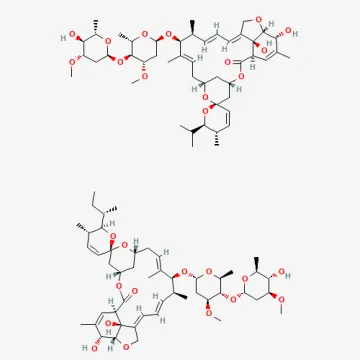
Description
Mode of action
Abamectin is a member of the avermectin class, derived from the fermentation of the soil-dwelling actinomycete Streptomyces avermitilis. It acts as a potent insecticide and acaricide, primarily affecting the nervous system of pests.
The mode of action involves stimulating the release of gamma-aminobutyric acid (GABA) at the nerve synapses. This causes an irreversible blockade of nerve impulses, leading to paralysis and the eventual death of the target pest through starvation.
This substance exhibits significant translaminar activity, meaning it penetrates leaf tissues rapidly. This is crucial for controlling pests such as leaf miners or mites that live within the leaf layers, where contact pesticides often fail.
Although it is not a systemic pesticide, abamectin is absorbed into the leaf cuticle and parenchyma. This allows the plant to maintain a level of protection against feeding pests even if the surface residue is washed away or degraded by sunlight.
Abamectin is generally categorized as a low-persistence pesticide in the field, as it breaks down rapidly upon exposure to UV light. This characteristic helps minimize chemical residues on harvested produce while providing immediate knockdown power.
What it targets
The primary use of abamectin is the control of mite populations, including spider mites, rust mites, and broad mites. It is also highly effective against leaf miners, thrips, and various stages of lepidopteran larvae.
Abamectin is widely used across various sectors, including greenhouses, open-field vegetable cultivation (such as tomatoes and peppers), fruit orchards, and ornamental horticulture. It is a cornerstone in integrated pest management programs.
Rates and timing
Application rates generally vary from 0.3 to 1.5 liters per hectare depending on the crop and the specific pest pressure. It is essential to apply the product when the first signs of infestation appear to prevent population explosions.
The timing of applications should be adjusted based on the pest's life cycle. Multiple applications may be required if the infestation is heavy; however, it is standard practice to rotate with other chemical classes to prevent resistance development.
Restrictions
Abamectin is highly toxic to bees and aquatic organisms. Therefore, applications during the bloom period are prohibited, and buffer zones must be maintained to prevent drift into non-target areas and water bodies.
Pre-harvest intervals (PHI) typically range between 3 and 7 days. Operators should wear appropriate protective clothing, including respirators and chemical-resistant gloves, to avoid inhalation or skin contact during preparation and application.
Regulatory
Status in the European Union
Approved in the EU
- CAS number
- 71751-41-2
- Approved from
- 01.04.2023
- Approval until
- 31.03.2038
- ADI
- 0.0012 mg/kg bw/day
- ARfD
- 0.0012 mg/kg bw
- AOEL
- 0.0012 mg/kg bw/day
Hazard classification (CLP)
Acute Tox. 1 - H330Acute Tox. 2 - H300Aquatic Acute 1 - H400Aquatic Chronic 1 - H410Repr. 2 - H361dSTOT RE 1 - H372
EU legislation
EU status is for reference only and does not replace national registration in your country.
Content graph
Connections · Abamectin
Most often together:
Marketplace
Products · 22


Fitoverm
Innovative company "Agro Protection", LLC
Insecticides
0
0
·
88
38 offers
40.66 €per 1 l
Buy


Abasaid 2
Джі. Джі. МАУГЕТ КОМПАНІ (J.J. MAUGET COMPANY), США
Insecticides
0
0
·
78
No offers
—
Details


