
Say's blister beetle
Pomphopoaea sayi
Description
How to identify
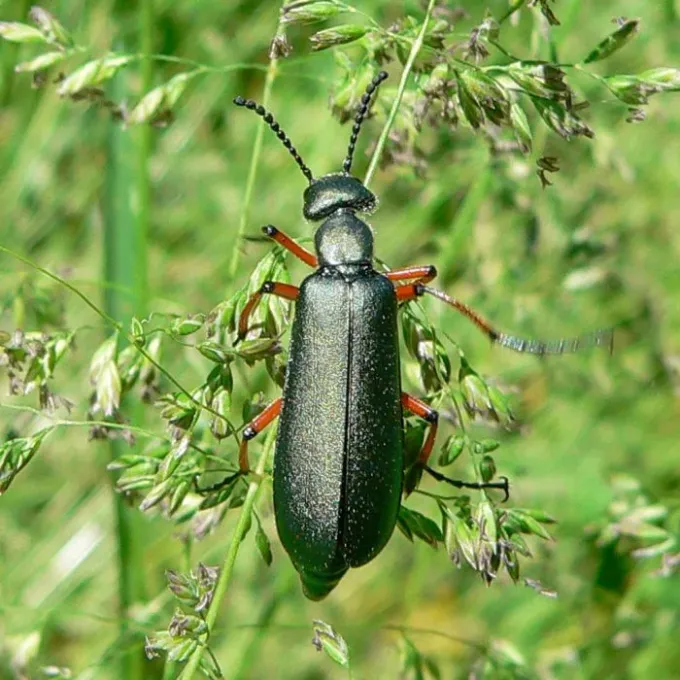
Say's blister beetle (Pomphopoaea sayi) is a member of the Meloidae family, belonging to the order Coleoptera. Adult beetles are characterized by an elongated body shape and often exhibit a metallic coloration, ranging from bronze to green with a coppery luster.
The head of the beetle is clearly distinct from the pronotum, and the legs are long and robust, allowing the insect to move quickly across leaf surfaces. The body length of an adult insect typically ranges from 10 to 15 millimeters.
The name originates from the beetle's defense mechanism: it secretes a chemical called cantharidin from its leg joints when threatened. This substance can cause chemical burns and blisters on human skin, necessitating the use of protective gloves when handling the insects.
The larvae of Say's blister beetle have a complex life cycle that differs significantly from the adult stage. They undergo several metamorphosis stages, often living in the soil or in the nests of hymenopterans, where they feed on the larvae and food stores of the host insects.
Adult beetles are primarily active during the day, preferring sunny and well-warmed areas in gardens and fields. They often aggregate in clusters on a single plant, making their presence highly visible to farmers and agronomists.
What it damages
The primary damage is caused by the adults, which feed on the foliage of a wide range of agricultural crops. Rosaceous plants, legumes, and various vegetable and fruit crops are particularly susceptible to their feeding habits.
Preferred host plants include beans, soybeans, apple trees, peaches, and various berry bushes. The damage manifests as extensive defoliation, which severely weakens the plant by reducing the leaf surface area available for photosynthesis.
Under high population density, these beetles can skeletonize entire plants, leaving only the thick leaf veins. This significantly impairs the plant's physiological processes and leads to a drastic reduction in crop yields.
Beyond foliage, the beetles frequently attack buds and flowers, directly reducing the potential harvest of fruits. If an infestation occurs during the flowering period, the damage becomes critical for both yield quantity and market quality.
For large-scale agricultural operations, Say's blister beetle poses a significant threat due to its voracious appetite and high mobility between plots. The wounds inflicted by the beetles also serve as entry points for secondary fungal and bacterial infections.
When it appears
Adult Say's blister beetles typically emerge at the beginning of the summer season when warm, stable weather conditions are established. The peak activity of these insects is usually observed throughout June and July.
The pest's life cycle is complex because the larval stages develop within the soil. Adult beetles emerge to the surface after pupation specifically for a period of intensive feeding and mating.
The duration of the life cycle depends heavily on regional temperature conditions and the availability of food sources. In hot, dry years, population numbers can spike, requiring increased vigilance and monitoring of the fields.
After mating, females lay eggs in the soil near feeding sites or host nests. The larval developmental stages consume a significant portion of the total life cycle, progressing through several sequential instars.
Monitoring should begin as soon as the target crops start their active growth phase to detect the first arrivals before the infestation spreads across the entire field.
Signs of infestation
The first sign of an infestation is the appearance of irregularly shaped holes in the plant leaves. Initially, the damage manifests as small consumed patches along the edges or in the center of the leaf blades.
A reliable indicator is the discovery of beetle clusters sitting on terminal shoots or inflorescences. Due to their tendency to aggregate, affected areas are clearly identifiable during a visual inspection of the crop field.
Presence of specific damage on fruits and flowers, appearing as gouged or chewed sections, also indicates the activity of this blister beetle species. Damage is often accompanied by the wilting of affected plant parts due to the disruption of vascular flow.
In dry weather, the damaged leaf tissues dry out quickly, turning a yellowish-brown color, which gives the plant a scorched appearance. This makes the infestation hotspots easily visible even from a distance.
The presence of these beetles is often associated with a distinct odor, which they release as a deterrent against predators. Experienced agronomists can spot an infestation by observing changes in the general health of the crop in specific areas.
Control measures
The most effective method for controlling small infestations is the manual collection of beetles. Because they secrete cantharidin, it is essential to perform these operations while wearing protective clothing and heavy-duty gloves.
During massive outbreaks, the application of contact-stomach insecticides approved for use on specific crops is recommended. Treatments should be applied in the evening hours to minimize the risk to beneficial pollinators.
Agronomic practices, such as deep fall tilling or plowing, help destroy overwintering life stages in the soil. This significantly lowers the potential pest pressure for the following growing season.
It is important to manage weed growth around field edges, as these plants can serve as an intermediate feeding station before the beetles migrate to the main crop. Implementing a proper crop rotation strategy helps limit the beetle population.
When considering biological control, look for products based on entomopathogenic fungi, which may be effective against larval stages residing in the soil. Regular monitoring remains the key to preventing catastrophic crop losses.
Taxonomy
- Latin name
- Pomphopoaea sayi
- Order
- Coleoptera (beetles)
- Family
- Meloidae
- EPPO code
- LYTTSA
Discussion
No discussions yet — be the first.