
Mylabris variabilis
Mylabris variabilis
Description
How to identify
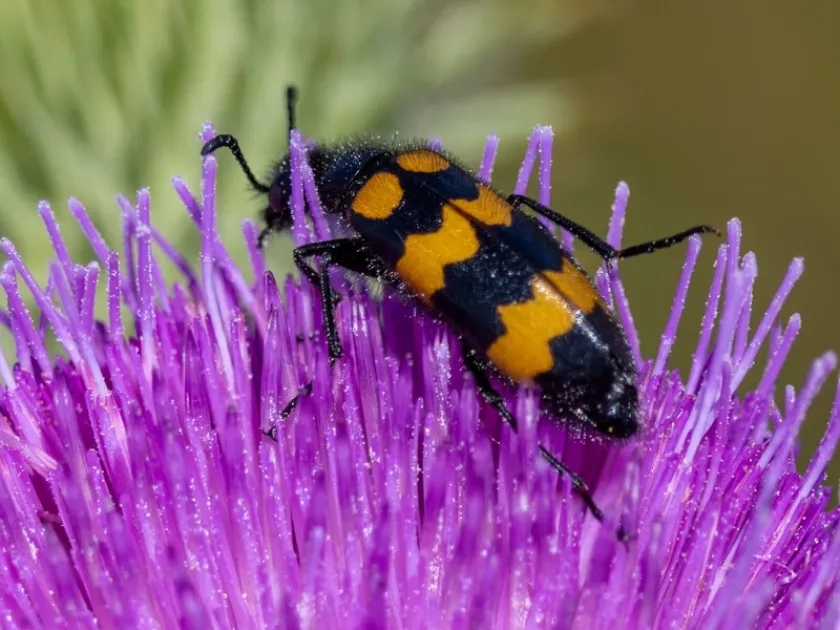
Mylabris variabilis, commonly known as a type of blister beetle, is a member of the Meloidae family within the order Coleoptera. Adult beetles are characterized by their distinct black pronotum and elytra featuring alternating transverse orange-red and black bands.
The head of the beetle is relatively large and heart-shaped, with antennae that gradually thicken towards the tips. A notable biological feature is that their hemolymph contains cantharidin, a toxic substance that can cause blistering if it comes into contact with human skin.
The larvae of these beetles undergo a complex developmental process called hypermetamorphosis. They typically reside in the soil and are known to be parasitic in the nests of wild bees, consuming both the bee larvae and their stored pollen.
The appearance of the elytra can be quite variable, which is reflected in the specific epithet "variabilis." The width and definition of the red and black stripes may differ between individuals, but the high-contrast pattern remains a reliable identifier.
These insects thrive in open, sunny environments where flowering plants are abundant, as the nectar and pollen of these flowers provide the primary energy source for the adult beetles throughout the season.
What it damages
Mylabris variabilis is considered a significant pest that poses a threat to a variety of agricultural crops. It is especially damaging to oilseeds, legumes, and vegetable crops during their critical flowering stages.
Key crops at risk include sunflower, alfalfa, chickpeas, soybeans, and various cucurbits. The adult beetles congregate in large numbers on the reproductive parts of the plants to feed intensively.
By consuming petals, stamens, and pistils, the beetles disrupt the pollination and fertilization process. This leads to a substantial reduction in yield, as the formation of seeds and fruits is severely hampered or entirely prevented.
In cases of high infestation, the beetles can devastate entire fields of sunflowers or legumes, leaving the plants without the ability to produce a viable crop. Their mobility allows them to move rapidly between fields, escalating the damage.
Additionally, the feeding activity creates wounds on the plant tissues, which often serve as entry points for secondary infections caused by fungi or bacteria, further degrading the overall health and quality of the crop.
When it appears
The emergence of adult beetles from overwintering sites generally occurs from late spring through early summer, coinciding with the onset of favorable warm temperatures and the beginning of the local flowering season.
The activity levels of the beetle are highly temperature-dependent. They are most active and feed most ravenously during hot, bright sunny days, often seeking shelter in the canopy or deep inside flower heads during cooler or overcast periods.
The life cycle is closely synchronized with the phenology of surrounding host plants. The peak period of damage typically overlaps with the bloom phase of the primary crops grown in the region.
Larval development takes place during the summer months. Overwintering occurs primarily in the late larval stage, deep within the soil profile, where they remain protected from extreme conditions until the following spring.
The lifespan and population density of the adult beetles can be extended in years with prolonged warm and dry weather, leading to a more sustained and aggressive attack on agricultural fields.
Signs of infestation
The most obvious sign of an infestation is the presence of the adult beetles themselves, which are easily visible on flowers due to their bright, warning-colored banding patterns.
Signs of damage include ragged, eaten petals and the complete removal of floral reproductive organs. In heavily infested sunflower heads, one may observe a skeletonized appearance where only the base of the flower remains.
Early morning or late evening observations are ideal for spotting the beetles, as they are less active and less likely to take flight when approached compared to the middle of the day.
The accumulation of beetle frass on the leaves directly beneath the infested blossoms is another indicator of active, high-intensity feeding by a colony of beetles.
A noticeable decline in the activity of beneficial pollinators, such as honeybees and bumblebees, in a field can also suggest that blister beetles are present and competing for the available floral resources.
Control measures
Chemical control via insecticides remains the primary method for managing large populations. It is essential to apply these treatments only when the economic threshold is met, ensuring that applications do not conflict with the activity of pollinators.
Cultural management strategies involve deep autumn plowing to disrupt soil-dwelling larvae, significantly reducing the survival rate of the next generation of beetles.
Maintaining clean field borders and eliminating weeds helps reduce the availability of alternative food sources, making the area less attractive for the beetles to establish themselves.
Continuous monitoring throughout the flowering period is crucial to detect initial colonization and allow for timely intervention before the beetles reach densities capable of causing economic damage.
- Apply systemic or contact insecticides during evening hours to minimize bee exposure.
- Implement crop rotation to break the specific life cycle requirements of the pest.
- Use localized perimeter treatments to halt the spread of migrating beetle swarms.
Taxonomy
- Latin name
- Mylabris variabilis
- Order
- Coleoptera (beetles)
- Family
- Meloidae
- EPPO code
- MYLBVA
Discussion
No discussions yet — be the first.