
Seven-spotted blister beetle
Mylabris seminigra
Description
How to identify
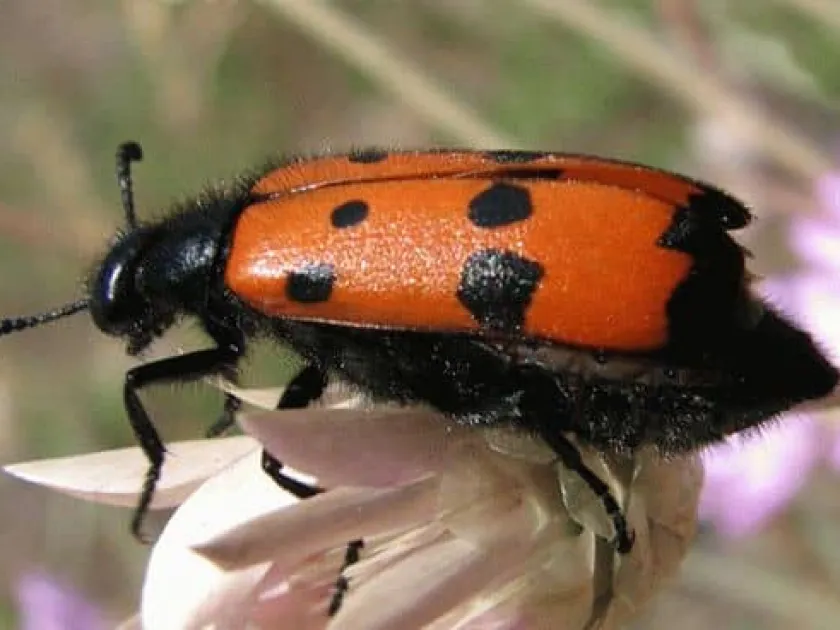
The Seven-spotted blister beetle (Mylabris seminigra) is a prominent member of the Meloidae family. This insect is easily identified by its striking appearance, featuring seven distinct orange or reddish spots on a black background of its elytra.
The body is robust and covered in fine hairs, with a relatively large head. When threatened, these beetles secrete an oily substance containing cantharidin from their joints, which acts as a powerful chemical defense against potential predators.
The biological cycle involves hypermetamorphosis, a complex development process where larvae transition through several distinct stages, each varying significantly in morphology and feeding behavior.
Adult beetles are diurnal and highly active during the flowering periods of various agricultural crops. Their warning coloration makes them easily visible during field surveys when they congregate on plant flowers.
Research into this species highlights its preference for warm, sunny areas, where they can feed effectively and find suitable nesting sites for reproduction in the soil.
What it damages
The primary damage caused by Mylabris seminigra involves feeding on the reproductive organs of plants. The pest poses a serious threat to legumes (such as soybeans, peas, and alfalfa) and certain technical crops like sunflowers.
Adults consume flowers, buds, and young ovaries, often destroying them entirely. This behavior significantly reduces yields, as the plants lose their ability to produce seeds or fruits due to the removal of vital reproductive tissues.
In addition to floral damage, the beetles may feed on young leaves, creating irregular holes. Severe infestation leads to the total sterility of flower clusters, impacting the overall productivity of the crop significantly.
The impact of this pest is most acute during hot and dry seasons when beetle populations surge. Uncontrolled infestations can lead to substantial economic losses, potentially reducing harvest yields by 30-50% in heavily infested areas.
The beetle's mobility further complicates management, as they can quickly relocate between fields in search of new, abundant food sources during the peak of the flowering season.
When it appears
The flight period and active phase of the Seven-spotted blister beetle typically occur from late spring through the summer months. Peak activity is most commonly observed during June and July.
Beetles exhibit maximum activity during sunny, warm weather. In cooler conditions or at night, they become lethargic and seek shelter within flowers or near the base of the plant stems, making them harder to detect.
The species life cycle is strictly linked to environmental conditions. Mating occurs in summer, followed by oviposition in the soil, where larvae develop by feeding on the resources of wild bee nests or locust egg pods.
Overwintering usually takes place in the larval or pupal stage within the soil profile. Spring warming triggers pupation and the emergence of a new generation of adults that move to the surface to feed.
Understanding these phenological phases allows agronomists to time pest control measures accurately, intervening before the beetle population reaches the threshold of causing significant damage.
Signs of infestation
The primary sign of infestation is the visual detection of the brightly colored beetles on the flowers of crops. They are frequently found in groups, actively feeding on the generative organs of the plants.
Damaged plants exhibit distinct signs: floral stalks are often left bare, with eaten buds and flowers missing entirely. Leaves may show numerous irregular, ragged holes caused by adult feeding.
When the beetle population is dense, widespread wilting of inflorescences becomes apparent. Affected plants appear stunted, with gaps where fruits or seeds should have developed, resulting in a thin and uneven stand.
A peculiar odor, released by the beetles when disturbed, can serve as an olfactory indicator of their presence during routine field inspections, especially in areas with high infestation density.
Monitoring should prioritize field borders and areas near flowering weeds, as beetles often colonize these peripheral zones before migrating into the main crop fields.
Control measures
Effective management of Mylabris seminigra relies on an integrated pest management (IPM) approach, combining cultural, chemical, and preventive strategies to keep populations under control.
Chemical control, using broad-spectrum insecticides, remains the most reliable method when beetle populations reach economic injury levels per square meter of field area.
Cultural practices, such as rigorous weed management and proper crop rotation, help limit the availability of auxiliary food sources and nesting habitats, thereby suppressing long-term population growth.
Deep autumn plowing of fields helps disrupt the soil environment, destroying a significant number of larvae and pupae overwintering in the soil, which in turn reduces the number of adults in the following spring.
- Regular monitoring during the critical flowering stage.
- Spot spraying with insecticides at the first sign of mass infestation.
- Removal of flowering weeds along field perimeters.
- Utilization of resistant crop hybrids if available.
Taxonomy
- Latin name
- Mylabris seminigra
- Order
- Coleoptera (beetles)
- Family
- Meloidae
- EPPO code
- MYLBSE
Discussion
No discussions yet — be the first.