
Mylabris quadripunctata
Mylabris quadripunctata
Description
How to identify
Mylabris quadripunctata is a member of the Meloidae family, commonly known as blister beetles, within the order Coleoptera.
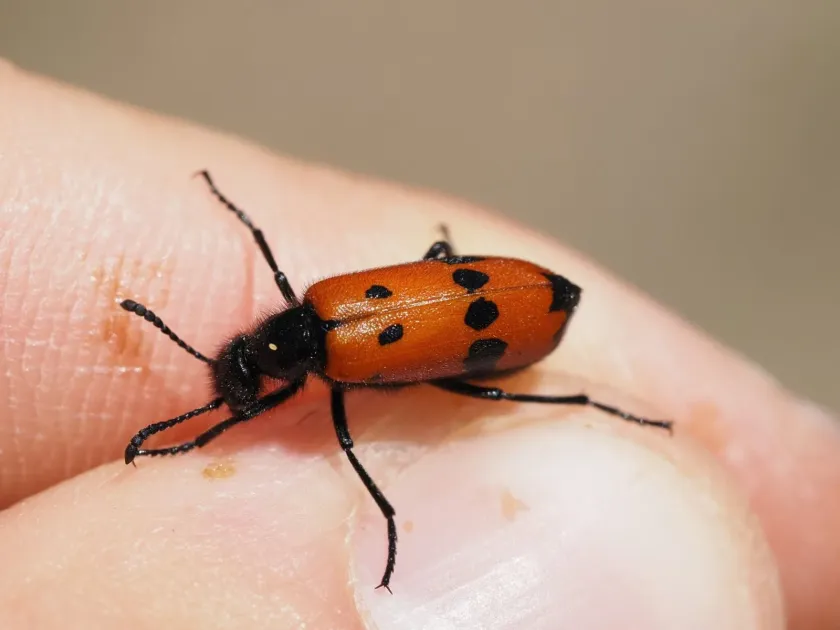
Adult beetles typically measure 15–20 mm in length and feature a distinct yellow-orange elytra adorned with four black spots.
The head and pronotum are black, and the entire body is covered with fine, dense hairs, making the insect easily recognizable in the field.
The larvae undergo hypermetamorphosis; the first-instar larvae are highly mobile, equipped with well-developed legs to actively search for food sources.
These beetles contain cantharidin, a toxic substance that serves as a defense mechanism, which can cause severe skin irritation and blisters upon contact.
What it damages
The pest primarily targets legumes, including alfalfa, clover, soybeans, and chickpeas, causing significant damage during the flowering stage.
Adults are the main cause of economic damage, as they feed voraciously on flowers, buds, and young pods, preventing the plant from setting fruit.
In years of high population density, these beetles can destroy entire fields by stripping all reproductive organs from the plants.
The larvae have a complex life cycle; they develop in the soil, often acting as predators that feed on the egg pods of locusts and grasshoppers.
While larvae play a role in ecosystem regulation, the adult stage is considered a significant agricultural pest that requires direct management.
When it appears
The adult emergence typically begins in late spring, with the peak of activity occurring throughout the hot summer months of June and July.
Beetles are most active during sunny, warm days, spending their time feeding on nectar and floral parts of their host plants.
Development is highly dependent on climatic conditions, as high soil temperatures are necessary for the successful progression of larval stages.
After completing their development and pupation in the soil, the new generation of adults emerges to repeat the reproduction cycle.
Agronomists use meteorological data and field scouting to predict emergence periods, which is crucial for timing control measures effectively.
Signs of infestation
The primary symptom of infestation is the presence of damaged flowers, which appear ragged or hollowed out after the beetles have fed on them.
Scouting during bright, sunny hours often reveals groups of beetles gathered on the tops of stems, particularly on the most vibrant blossoms.
A noticeable decrease in flower count and premature bud drop are strong indicators of significant beetle pressure within the crop canopy.
Accumulation of insect frass on the foliage directly beneath the flower clusters is another visual cue that the pests are actively feeding.
Reduced yields at harvest time, despite proper irrigation and soil management, often lead to the discovery of hidden blister beetle damage.
Control measures
Integrated pest management begins with regular monitoring using sweep nets to assess the population density relative to economic thresholds.
When infestation levels exceed the tolerable limit, application of broad-spectrum insecticides, such as pyrethroids, is recommended to save the yield.
Cultural practices, including proper crop rotation, can disrupt the beetle's life cycle by changing the habitat conditions for the larvae.
Fall tillage is an effective mechanical method to destroy overwintering sites, significantly reducing the beetle population for the following season.
- Maintain weed-free field margins to limit shelter.
- Monitor crops specifically during the pre-flowering and flowering stages.
- Coordinate insecticide timing with peak adult activity.
Taxonomy
- Latin name
- Mylabris quadripunctata
- Order
- Coleoptera (beetles)
- Family
- Meloidae
- EPPO code
- MYLBQU
Discussion
No discussions yet — be the first.