
Oil beetle
Mylabris oleae
Description
How to identify
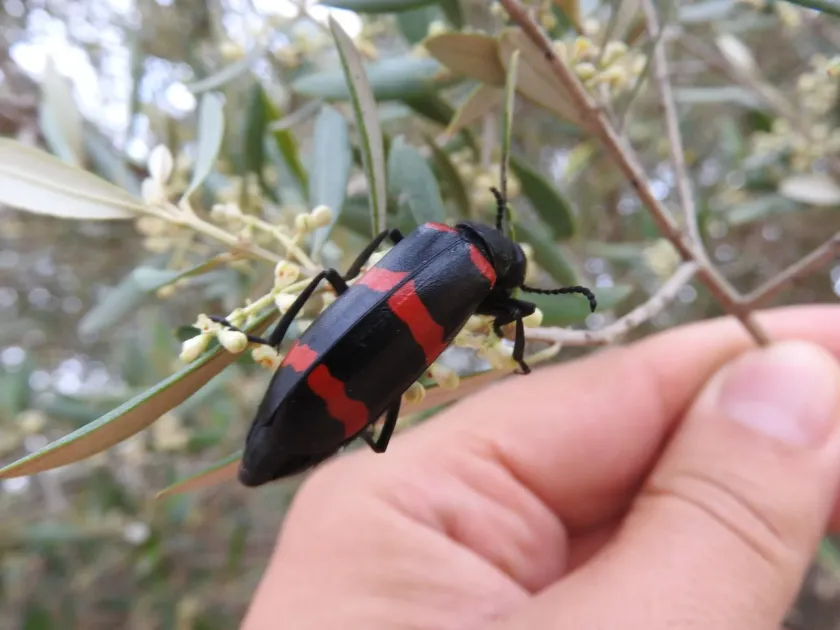
The oil beetle (Mylabris oleae) belongs to the Meloidae family (blister beetles) within the order Coleoptera. Adult beetles are easily recognized by their elongated bodies and vibrant warning coloration.
Their elytra typically feature alternating black and yellow or orange transverse stripes. This aposematic coloration serves as a visual signal to potential predators, indicating their chemical defense mechanisms.
The haemolymph of these beetles contains cantharidin, a potent toxin. Contact with this substance can cause skin irritation and blisters, requiring handlers to exercise caution during agricultural inspections.
They possess a downward-sloping head and clubbed antennae. Their biological development involves hypermetamorphosis, a complex life cycle characteristic of the Meloidae family, involving several larval stages.
These beetles are primarily found in warm, arid regions where the climate supports their specific larval development, often involving parasitism in the nests of solitary bees or locust egg pods.
What it damages
Adult oil beetles are voracious phytophages that primarily target the reproductive parts of plants. They pose a significant threat to various legume crops, including soybeans, chickpeas, and peas.
By consuming petals, stamens, and pistils, they effectively halt the fertilization process. In cases of severe infestation, this results in the total destruction of flower clusters and substantial yield loss.
Besides agricultural crops, the beetles often thrive on wild Asteraceae plants, utilizing them as temporary food sources before migrating into nearby cultivated fields during the bloom period.
The economic impact of the oil beetle is most pronounced during the flowering stage. Their feeding activity leads to a sharp reduction in pod set, directly affecting the final grain weight at harvest.
Although their larval stages may have complex ecological roles, adult beetles are considered detrimental pests in commercial legume production due to their direct impact on the generative organs.
When it appears
Adult activity typically peaks during the summer months, coinciding with the flowering phase of most agricultural crops, generally occurring from June through August depending on the latitude.
Temperature serves as the primary driver for adult emergence. Hot, dry weather accelerates the transition from pupation to active feeding, leading to rapid colonization of blooming crops.
These beetles exhibit varying activity levels throughout the day; they are often sluggish during cool morning hours but become highly mobile and aggressive feeders during the peak heat of the day.
The life cycle is closely linked to regional climate patterns. Early onset of spring warmth often results in earlier appearance and potential for multiple minor cycles in warmer southern climates.
As the flowering period of the main crops concludes, the beetle population naturally declines as they disperse to find other host plants or prepare for the overwintering phase.
Signs of infestation
The most obvious sign of an oil beetle infestation is the physical presence of the insects on the floral parts of the plants, where they are easily spotted due to their bright coloring.
Damage symptoms include ragged edges on petals, hollowed-out flower interiors, or entirely missing reproductive structures, leaving only the stem or the remains of the flower head behind.
Mass infestations often lead to premature wilting and abscission of flowers. This results in barren stems or "missing" pods that are clearly visible during routine field scouting.
In areas of high beetle concentration, pollinator activity may be discouraged. The presence of the beetles can alter the micro-environment of the flowers, making them less attractive to bees.
Field inspectors may also find trace amounts of beetle excrement or secretions on foliage, which can serve as an additional, albeit subtle, indicator of their long-term presence in a crop stand.
Control measures
Effective management requires the application of registered insecticides during the peak of adult emergence, ensuring that applications are timed to coincide with the start of the bloom period.
Cultural control practices, such as maintaining weed-free field margins, are essential. Removing alternative wild host plants reduces the reservoir populations that serve as a source for crop infestation.
Integrated Pest Management (IPM) strategies favor the use of biological control agents or selective insecticides to protect essential crop pollinators during the critical flowering phase.
The use of yellow sticky traps or pheromone-based monitoring tools is highly recommended to track adult migration and determine the economic threshold for intervention on a per-field basis.
Crop rotation and spatial isolation of new legume plantings from historical "hotspots" are effective preventive measures that significantly decrease the risk of oil beetle pressure.
Taxonomy
- Latin name
- Mylabris oleae
- Order
- Coleoptera (beetles)
- Family
- Meloidae
- EPPO code
- MYLBOL
Discussion
No discussions yet — be the first.