
Mylabris convexior
Mylabris convexior
Description
How to identify
Mylabris convexior is a species of beetle belonging to the family Meloidae, commonly known as blister beetles. They are known for their distinct appearance and specific defensive mechanisms.
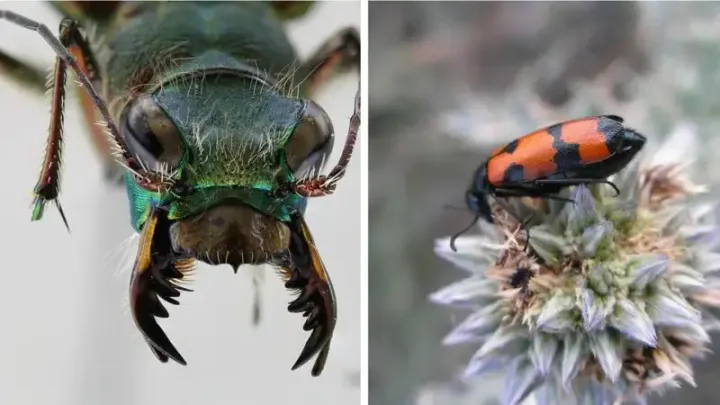
The adults are medium-sized beetles with elongated bodies. Their elytra (wing covers) typically feature bright yellow or orange bands against a black background, serving as aposematic coloration.
These beetles possess cantharidin in their hemolymph, a toxic substance that can cause blistering if they come into contact with human skin. Caution is advised during handling.
The antennae are slightly thickened at the tips, and the head is clearly separated from the pronotum. Their bodies often have a light covering of fine, short hairs.
The larval stage of Mylabris convexior is complex and differs significantly from the adult form. The larvae typically live in the soil and are known to be parasitic in nature.
What it damages
Adult Mylabris convexior beetles are primary consumers that target the reproductive parts of various agricultural crops, with a strong preference for legumes.
The main damage occurs when beetles feed on buds, flowers, and young pods. This destructive feeding behavior can lead to significant yield losses in affected fields.
By consuming the floral structures, the beetles prevent proper pollination and seed development, effectively reducing the overall productivity of the crop.
In cases of high pest density, the entire inflorescence of a plant can be destroyed, leaving only the stalk and causing widespread infertility in the crop population.
While the larvae do not typically feed on crops in the same way adults do, their biological cycle can impact the local ecosystem, potentially affecting beneficial pollinators.
When it appears
The activity of Mylabris convexior is closely tied to the warm summer months, particularly when host plants are in their peak flowering phase.
Beetles are diurnal, meaning they are most active during the day. They prefer sunny weather for feeding and mating, and they are capable of rapid flight between host plants.
The lifecycle involves a complete metamorphosis. After mating, eggs are laid in the soil, where the larvae undergo several developmental stages.
Overwintering typically occurs in the soil as a larva. When soil temperatures rise in the spring, the beetles prepare for pupation and eventual emergence as adults.
The emergence of the adult generation often aligns with the budding and flowering stages of agricultural crops, making this the critical window for monitoring.
Signs of infestation
The most obvious sign of infestation is the presence of the adult beetles themselves on the flowers. Their bright, contrasting patterns make them easy to spot.
Visual damage to floral tissues is a key indicator. You may see jagged or completely eaten petals, with only the base of the flower remaining intact.
Massive flower drop or stunted development of buds on host plants is a clear sign that a significant population of these beetles is present and feeding.
The presence of beetle excrement on leaves directly beneath the blossoms is another secondary sign that helps confirm the cause of the damage.
A decline in the number of flowers successfully setting fruit is a late-stage indicator that the infestation has reached a level that impacts economic yield.
Control measures
Cultural control is essential. Deep plowing of fields during the autumn (stubble cultivation) can destroy overwintering sites, significantly reducing the next generation's population.
Implementing crop rotation helps break the cycle of the beetle, especially in areas where these pests are historically prevalent in legume-heavy systems.
Chemical control should be applied strictly when the economic threshold is exceeded. It is crucial to choose insecticides that minimize impact on beneficial pollinators.
Whenever chemical intervention is necessary, it should be conducted during the evening hours when bees and other pollinators are inactive to reduce non-target mortality.
Regular field scouting during the susceptible crop stages allows for early detection, enabling farmers to use spot treatments rather than broad-spectrum spraying.
Taxonomy
- Latin name
- Mylabris convexior
- Order
- Coleoptera (beetles)
- Family
- Meloidae
- EPPO code
- MYLBCO
Discussion
No discussions yet — be the first.