
Blister beetle
Mylabris aperta
Description
How to identify
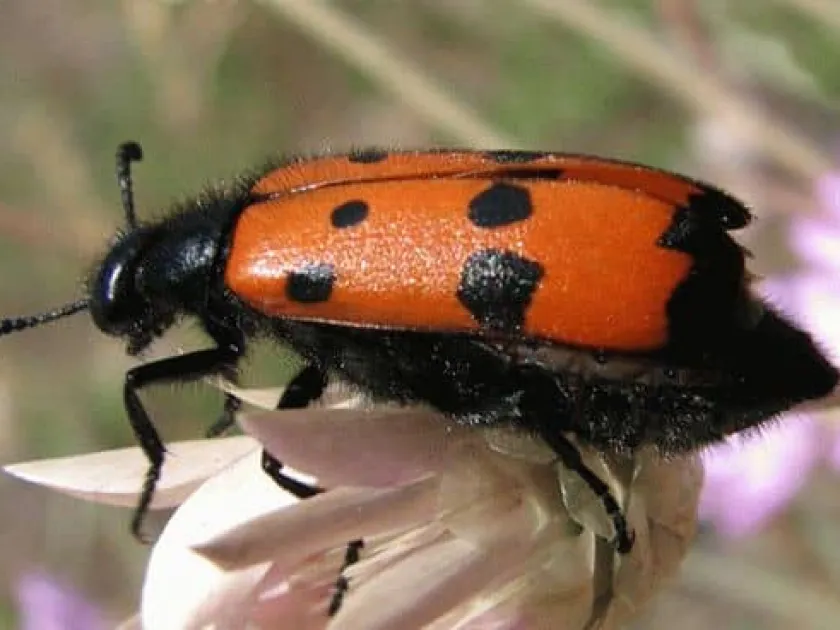
Mylabris aperta belongs to the Meloidae family, commonly known as blister beetles, within the order Coleoptera. These beetles are easily identified by their conspicuous, bright transverse stripes of black and yellow-orange across their elytra, which serve as an aposematic signal to warn predators.
The body of the beetle is elongated with a clearly defined head and pronotum. A key biological feature of this species is the presence of cantharidin, a potent toxic substance in their hemolymph that acts as a chemical defense mechanism, capable of causing blistering on human skin.
Adult beetles are strong fliers and are highly active during warm, sunny days. They are naturally attracted to open areas with an abundance of flowering plants, which they utilize for both feeding and mating purposes.
The larval stages of Mylabris aperta have a complex life history, typically developing as predators or parasites in the nests of wild bees or within the egg pods of locusts, which makes their population dynamics closely tied to the presence of other insects.
Environmental factors, particularly spring and summer temperature patterns, significantly influence the timing of emergence and the overall population density of these beetles in agricultural landscapes.
What it damages
The primary damage is caused by the adults, which are specialized feeders on the reproductive parts of plants. They aggressively consume petals, stamens, and pistils, which often results in the total destruction of the flower and a complete loss of the potential fruit or seed set.
A wide variety of crops can be affected, with a particular affinity for legumes (such as soybeans and chickpeas), certain vegetables, and asters. Flowering alfalfa fields are also frequently targeted during their peak bloom.
A heavy infestation can destroy 50 to 80 percent of a crop's flowers within a short period. This rapid devastation leads to significant economic losses, as the plants fail to develop necessary yields despite healthy vegetative growth.
Beyond direct feeding on flowers, beetles may damage young leaves and developing pods, further stressing the plant and leaving it vulnerable to secondary fungal or bacterial pathogens.
Due to their high mobility, these beetles often move into fields in localized swarms, creating "hotspots" of damage that can spread rapidly throughout the entire crop area if not addressed promptly.
When it appears
Adults typically emerge from their overwintering sites in the soil during late spring and early summer. This emergence is synchronized with the phenology of various host crops, ensuring that the beetles have immediate access to blooming flowers.
Depending on the climatic zone, the beetle may complete one or two generations per year. The presence of continuous flowering resources is essential for the beetles to maximize their reproductive output throughout the summer season.
As summer progresses, adult activity gradually declines. Females deposit their eggs into the soil, where the larvae hatch and proceed through several stages of development, often relying on the specific biology of their insect hosts to reach maturity.
The insect predominantly overwinters in the larval stage deep within the soil profile, which provides insulation against harsh winter temperatures and ensures survival for the next growing season.
Regular scouting should begin as soon as the first floral buds appear on the target crops, utilizing visual inspections and the use of sticky traps to monitor for early signs of beetle activity.
Signs of infestation
The most obvious sign of infestation is the presence of the distinctly striped beetles feeding on flowers during the day. Their bright coloration makes them highly visible against the green foliage of the crop.
Damaged flowers appear ragged, with petals completely or partially eaten. If multiple beetles are observed on a single plant, it is a clear indicator that the population density is increasing and control measures may be required.
During the cooler parts of the day, such as early morning or late evening, the beetles may hide inside the flower buds or beneath the leaf canopy, making them harder to spot during brief field walks.
Accumulation of frass (beetle waste) on the leaves directly beneath the flowers is another reliable indicator of feeding activity. The premature shedding of buds and blossoms onto the ground is a common sight in fields experiencing heavy pest pressure.
To quantify the infestation level, agronomists often use sweep nets to collect samples from the canopy, allowing for an accurate estimate of beetle density per square meter of the field.
Control measures
The primary control strategy involves the application of contact-action insecticides during the flowering period. It is critical to select chemicals that are safe for pollinators, applying them during times of minimal bee activity to avoid collateral damage.
Good agricultural practices, such as the removal of weeds along field borders, can significantly reduce the number of initial colonization sites for the beetles, effectively limiting their spread into the main crop.
Deep autumn tillage is a recommended cultural practice to disrupt the life cycle of the beetles by destroying the larvae and pupae residing in the soil, which helps to lower the population base for the following year.
Biopesticides and biological control agents are currently being researched as potential non-chemical alternatives to manage populations in environmentally sensitive areas or organic farms.
Decision-making regarding insecticide applications should be based on established economic thresholds. Consistent monitoring and timely intervention are key to minimizing yield losses and protecting crop quality from these destructive pests.
Taxonomy
- Latin name
- Mylabris aperta
- Order
- Coleoptera (beetles)
- Family
- Meloidae
- EPPO code
- MYLBAP
Discussion
No discussions yet — be the first.