
Blister beetle
Mylabris
Description
How to identify
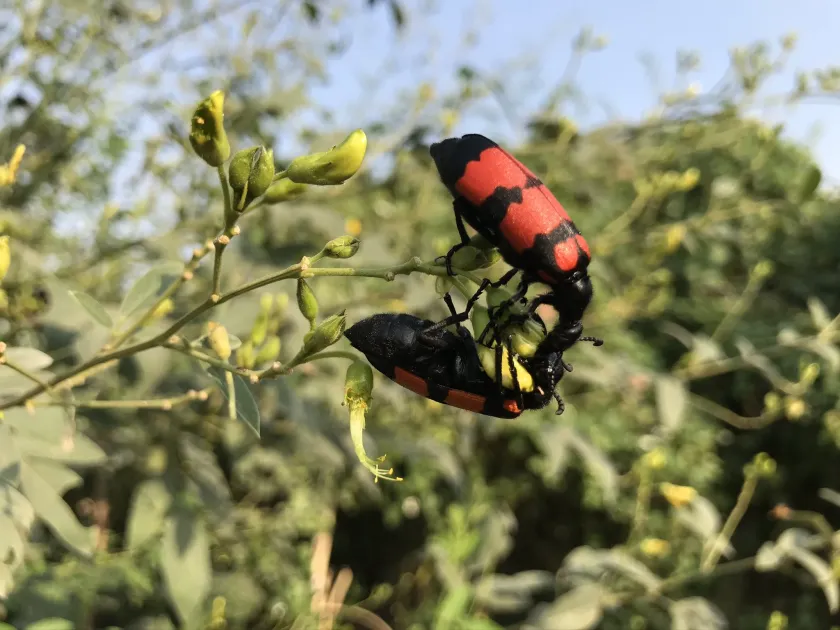
Blister beetles (genus Mylabris) belong to the Meloidae family within the order Coleoptera. Adult beetles are typically 10–25 mm long, featuring an elongated body and striking aposematic coloration, usually alternating black and yellow or orange bands across their wing covers.
These insects are well-known for their defensive secretion containing cantharidin. This chemical causes severe skin irritation and blisters upon contact with human skin, serving as a powerful deterrent against predators.
They are primarily diurnal, showing peak activity during hot, sunny weather. Adults are frequently observed feeding on the pollen and nectar of flowering plants, which they find highly attractive.
The life cycle involves hypermetamorphosis. The first-instar larvae are highly mobile and search for the nests of wild bees or grasshopper egg pods, where they develop as parasites or predators of the eggs and stored food.
Their population size is closely linked to the availability of host species, meaning that in areas with high grasshopper activity, blister beetle outbreaks are more common.
What it damages
Blister beetles are polyphagous pests capable of causing significant damage to various crops. Their feeding habits are most destructive during the flowering stage, as they target the reproductive organs of plants.
Leguminous crops like alfalfa, soybeans, and beans are particularly susceptible. The beetles consume flowers, flower buds, and even young pods, which can result in complete crop failure and substantial economic loss.
In addition to legumes, vegetable crops such as potatoes, tomatoes, and eggplants often suffer from their presence. Adults chew large, irregular holes in the foliage, drastically reducing the leaf surface area needed for photosynthesis.
Sunflower fields are also at high risk, as the beetles often congregate on the flower heads, destroying them and severely impacting seed development and oil yield.
Due to the toxicity of the beetles, their presence can contaminate harvested crops and pose health risks to farm workers handling the produce manually.
When it appears
Adult blister beetles typically emerge in mid-to-late summer, usually between July and August. This timeframe often coincides with the flowering period of many agricultural and garden crops.
These insects thrive in hot, arid conditions. During cloudy or cool days, their movement is significantly reduced, and they seek shelter within the dense foliage of their host plants.
Infestations often appear suddenly as the beetles are strong fliers and migrate from surrounding wilderness or fallow lands to cultivated fields in search of abundant food sources.
Adults live for several weeks, during which they cause most of the visible crop damage and lay their eggs in the soil, ensuring the continuity of the next generation.
Regular field scouting is essential during the flowering stage, especially in the early morning hours when the beetles are less active and easier to spot on flower heads.
Signs of infestation
The primary symptom of an infestation is the presence of heavily damaged blossoms. Plants may appear stripped of their flowers, leaving only stems behind in severe cases.
Foliage damage is characterized by large, ragged holes with jagged edges. In the immediate vicinity of the feeding sites, you may observe the accumulation of insect frass.
A distinctive, unpleasant, and pungent smell is often associated with large swarms of these beetles, which can serve as a warning sign of their presence before they are visually identified.
On infested plants, individuals or clusters of bright-colored beetles are easily visible, especially against the background of green leaves or light-colored flowers.
When disturbed, the beetles often exhibit a passive defense strategy by falling to the ground and feigning death, which makes them easy to detect if the plant is shaken gently.
Control measures
Effective management requires the application of contact or systemic insecticides during the flowering period, while strictly adhering to bee-safety guidelines to minimize the impact on pollinators.
Treatment should be timed for the late evening when adult beetle activity is high, but pollinating bees have returned to their hives, thus reducing the collateral damage to beneficial insects.
Manual collection of beetles is feasible for small gardens, provided that the handler wears protective gloves to prevent cantharidin-induced skin burns and blistering.
A strong cultural control method is deep autumn plowing, which disturbs the soil, destroys the pupal chambers, and drastically reduces the survival rate of the next generation.
Maintaining field margins and eliminating weeds help reduce the availability of breeding habitats for hosts, which effectively suppresses the overall blister beetle population in the area.
Taxonomy
- Latin name
- Mylabris
- Order
- Coleoptera (beetles)
- Family
- Meloidae
- EPPO code
- MYLBSP
Discussion
No discussions yet — be the first.