
Violet oil beetle
Meloe violaceus
Description
How to identify
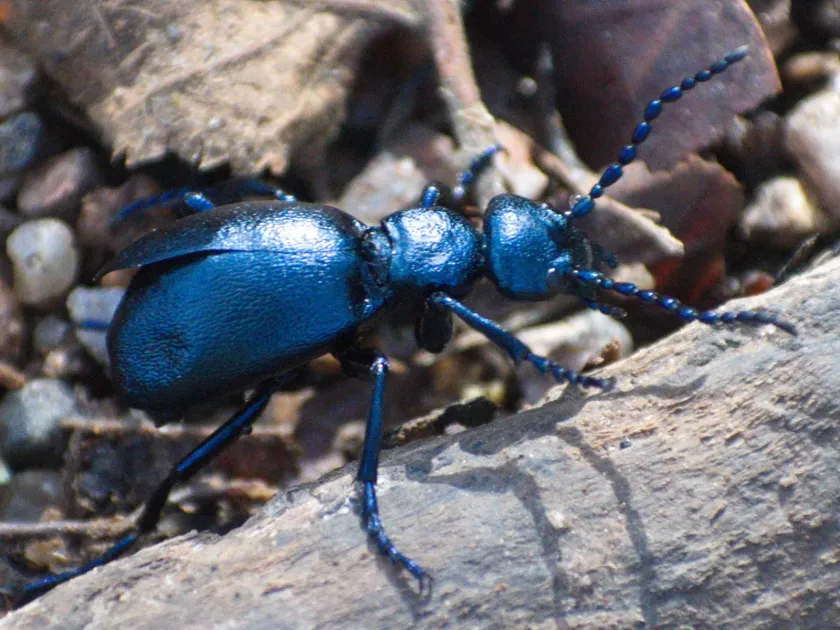
The violet oil beetle is a large insect belonging to the Meloidae family, characterized by its deep metallic blue or violet coloration. Adult beetles can grow between 10 and 35 mm in length.
One of the most distinct features of this species is its greatly enlarged and distended abdomen, which extends well beyond the short elytra (wing covers). They are flightless insects that move solely by walking.
These beetles possess a unique chemical defense mechanism: when disturbed, they exude hemolymph from their leg joints. This fluid contains cantharidin, a potent toxin that can cause skin blisters in humans.
The life cycle involves hypermetamorphosis. The first-instar larvae, known as triungulins, are highly active and specialized for hitchhiking on solitary bees to reach their host nests for further development.
While their appearance is striking, they are rarely found in high densities. They prefer sunny, open areas where they can easily find host bees and forage on low-growing vegetation.
What it damages
Adult beetles primarily feed on the leaves and flowers of various herbaceous plants. While they consume plant tissue, their impact on commercial crops is generally considered to be low to moderate.
The primary concern regarding this pest is its toxicity. If these beetles are accidentally harvested along with fodder crops, they can cause serious poisoning or health issues in livestock if consumed.
The larval stage is parasitic. By attacking the nests of solitary bees, they reduce the population of these vital pollinators. This has an indirect but negative effect on the yield of many agricultural crops.
They are sometimes found in ornamental gardens where they may damage decorative flowers. Their presence is more of a safety concern than a direct threat to crop survival in most cases.
Agricultural managers should be aware of their presence, especially in organic or sustainable systems where bee populations are encouraged for pollination services.
When it appears
Adult violet oil beetles emerge in the early spring, typically from April to May, depending on the local climate and temperature. This is the peak time for their mating and egg-laying activities.
The adult stage is relatively brief. Once the females have successfully laid their eggs in the soil, the adults die, usually by the early part of the summer season.
The larvae hatch in late spring, timing their appearance with the active flight period of their host bees. This synchronization is critical for the survival of the next generation.
The entire life cycle from egg to adult takes approximately one year. Most of this time is spent underground as the larvae develop within the bee nests.
Observers are most likely to spot these beetles on sunny, warm days when the insects are actively crawling on the ground or on low-lying vegetation.
Signs of infestation
Visual identification of adult beetles on the ground or vegetation in spring is the primary sign of their presence. They are easy to spot due to their size and distinct color.
Ragged or irregularly chewed leaf edges on susceptible plants can indicate feeding activity. However, these symptoms are often minor compared to other pests.
Yellowish, oily-looking secretions on leaves or stems may indicate the presence of the beetle and its defensive reaction. Avoid touching these areas with bare skin.
A noticeable decline in the number of solitary ground-nesting bees in a particular area might suggest that a population of oil beetle larvae is thriving nearby.
Monitoring the soil surface in spring, particularly near areas with sandy or loose earth, provides the best chance of detecting their emergence.
Control measures
Hand-picking is the most effective method for controlling small numbers of beetles. Always wear thick, protective gloves to prevent cantharidin-induced blisters.
Tillage and soil cultivation in early spring can help disrupt the soil where eggs are laid and where larvae develop, reducing the survival rate of the population.
Maintaining a clean garden by removing excessive weeds can reduce the attractiveness of the area to adult beetles, who use these plants for cover and initial foraging.
Broad-spectrum insecticides are generally discouraged, as they are likely to kill the beneficial bees that these beetles naturally prey upon, potentially worsening the ecological balance.
- Wear protective gloves during handling.
- Practice soil cultivation to disturb larvae.
- Remove non-crop vegetation near nests.
- Prioritize safety to avoid contact with the toxin.
Taxonomy
- Latin name
- Meloe violaceus
- Order
- Coleoptera (beetles)
- Family
- Meloidae
- EPPO code
- MLOEVI
Discussion
No discussions yet — be the first.