
Violet oil beetle
Meloe variegatus
Description
How to identify
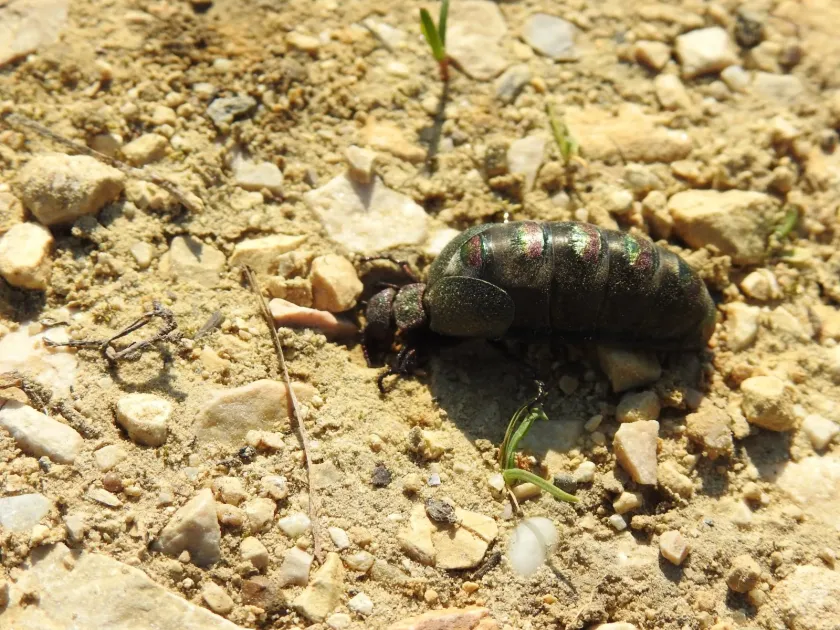
The violet oil beetle (Meloe variegatus) is a large beetle belonging to the Meloidae family (blister beetles), within the order Coleoptera. Adult specimens are easily identified by their elongated abdomen, which is particularly swollen in females and protrudes beyond their shortened wing cases.
The beetle's coloration ranges from deep blue-black to a metallic finish with a distinct golden or copper sheen. The surface of the elytra displays a pronounced pitted and punctured texture, giving the insect its characteristic variegated appearance.
This species possesses reduced, non-functional wings and is incapable of flight, moving exclusively across the soil surface. This limitation makes them highly visible targets during their active season in open fields.
A primary defense mechanism of the oil beetle is the secretion of hemolymph containing a toxic compound known as cantharidin. When threatened, the beetle releases yellow, oily droplets from its limb joints, which can cause chemical burns and blisters on human skin.
The larvae undergo a complex metamorphosis known as hypermetamorphosis. During their initial stages, they develop as parasites within the nests of solitary bees, which is a crucial aspect of their life cycle.
What it damages
Adult violet oil beetles are typical phytophagous insects. They feed on the aerial parts of plants, favoring tender leaf tissues, flower buds, and petals of both wild flora and agricultural crops.
Among crops, these beetles can cause damage to seedlings of cereals, legumes, and vegetables. However, their economic impact is generally localized due to relatively low population densities compared to other primary pests.
Damage is primarily caused by mechanical destruction of the leaf surface. In areas with high insect density, they can consume a significant portion of the foliage, leading to stunted growth and reduced photosynthetic capacity in young plants.
In addition to direct consumption, the beetles represent a qualitative risk. The presence of cantharidin in their secretions renders plant matter that has been in contact with the insects potentially hazardous if ingested by livestock.
In intensive farming regions, the damage level caused by Meloe variegatus is typically rated as moderate. The most significant threat occurs when mass emergence coincides with the vulnerable stage of crop germination.
When it appears
The adult activity of the violet oil beetle occurs during the spring season, primarily from late April through June. This window is when mating and egg-laying in the soil typically take place.
Soil temperature is a decisive factor in triggering the beetles' emergence from diapause. Favorable soil conditions allow for rapid maturation and active feeding on early emerging crops.
The life cycle is closely synchronized with the activity of pollinators. The first-instar larvae, known as triungulins, actively seek out bees to hitch a ride to their nests, coinciding with the peak flowering period of early meadow plants.
During the summer, adults gradually die off, marking the completion of their reproductive cycle. Subsequent larval development occurs hidden within the soil or host nests, making sightings rare in the second half of the summer.
Agronomic monitoring during the spring emergence phase is essential for assessing potential risks and implementing early protection measures if necessary.
Signs of infestation
The primary indicator of the pest's presence is the visual observation of adults on the soil surface or climbing plant stems. Due to their unique shape, they are difficult to confuse with other common field pests.
Damage signs on leaves include distinct irregular feeding patterns that differ from those caused by leaf beetles or caterpillars. The edges of the chewed areas often appear ragged or torn.
The appearance of tiny, slow-moving, yellow-orange larvae on flower blossoms indicates a nearby population, as these larvae are actively searching for hosts to continue their complex developmental cycle.
An unpleasant odor or traces of oily secretions on plant stems can serve as a warning sign of the presence of blister beetles, which utilize this chemical defense against potential predators.
In cases of high-density populations, localized thinning of crop stands is observed. Affected plant clusters appear suppressed and exhibit noticeable foliage reduction or complete leaf consumption.
Control measures
Deep soil cultivation is the most effective cultural control method. Plowing disrupts the overwintering conditions and destroys the nest sites where larvae develop, significantly limiting the population for subsequent seasons.
The use of insecticides is recommended only when the economic threshold of damage is exceeded. Contact-based pyrethroid insecticides are generally effective during the adult feeding phase.
Maintaining clean field borders by controlling weed vegetation is a critical preventive measure. Weeds act as reservoirs for adult feeding and as habitats for insects that attract oil beetle larvae.
Biological control, primarily the preservation of natural predators and parasitoids, helps limit oil beetle numbers naturally. It is important to minimize pesticide application during the peak pollinator activity window.
- Implement crop rotation to disrupt the life cycle.
- Hand-picking adults on small-scale plots.
- Apply edge treatments with insecticides if invasion is imminent.
- Manage field margins to reduce flowering weed attractiveness.
Taxonomy
- Latin name
- Meloe variegatus
- Order
- Coleoptera (beetles)
- Family
- Meloidae
- EPPO code
- MLOEVA
Discussion
No discussions yet — be the first.