
Oil beetle
Meloe impressus
Description
How to identify
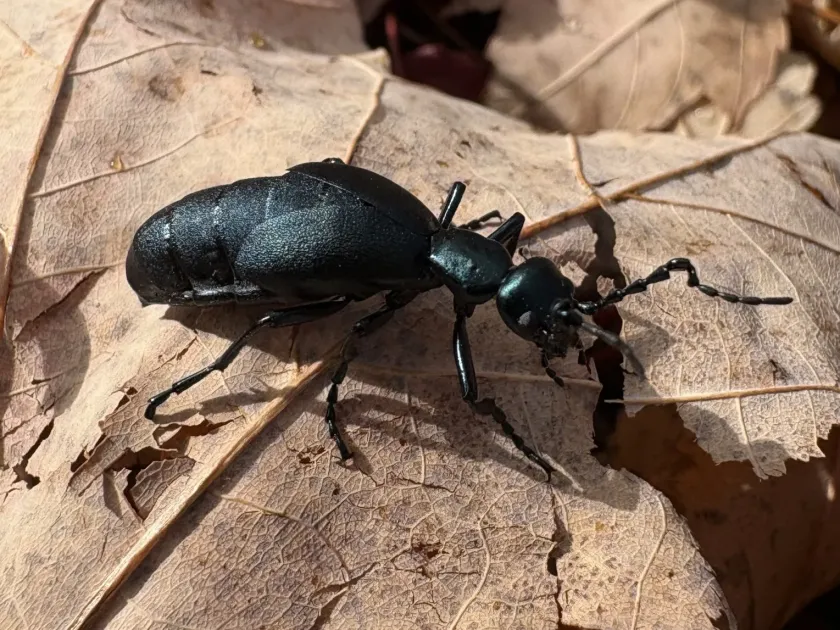
The oil beetle (Meloe impressus) belongs to the Meloidae family, also known as blister beetles. Adult specimens typically range from 10 to 30 mm in length and possess a soft, highly distended abdomen and shortened elytra that do not fully cover the body.
Their coloration is generally deep black or dark blue with a metallic luster. The head and pronotum are characterized by dense, distinct punctures, providing a unique textured appearance.
These insects are chemically defended; they secrete a toxic substance called cantharidin from their joints when disturbed. This substance causes blistering and irritation if it comes into contact with human skin.
The life cycle involves hypermetamorphosis, where the larvae go through several complex stages, initially acting as parasites within solitary bee nests.
Adult beetles are frequently found in sunny, open habitats, meadows, and along field margins where they feed on vegetation during the spring months.
What it damages
Oil beetles are polyphagous, meaning they feed on a variety of herbaceous plants. They can be found on legumes, cruciferous crops, and various garden plants.
Adult beetles damage the aerial parts of plants by feeding on leaf margins, young shoots, and flower buds. Significant defoliation can occur if the pest population density is high.
Young seedlings are particularly vulnerable to these beetles, as heavy feeding at the early stages of growth can result in stunted development or the total loss of the plant.
Beyond the direct impact on plant tissues, these insects reduce the ornamental value of flowering crops by consuming flower parts and buds.
While mass outbreaks are relatively rare in modern agriculture, localized infestations can be severe enough to warrant monitoring and management.
When it appears
The activity of adult oil beetles typically begins in early spring, usually peaking in April and May, depending on regional climatic conditions.
Beetles emerge from the soil once temperatures rise sufficiently, becoming highly mobile as they search for food and mating partners in open fields.
The life cycle is closely synchronized with the phenology of their host bees, making spring the primary period for adult observation.
By mid-summer, the adult population declines significantly as their short lifespan comes to an end after the reproductive phase.
The overwintering stage occurs in the soil as larvae, which develop slowly and pupate to emerge as adults the following spring.
Signs of infestation
The most common sign of infestation is irregular, ragged feeding patterns on the edges of leaves, which often appear as if they were mechanically chewed.
Direct observation of adult beetles on the plants or on the soil surface near the root zone is the most definitive way to identify their presence.
Visual identification of the characteristic yellow hemolymph droplets on damaged plant parts can also indicate the activity of oil beetles.
Weakened plant growth and retarded development during the early season are often correlated with intensive feeding by the adult beetles.
Finding a cluster of slow-moving black beetles in field margins or on lawns serves as a primary warning to monitor nearby crop areas.
Control measures
Hand-picking beetles is an effective control method for small areas, but it must be done with protective gloves to avoid exposure to their toxic secretions.
Cultural practices, such as maintaining weed-free fields and removing overgrown vegetation around field edges, significantly reduce their food sources.
Deep autumn tillage of the soil is recommended to disrupt overwintering sites, which can significantly lower the population density for the next season.
When chemical intervention is necessary, insecticides should be applied according to local regulations, targeting the adults at the economic threshold.
- Always wear protective gloves when handling.
- Monitor crops frequently during April and May.
- Practice autumn soil cultivation to reduce larvae populations.
Taxonomy
- Latin name
- Meloe impressus
- Order
- Coleoptera (beetles)
- Family
- Meloidae
- EPPO code
- MLOEIM
Discussion
No discussions yet — be the first.