
Oil beetle (Meloe angusticollis)
Meloe angusticollis
Description
How to identify
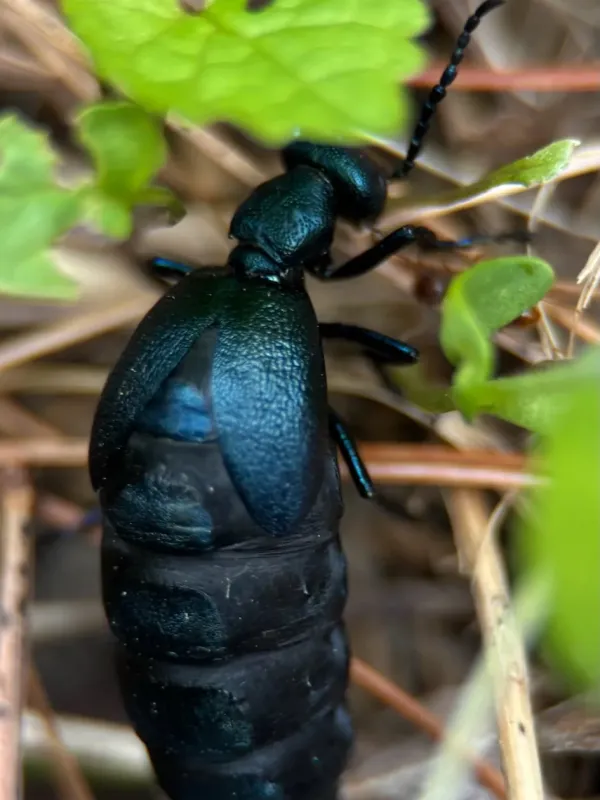
The oil beetle (Meloe angusticollis) is a member of the Meloidae family, commonly known as blister beetles. Its physical appearance is striking, featuring significantly shortened wing covers that leave the abdomen exposed, which is often swollen in female specimens.
The beetle typically exhibits a dark color palette, ranging from deep black to blue with a metallic sheen. The body surface is finely punctured, giving it a distinctive matte appearance. These insects are flightless, as their hind wings are absent or vestigial, meaning their mobility is limited to the ground.
A notable biological trait of this species is its defensive mechanism: when threatened, the beetle exudes a yellowish fluid containing cantharidin, a potent irritant. This fluid is released from the joints of their legs to deter predators and poses a risk to human skin upon contact.
The life cycle is characterized by hypermetamorphosis. The first-instar larvae, or triungulins, are highly mobile and are designed to find and attach themselves to bees, effectively hitching a ride to the host's nest, where they feed on bee larvae and provisions.
These beetles are generally associated with ecosystems that support populations of ground-nesting solitary bees, making them a common sight in field borders, meadows, and semi-natural habitats adjacent to cultivated lands.
What it damages
While adult oil beetles may feed on the foliage of various herbaceous plants, their economic impact as a primary crop pest is generally considered moderate unless populations experience significant outbreaks.
The primary damage is caused by the consumption of leaf tissue, which can reduce the photosynthetic capacity of the plant. If infestation levels are high, the resulting defoliation can hamper the development of young crops and negatively influence overall growth rates during critical vegetative stages.
Crops adjacent to wild habitats, such as field edges bordering woodlands or uncultivated grasslands, are the most susceptible to adult beetle feeding. While they rarely cause complete crop failure, their presence in high densities can necessitate monitoring.
The indirect harm caused by this species is equally significant, as the larvae act as parasites on solitary bee populations. By reducing the number of effective pollinators in the area, they can indirectly contribute to reduced crop yields for plants that rely on insect-mediated pollination.
Thus, the damage profile is twofold: direct impact on plant biomass and an ecological disruption that affects the natural pollination services essential for high-yield farming.
When it appears
The emergence of adult oil beetles in agricultural areas typically occurs in the spring, spanning from April through June. This timing is heavily dependent on regional climate, soil temperature, and the specific emergence patterns of their host bee species.
During this period, the adults are active, feeding, and mating. Females lay their eggs in the soil near potential bee nest sites, ensuring that the next generation of larvae will have access to their required hosts once they hatch and begin their search.
Once the reproductive season concludes, the adult population rapidly declines and eventually dies off. The remainder of the life cycle takes place underground or within nests, making the species largely inconspicuous to farmers throughout the summer and autumn months.
Agricultural monitoring should be concentrated during the spring window. Early detection of beetle congregations along field margins is the best way to determine if local control measures are necessary to protect emerging crops.
Environmental conditions, such as the duration of the winter and the speed of the spring thaw, dictate the precise timing of emergence. However, the life cycle stages remain strictly synchronized with the life cycles of the host insects.
Control measures
Integrated pest management strategies for the oil beetle should be balanced and mindful of protecting non-target insects, particularly the solitary bees that are essential for ecosystem health and pollination.
- Regular scouting of field margins in the spring to identify hotspots where beetles might be congregating.
- Mechanical removal or hand-picking of adult beetles in small-scale areas or greenhouses to avoid chemical use.
- Deep tillage practices that can disrupt the soil layers where larvae develop or where host nests are located.
- Preservation of pollinator-friendly habitats and restricting pesticide applications during flowering periods.
In cases where beetle density exceeds economic injury thresholds, selective application of contact-action insecticides may be used. It is crucial to choose products that minimize harm to beneficial insects and follow safety labels precisely.
Effective management focuses on creating a stable environment where natural enemies and pollinators can thrive, thereby keeping the oil beetle population within acceptable limits through ecological, rather than solely chemical, means.
Taxonomy
- Latin name
- Meloe angusticollis
- Order
- Coleoptera (beetles)
- Family
- Meloidae
- EPPO code
- MLOEAN
Discussion
No discussions yet — be the first.