
American blister beetle
Meloe americanus
Description
How to identify
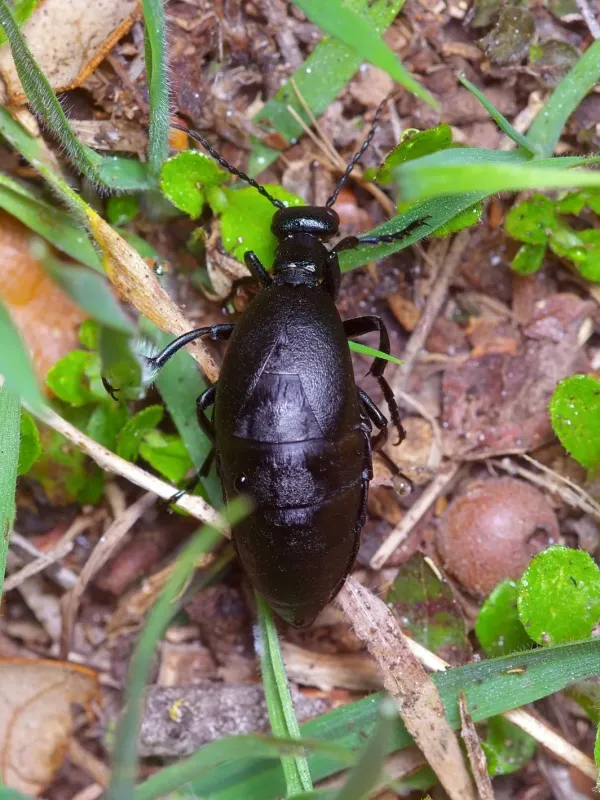
The American blister beetle Meloe americanus belongs to the Meloidae family, order Coleoptera. These insects are distinguished by their reduced, overlapping elytra and a bloated, heavy abdomen, especially in gravid females.
Adults are typically dark-colored, ranging from black to metallic blue. Lacking functional wings, they are strictly ground-dwelling beetles, often found moving slowly through vegetation or across the soil surface.
These beetles are infamous for secreting cantharidin, a toxic blistering agent, from their joints when threatened. This chemical acts as a potent defense mechanism against predators and can cause severe skin irritation to humans.
Their life cycle is complex, involving hypermetamorphosis. The first-instar larvae, known as triungulins, are highly active and specialized to hitchhike on solitary bees to reach their nesting sites.
Once inside the host nests, the larvae undergo dramatic physiological changes, consuming the bee's provisions and eventually the bee larvae themselves, before pupating into adult beetles.
What it damages
Adult Meloe americanus beetles are known to feed on the foliage of various plants, including legumes, vegetables, and ornamentals. They chew irregular holes in leaf tissue, often starting from the leaf margins.
While sporadic, infestations can lead to significant defoliation when beetle numbers are high. This loss of leaf area reduces the plant's ability to photosynthesize, thereby stunting growth and development.
Young seedlings are particularly vulnerable to attack. In severe cases, the beetles can consume the majority of the leaf mass, forcing the plant to use stored energy to recover, which delays crop maturity.
Beyond vegetative damage, some blister beetles also target flowers and fruit buds, which has a direct negative impact on the final yield of entomophilous crops.
The damage is usually localized because the beetles do not fly, meaning they congregate in specific patches within a field rather than dispersing uniformly across a large area.
When it appears
Adults are typically observed in the spring and early summer. Their emergence is tightly synchronized with both ambient temperature and the activity cycles of their solitary bee hosts.
Peak feeding activity often coincides with the vegetative stage of many field crops. A warm, early spring often leads to a faster and more concentrated emergence of the adult beetle population.
The development time of the larvae within bee nests means that the emergence of new adults is often protracted over several weeks, creating a continuous threat throughout the growing season.
Weather conditions significantly dictate their behavior. Cool, rainy weather may force them to hide within soil crevices or beneath heavy foliage, making them harder to detect during field surveys.
Agronomists should schedule consistent field monitoring starting early in the season to detect the first sign of adult activity before they reach damaging population densities.
Signs of infestation
Visible defoliation is the primary sign of an infestation. Leaves will show large, irregular holes or ragged edges, leaving only the primary veins behind in severe cases.
The beetles themselves are easily spotted due to their distinct body shape and slow movement. They are often found in clusters on the lower parts of plants or on the ground nearby.
The presence of cantharidin, sometimes visible as a yellow oily residue on plant tissues, is a warning sign. Caution must be exercised to avoid skin contact when handling or inspecting infested plants.
The proximity of solitary bee nesting areas in the soil often indicates a high probability of finding Meloe americanus in adjacent crop rows.
Regular scouting is essential, especially at field edges or near grassy borders, where the beetles frequently establish themselves before moving deeper into the crop canopy.
Control measures
Chemical control with registered insecticides is the most effective way to manage high population spikes. Applications should be targeted to coincide with peak beetle activity.
For small-scale or localized infestations, hand-picking can be effective. However, protective gloves are mandatory to prevent skin blistering from the cantharidin released by the beetles.
Deep plowing in the autumn or spring can disrupt the soil environment where these beetles spend their larval stages, effectively reducing the number of adults that will emerge the following season.
Managing weeds along field margins helps reduce the host bee population and limits the beetle's initial food supply, making the area less attractive for colonization.
Integrated pest management strategies should prioritize the protection of non-target pollinators, ensuring that insecticide applications do not harm the very bee populations that provide essential ecosystem services.
Taxonomy
- Latin name
- Meloe americanus
- Order
- Coleoptera (beetles)
- Family
- Meloidae
- EPPO code
- MLOEAM
Discussion
No discussions yet — be the first.