
Oil beetle
Meloe
Description
How to identify
The oil beetle (Meloe) is a genus of blister beetles known for their unique appearance and chemical defensive mechanisms.
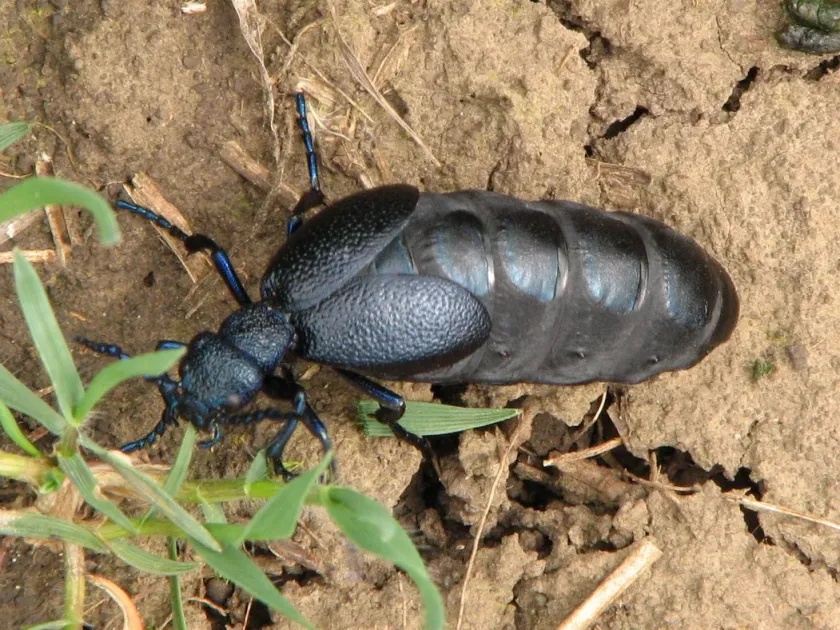
Adult beetles are characterized by an elongated, bulky abdomen that extends far beyond their short wing covers (elytra).
These insects are typically black or dark blue, often with a metallic sheen, and have a coarsely punctured surface on their bodies.
Oil beetles are flightless, as they lack hind wings, meaning they spend their entire adult life crawling on the ground or host plants.
When threatened, they release an oily hemolymph from their leg joints containing cantharidin, a potent toxin that causes severe skin irritation and blisters.
What it damages
Adult oil beetles are generalist herbivores that feed on the leaves of various field crops, vegetables, and ornamental plants.
They consume large amounts of foliage, often stripping leaves down to the veins, which significantly impacts the plant's ability to photosynthesize.
Although adult damage is primarily localized to the leaves, the larval stage is parasitic and typically develops in the nests of solitary bees.
By consuming bee larvae and food stores, the oil beetle indirectly affects agriculture by reducing the population of essential pollinators.
The presence of these beetles on farmland presents both a direct threat to crop health and a safety concern for farm workers due to their toxic secretions.
When it appears
Adult oil beetles typically emerge from the soil in early spring after overwintering, coinciding with the growth of early vegetation.
Peak activity is usually observed during late spring, where beetles move actively to find mates and feed on available host plants.
Females deposit eggs in soil clusters, initiating a complex larval cycle known as hypermetamorphosis, which is vital for their development.
By mid-summer, the population of adult beetles naturally declines as their reproductive season and life cycle reach completion.
Agronomic surveillance is most critical during the seedling stage of crops, when even moderate feeding can cause permanent stunted growth or total plant loss.
Signs of infestation
The most common sign of an oil beetle infestation is the appearance of large, irregular holes in the leaf blades of affected plants.
Adult beetles are easily visible during the day due to their size and characteristic shape, often found clustered on stems or foliage.
Presence of a pungent odor or visible traces of the oily, toxic hemolymph on the soil surface can indicate recent beetle activity.
A decline in solitary bee activity in the surrounding environment can serve as an early indicator of larval development in the nearby soil.
Plants suffering from heavy feeding show signs of wilting and reduced vigor, eventually leading to lower yields if the infestation is left uncontrolled.
Control measures
Manual collection of beetles is an effective control strategy for small-scale gardens, provided that protective gloves are worn to avoid chemical burns.
Application of broad-spectrum insecticides can effectively mitigate large-scale outbreaks when pest densities exceed economic threshold levels.
Autumn soil cultivation, such as plowing or tilling, is recommended to disrupt overwintering sites and destroy egg clutches in the soil profile.
Crop rotation and weed management reduce the availability of temporary host plants, effectively forcing the pest population to disperse.
- Conducting field inspections during early spring emergence.
- Applying pyrethroid-based insecticides for localized suppression.
- Promoting biodiversity to support the natural enemies of the beetles.
Taxonomy
- Latin name
- Meloe
- Order
- Coleoptera (beetles)
- Family
- Meloidae
- EPPO code
- MLOESP
Discussion
No discussions yet — be the first.