
Spanish fly
Lytta vesicatoria
Description
How to identify
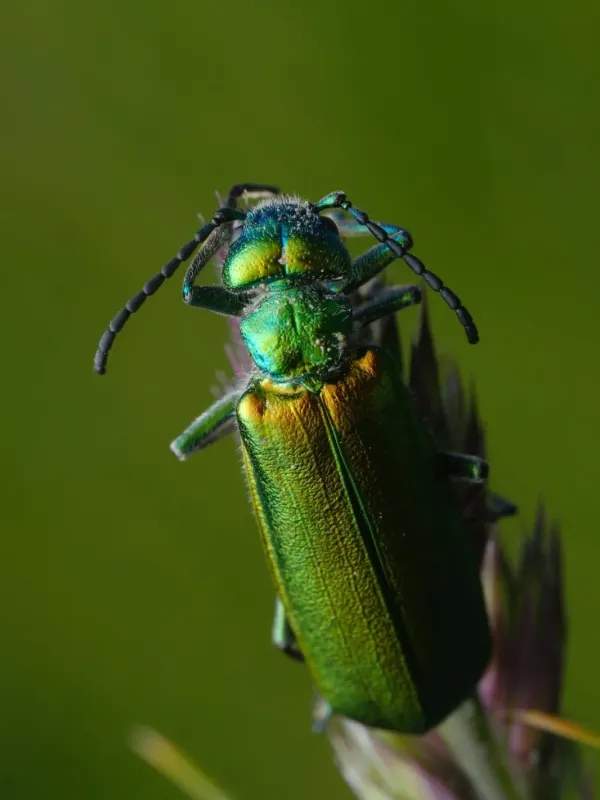
The Spanish fly (Lytta vesicatoria) is a member of the Meloidae family, commonly known as blister beetles. Adults typically grow to 15–22 mm in length and possess a brilliant, metallic emerald-green coloration.
These insects are famous for producing cantharidin, a potent blistering agent that serves as a chemical defense against predators. Direct skin contact with the beetle can cause significant skin irritation.
The life cycle involves hypermetamorphosis. While adults are herbivorous, the larvae are parasitoids that develop in the nests of ground-nesting bees, feeding on their larvae and pollen stores.
Adults are diurnal and highly photophilous, preferring to bask and feed in direct sunlight during the warmest parts of the day.
The species is widespread across Europe and parts of Asia, frequently appearing in gardens and woodlands during the early summer season.
What it damages
Adult beetles are notorious defoliators that feed on the foliage of various woody plants, showing a strong preference for the Oleaceae and Caprifoliaceae families.
Common host plants include lilacs, ash trees, privet, and honeysuckle. In cases of high infestation, the beetles can consume nearly all leaf tissue, leaving only the primary veins behind.
The resulting damage reduces the aesthetic appeal of ornamental shrubs and trees and can weaken the plants, making them more susceptible to other stressors.
Mass outbreaks can lead to complete defoliation of trees in specific urban or park settings within a very short period of time.
Although the larvae are not agricultural pests, the adult feeding behavior causes noticeable economic and ornamental damage to landscaping.
When it appears
Spanish flies typically appear during the late spring and early summer, with the peak of their activity usually observed in June and July.
These beetles are most visible and active during hot, clear weather, which provides optimal conditions for their mating and feeding cycles.
The adult phase is relatively short-lived; the population usually declines rapidly after a few weeks as the beetles complete their egg-laying cycle in the soil.
Cooler or rainy weather significantly inhibits their movement, causing the beetles to seek shelter within the dense canopy of trees.
By late summer, the adults have perished, leaving their offspring to continue the life cycle underground until the following year.
Signs of infestation
The most prominent sign of an infestation is the appearance of jagged holes in leaves, which eventually leads to the skeletonization of the entire foliage.
Visual identification is straightforward due to the bright, metallic appearance of the beetles, which are often found clustered together on foliage.
A distinctive, pungent odor is often associated with large groups of these beetles, which can serve as a warning sign for gardeners.
Increased bird activity or the presence of frass on the ground beneath trees are additional indicators that the foliage is being actively consumed.
- Skeletonized leaves and stripped branches.
- Clusters of metallic green beetles on sunlit leaves.
- A strong, medicinal smell in infested areas.
Control measures
Management of the Spanish fly requires caution due to the cantharidin-containing hemolymph, which can cause severe skin blistering upon contact.
For smaller home gardens, manual collection in the early morning is recommended, as the beetles are sluggish and less likely to flee or release toxins when cold.
Chemical control involving contact insecticides can be effective if applied during peak feeding times, provided that safety guidelines are strictly followed.
Protective clothing, including gloves and long sleeves, is essential when handling the beetles or spraying chemicals to avoid accidental contact with the toxin.
Regular monitoring of susceptible host plants like lilacs and ash trees during June is the best strategy for early detection and prevention of significant damage.
Taxonomy
- Latin name
- Lytta vesicatoria
- Order
- Coleoptera (beetles)
- Family
- Meloidae
- EPPO code
- LYTTVE
Discussion
No discussions yet — be the first.