
Nuttall's Blister Beetle
Lytta nuttalli
Description
How to identify
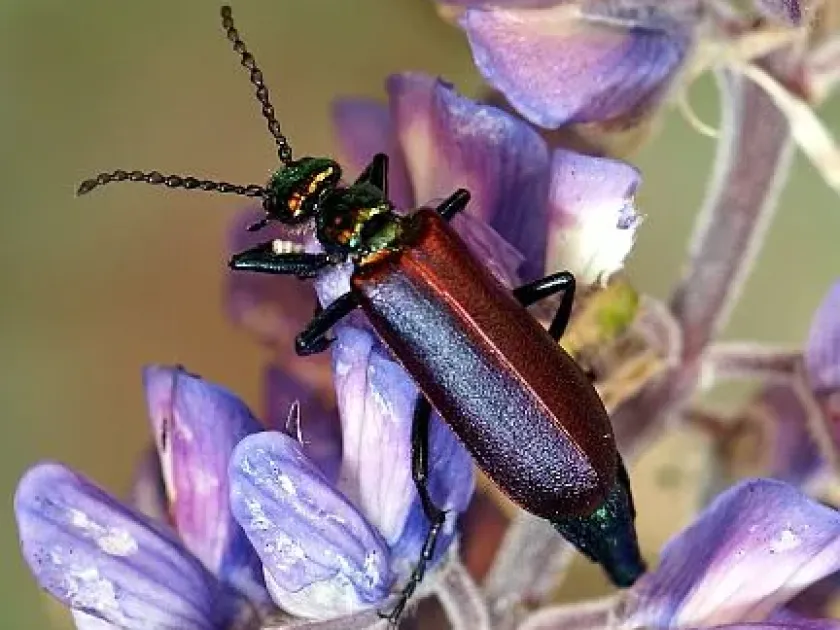
Nuttall's Blister Beetle (Lytta nuttalli) belongs to the Meloidae family, commonly known as blister beetles. Adult beetles are recognizable by their vibrant, metallic appearance, ranging from green to copper or purple hues.
The body is elongated and typically measures between 12 and 20 mm in length. These beetles possess soft, flexible elytra that contain cantharidin, a toxic compound that can cause skin blisters upon contact with humans.
The life cycle involves complete metamorphosis. Their larvae are specialized, often living in the nests of ground-nesting bees where they feed on larvae and food stores, which makes biological control challenging.
Adults are highly mobile and are known for their swarming behavior. They can fly long distances to locate suitable host plants, often appearing in large numbers on agricultural fields quite suddenly.
Due to their swarming nature and defensive chemical secretions, they pose significant risks not only to crops but also to the safety of field workers handling infested plant material.
What it damages
This species primarily targets plants in the Fabaceae family. Key crops at risk include alfalfa, clover, peas, lentils, and beans, which suffer significant damage when adult beetles swarm.
Beetles have chewing mouthparts that allow them to consume large portions of leaf tissue, often leaving only the main veins. This rapid defoliation drastically limits the plant's capacity to photosynthesize.
Beyond the foliage, they are particularly destructive to reproductive organs. They feed extensively on buds and flowers, directly causing yield loss by preventing pod set and seed development.
In cases of heavy infestations, entire fields can be defoliated within days. This severity causes immense economic impact, especially in regions dependent on high-quality forage and seed production.
Plants weakened by the beetles also become more susceptible to environmental stress and opportunistic pathogens, as the damage creates open entry points for secondary infections.
When it appears
The period of adult activity typically occurs during the summer months, usually starting in mid-June and continuing through August, depending on the local climate and temperature gradients.
Beetles are most active during hot, sunny days, which facilitates their flight and feeding cycles. During cooler or overcast periods, they tend to cluster within the canopy, becoming less visible.
The emergence of these beetles is synchronized with the phenology of their host plants. Their appearance often coincides with the flowering stage of legumes, marking a critical time for crop scouting.
There is typically one generation per year, but because the emergence of adults from the soil can be asynchronous, the presence of beetles may persist over several weeks in a single field.
Environmental factors like soil moisture and the availability of host bee nests determine population density, leading to significant fluctuations in beetle numbers from year to year.
Signs of infestation
The most immediate sign of an infestation is the presence of metallic-colored beetles congregating on the upper foliage of the plants. They are usually found in clusters, making them easy to spot.
The characteristic damage is "skeletonized" leaves. Once the soft tissue is removed by the beetles, the remaining vein structure gives the foliage a tattered, skeletal appearance.
Evidence of feeding is often accompanied by a distinct, unpleasant odor caused by the beetles' chemical defenses. In extreme cases, the waste (frass) left by the insects is visible on the leaves.
An unexpected drop in flower buds or a lack of pod development on healthy-looking stalks often serves as a late-stage indicator that a beetle infestation has occurred earlier in the season.
Because they are gregarious, an infestation is rarely localized to a single plant but rather spreads across a patch of the field, creating visible "hot spots" of damage within the crop rows.
Control measures
Effective management requires rigorous scouting, especially around the edges of fields where swarms often first land. Chemical control remains the most reliable method when thresholds are met.
Contact insecticides, particularly pyrethroids, are commonly utilized to reduce populations quickly. Treatment should target the clusters to minimize the overall spread across the field.
Given the toxicity of the beetles, field personnel should wear protective equipment when working in infested areas to avoid accidental skin contact with cantharidin secretions.
Agricultural practices, such as maintaining clean field borders and rotating crops, can help mitigate the risks of harboring larval nests, though they may not eliminate the threat of migratory swarms.
- Scout fields frequently during the late vegetative and flowering stages.
- Apply insecticides promptly upon detecting the start of a swarm.
- Prioritize safety measures due to the beetle's toxic nature.
Taxonomy
- Latin name
- Lytta nuttalli
- Order
- Coleoptera (beetles)
- Family
- Meloidae
- EPPO code
- LYTTNU
Discussion
No discussions yet — be the first.