
Blister beetles
Lytta
Description
How to identify
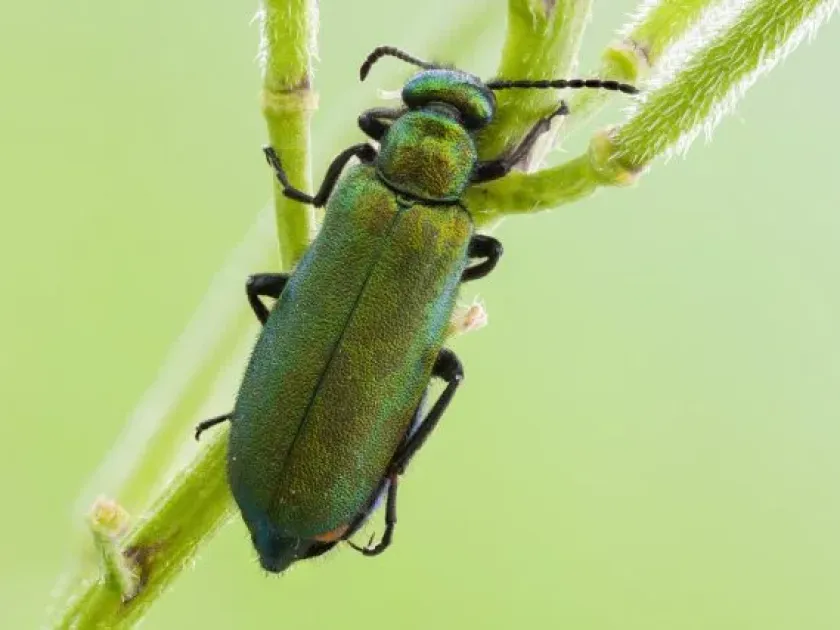
Blister beetles (genus Lytta) are members of the Meloidae family. The most prominent species is the Spanish fly (Lytta vesicatoria), known for its metallic green or golden-bronze coloration.
Adult beetles typically range from 10 to 20 mm in length. They possess elongated, slender bodies with soft wing covers (elytra). Their head is clearly defined and heart-shaped, set off from the pronotum.
These beetles are infamous for producing cantharidin, a toxic chemical found in their hemolymph. This substance can cause severe skin irritation, dermatitis, and painful blisters upon contact with human skin, which gives the family its common name.
Their life cycle involves hypermetamorphosis, a complex development process. The larvae are often parasitic, dwelling in the nests of solitary bees or consuming the egg pods of grasshoppers, which links their population cycles to those of other insects.
Adult beetles emit a distinct, pungent odor that serves as a warning signal to predators. Because of their toxicity, they have very few natural enemies, allowing their populations to increase rapidly under favorable conditions.
What it damages
Blister beetles are significant phytophagous pests that attack a wide variety of plants. They are particularly known for causing extensive damage to trees, shrubs, and field crops.
Preferred hosts include lilac, ash, privet, and poplar trees. In orchards, they can severely damage apple, pear, and plum trees by skeletonizing the foliage, which reduces the tree's photosynthetic capacity.
Field crops such as sugar beets, potatoes, alfalfa, and cereals are also frequent targets. A large swarm of these beetles can defoliate an entire section of a crop in a relatively short period.
Feeding damage is characterized by irregular holes and skeletonized leaves where only the thickest veins remain. This extensive leaf loss weakens the plant, making it more susceptible to environmental stress and secondary infections.
Beyond the direct loss of foliage, the sheer presence of the beetles and their waste can contaminate forage, which is particularly dangerous in hay production, as the toxins remain potent even after the beetles are dead.
When it appears
Adult blister beetle activity typically occurs from late spring through mid-summer, generally spanning May to July. This timing corresponds with the peak vegetative growth phase of their host plants.
They are highly active during warm, sunny days. In cooler conditions or early morning hours, they remain relatively sluggish, often resting in large clusters on the foliage, making them easier to spot.
The life cycle is generally univoltine (one generation per year), although environmental conditions and food availability can cause minor fluctuations in their developmental timing.
Overwintering usually occurs in the larval stage, buried in the soil or within the nests of their hosts. The emergence of adults in the spring is synchronized with the onset of the active growth of local vegetation.
Major outbreaks of blister beetles are often correlated with hot, dry spring seasons, which provide ideal conditions for larval development and adult emergence.
Signs of infestation
One of the earliest signs of a blister beetle infestation is a pungent, mouse-like odor emanating from the affected plants, caused by the beetles' chemical secretions.
Visual observation is usually straightforward, as the beetles often feed openly and congregate in large groups on the upper surfaces of leaves. Their metallic coloration makes them highly visible against green foliage.
Skeletonized leaves and large, irregular holes in the canopy are primary diagnostic symptoms. If the population is high, the sudden thinning of foliage across a garden or field is a clear indicator.
Disturbing the branches of a tree or a row of crops will often cause the beetles to take flight simultaneously, producing a characteristic buzzing sound and revealing the density of the swarm.
The presence of beetle droppings and shredded leaf remnants on the ground beneath the plants provides further confirmation of active feeding by a large colony.
Control measures
Managing blister beetles requires caution due to their toxic secretions. Always wear protective gear, especially gloves, when dealing with these insects to prevent skin contact.
On small scales, hand-picking may be effective if the population is low. However, it must be done carefully to avoid direct contact with the beetles' hemolymph, which can cause severe blisters.
For larger commercial plantings, insecticide applications are the standard control method. Products with contact and systemic activity are generally the most effective at suppressing swarms.
- Application of approved pyrethroid or organophosphate insecticides.
- Regular scouting of fields and gardens starting in late spring to identify hotspots.
- Cultural practices that limit the proximity of host plants to nesting areas of solitary bees or grasshoppers.
Because these insects are inherently toxic to most predators, biological control using birds or insect predators is often ineffective, making vigilant chemical or mechanical control the primary management strategy.
Taxonomy
- Latin name
- Lytta
- Order
- Coleoptera (beetles)
- Family
- Meloidae
- EPPO code
- LYTTSP
Discussion
No discussions yet — be the first.