
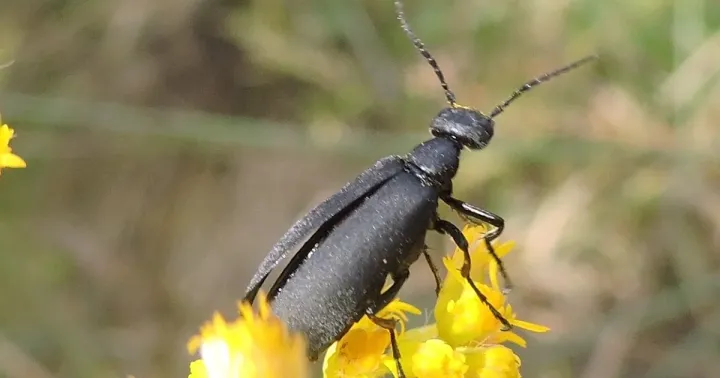
Black blister beetle
Epicauta pennsylvanica
Description
How to identify
The black blister beetle (Epicauta pennsylvanica) is a member of the Meloidae family within the order Coleoptera. This beetle is characterized by its elongated, matte-black body and relatively soft wing covers.
A distinctive feature of the adult beetle is the presence of cantharidin in its hemolymph. This toxin can cause severe skin irritation and blisters upon contact with humans, which is the origin of the common name "blister beetle."
Adults are highly active during the day and are frequently found congregating in large groups on flowering plants. They are agile insects that readily take flight when disturbed.
The larvae live underground and have a secretive life cycle; they are actually beneficial as they feed on the eggs of grasshoppers and locusts, playing a complex role in the ecosystem.
The life cycle involves complete metamorphosis, progressing through egg, larval (with several active instars), pupal, and adult stages.
What it damages
Adult beetles are significant agricultural pests that feed voraciously on the foliage, flowers, and developing buds of a wide variety of crops.
Preferred hosts include potatoes, tomatoes, beans, alfalfa, beets, and numerous ornamental plants found in gardens and commercial fields.
During periods of high infestation, these beetles are capable of completely skeletonizing leaves over large areas in a very short period of time.
Damage to floral parts is particularly destructive, as the beetles destroy reproductive organs before fruits have a chance to develop, leading to significant yield loss.
In addition to physical crop damage, the presence of these beetles can pose health risks to livestock if the insects are accidentally ingested during foraging, due to their toxic cantharidin content.
When it appears
Adult beetles typically appear in mid-to-late summer, coinciding with the flowering stages of many agricultural and garden crops.
Peak activity is observed during hot, dry weather, when the insects migrate actively between fields in search of succulent food sources.
Because their larval development occurs in the soil, the emergence of adults is often synchronized with the life cycle of their primary prey, the grasshoppers.
In northern climates, the species generally produces one generation per year, although warmer regions may see partial second generations depending on local conditions.
Monitoring for adult populations should begin as soon as the first buds appear on susceptible plants to prevent population explosions.
Signs of infestation
The primary sign of an infestation is the sudden appearance of clusters of black beetles on the tops of plants and flowering stalks.
Leaves often exhibit a "lace-like" appearance, as the beetles consume the soft tissue between veins, leaving only the tough leaf skeleton behind.
During field inspections, significant amounts of frass (insect excrement) can often be seen on leaf surfaces, alongside heavy shedding of damaged flower petals.
During cooler morning hours, the beetles are less active and can be easily detected by inspecting the stems and foliage of the plants.
Rapid defoliation, where plants lose a substantial percentage of their leaf area within a few days, is a critical warning sign that requires immediate action.
Control measures
For small-scale gardens, the most effective control method is hand-picking the beetles in the early morning; it is crucial to wear gloves to avoid skin contact with cantharidin.
In commercial agriculture, chemical control using registered insecticides, such as pyrethroids, is employed following specific application guidelines and safety protocols.
Integrated pest management includes removing weeds that act as secondary food sources for adults before they move on to primary crop fields.
Tillage practices, such as discing or plowing, can disrupt the soil where larvae overwinter, effectively reducing the adult population for the following season.
- Always use proper personal protective equipment (PPE).
- Use yellow sticky traps for population monitoring.
- Encourage the presence of natural predators like birds and predatory insects.
Taxonomy
- Latin name
- Epicauta pennsylvanica
- Order
- Coleoptera (beetles)
- Family
- Meloidae
- EPPO code
- EPIAPN
Discussion
No discussions yet — be the first.