
Spotted blister beetle
Epicauta maculata
Description
How to identify
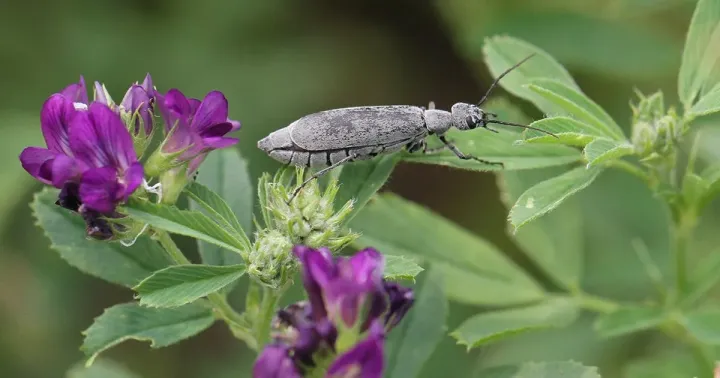
The spotted blister beetle (Epicauta maculata) belongs to the family Meloidae within the order Coleoptera. Adult beetles possess an elongated body covered in fine pale hairs, which form a distinct spotted pattern against their dark elytra.
These beetles typically measure between 10 and 15 mm in length. They feature a prominent head separated from the thorax by a distinct neck, with thread-like antennae. Their coloration ranges from grayish to black, marked with small, light-colored spots.
The life cycle of this beetle includes a complex process called hypermetamorphosis. In their early larval stages, they are highly mobile and actively seek out grasshopper egg pods in the soil, which serve as their primary food source.
Blister beetles produce a chemical compound known as cantharidin, which causes skin irritation and blisters if touched. This defensive secretion is a hallmark of the family and serves to protect them from predators.
The species is commonly found in arid and temperate regions, favoring open areas, pastures, and agricultural land where both food sources for larvae and host plants for adults are available.
What it damages
Adult spotted blister beetles can cause severe damage to a wide range of agricultural crops. They feed aggressively on leaves, flowers, and developing fruit, often clustering in large groups on specific plants.
Major crops affected include potatoes, tomatoes, alfalfa, sugar beets, and various legumes. During outbreaks, a group of these beetles can defoliate a plant almost entirely in a very short period.
Damage symptoms include skeletonized leaves or complete defoliation, leaving only coarse leaf veins. This significantly reduces the plant's photosynthetic capacity, leading to substantial yield losses.
Beyond direct damage to plants, their presence poses a risk to livestock forage. If beetles are harvested with hay or silage, they can cause fatal poisoning in cattle and horses due to the toxic cantharidin they contain.
Damage to flowers and buds prevents fruit set, which is especially critical for vegetable crops and legumes, negatively impacting both the quantity and quality of the harvest.
When it appears
Adult spotted blister beetles typically appear during the summer months when the weather is consistently warm. Their activity often peaks throughout July and August.
Their life cycle is closely linked to grasshopper populations. Because the larvae are obligate predators of grasshopper eggs, population booms of this beetle often occur in years following major grasshopper outbreaks.
They generally complete one generation per year. Larvae overwinter deep in the soil, where they are protected from extreme cold and can survive the winter season successfully.
Pupation occurs in the spring, followed by the emergence of new adults. These adults require supplemental feeding and are most active during warm, sunny days, making them highly visible on field crops.
Scouting is essential during the flowering stage of key crops, as beetles often aggregate in large numbers to feed and mate during this critical window of plant development.
Signs of infestation
The first sign of an infestation is the sudden appearance of beetle clusters feeding on foliage. They are often easy to spot due to their aggregation behavior and distinctive spotted appearance.
Visual signs of damage include ragged, eaten leaf margins and stripped stems. Fields heavily infested may appear stunted and yellowish as the plant's vegetative mass is rapidly consumed.
If you notice insects resembling blister beetles on your legumes or tomato blossoms, monitor the density carefully to determine if an intervention is necessary to prevent significant yield loss.
Infestations are often associated with proximity to pasturelands or undisturbed soil where grasshopper populations thrive, serving as a primary reservoir for the beetle population.
A noticeable, sharp odor emitted by the beetles when disturbed is another indicator that a large population is present and actively feeding in the area, providing an early warning for field staff.
Control measures
The primary control strategy involves the application of contact or systemic insecticides upon the detection of beetles. It is crucial to treat early to protect flowers and fruit set.
Cultural practices include deep tillage, which can disrupt the soil, destroying larvae and pupae developing underground. Regular weed management around fields also reduces potential habitats for the pest.
Implementing crop rotation and monitoring grasshopper populations help limit the food source for the larvae, naturally regulating the beetle population within the agroecosystem.
For small-scale infestations, manual collection is possible but must be done with protective gear, such as gloves, to avoid the irritating effects of the beetle's defensive secretions.
- Application of registered insecticides (pyrethroids, organophosphates).
- Monitoring field edges near pastures for signs of migration.
- Integrated pest management targeting grasshopper populations.
- Use of light traps for population density estimation.
Taxonomy
- Latin name
- Epicauta maculata
- Order
- Coleoptera (beetles)
- Family
- Meloidae
- EPPO code
- EPIAMA
Discussion
No discussions yet — be the first.