
Leopard blister beetle
Epicauta leopardina
Description
How to identify
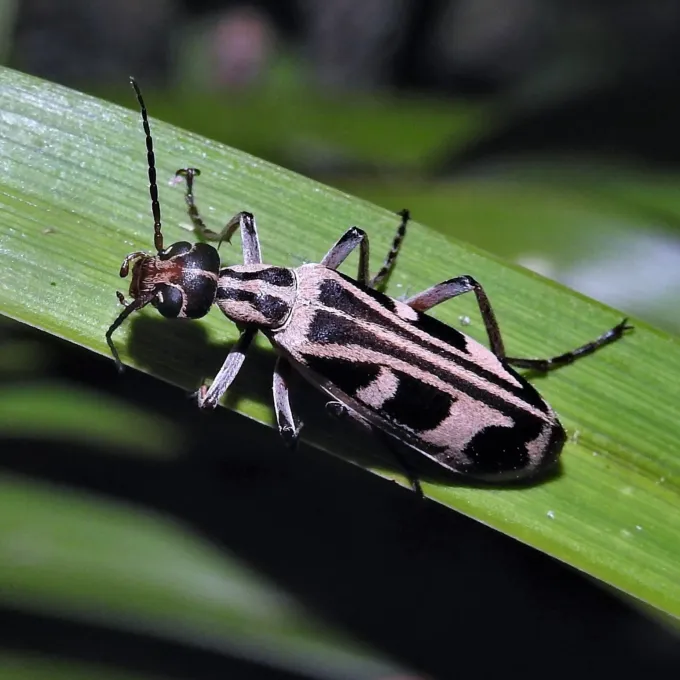
The leopard blister beetle (Epicauta leopardina) belongs to the family Meloidae (blister beetles) within the order Coleoptera. This insect is easily identified by its distinctive spotted pattern, which resembles that of a leopard.
The adult beetle has an elongated body, typically measuring 10 to 15 mm in length. It possesses a prominent head with kidney-shaped eyes and elytra adorned with yellowish or light-colored spots on a dark background.
These beetles are chemically defended, as their hemolymph contains cantharidin. This substance causes severe irritation and blistering upon contact with human skin, serving as a powerful deterrent against predators.
The life cycle involves hypermetamorphosis, a complex developmental process where larvae undergo significant changes in morphology and behavior throughout their different instars.
The distribution of this species is largely dictated by environmental conditions, particularly in semi-arid regions where the ecological requirements for their larval development are met.
What it damages
The primary damage is caused by the adult beetles, which are voracious feeders. They are known to attack a wide range of both cultivated crops and wild vegetation.
Favored hosts include various species from the Solanaceae and Fabaceae families. In cases of high infestation, these beetles can completely defoliate a plant, leaving only the primary leaf veins behind.
Damage symptoms include leaf skeletonization, total leaf consumption, and destruction of buds and young inflorescences. This significantly reduces the plant's photosynthetic capacity and overall health.
For vegetable and ornamental crops, the damage is most severe during the flowering and fruit-setting stages, potentially leading to total crop failure if left unchecked.
While larvae typically do not feed on crops, their presence in the soil environment is essential for understanding the population dynamics of this pest species.
When it appears
Adult activity of the leopard blister beetle generally peaks during the summer months. The emergence of beetles from the soil is synchronized with environmental cues and rising temperatures.
Adult life spans are relatively short, lasting only a few weeks. During this time, they feed actively, mate, and deposit eggs to ensure the continuation of the species.
The development is closely linked to soil moisture and climatic conditions. Precipitation patterns can significantly influence the timing and magnitude of beetle emergence.
Pupation takes place within the soil, where the insect remains for a substantial portion of its life cycle, awaiting the environmental triggers for adult emergence.
Regular field monitoring starting from the early summer is critical to detect the first arrivals and implement protective measures before damage becomes widespread.
Signs of infestation
The most immediate sign of infestation is the physical presence of the beetles, which often aggregate in groups on host plants during the day.
Plants affected by the beetle exhibit jagged, eaten leaf margins, destroyed flower buds, and damaged reproductive parts. Heavily infested plants may look sparse and stunted.
- Skeletonized or tattered leaf foliage.
- Consumed buds and young flower stalks.
- Presence of insect droppings on the foliage.
- Visibility of the leopard-patterned beetles on stems and leaves.
Unlike many other pests, these beetles do not always hide, as their toxic defense mechanism makes them unpalatable to birds and many insect predators.
Due to their ability to fly effectively, infestation patches can appear abruptly across a field, requiring consistent scouting efforts to maintain control.
Control measures
Managing the leopard blister beetle requires an integrated approach that combines cultural practices and chemical control methods to reduce population density.
In small-scale gardening, hand-picking can be effective; however, protective gloves must be worn to prevent skin irritation from the cantharidin toxin.
Cultural practices, such as deep autumn or winter plowing, can disrupt the soil-dwelling pupae, effectively reducing the number of adults that will emerge in the following season.
When the economic threshold of damage is reached, the application of registered insecticides is recommended to protect the crop during critical growth phases.
Maintaining clean fields by removing wild host weeds is an essential preventive measure, as these plants often serve as early-season food sources for the emerging beetles.
Taxonomy
- Latin name
- Epicauta leopardina
- Order
- Coleoptera (beetles)
- Family
- Meloidae
- EPPO code
- EPIALP
Discussion
No discussions yet — be the first.