
Epicauta latitarsis
Epicauta latitarsis
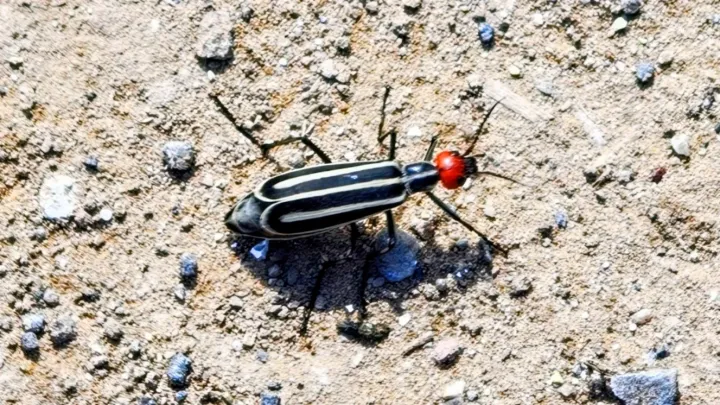
Description
How to identify
Epicauta latitarsis is a member of the Meloidae family, commonly known as blister beetles. These insects are characterized by their elongated, soft bodies and the release of cantharidin, a toxic substance that acts as a chemical defense.
The adults are recognized by the specific structure of their tarsi, which is the primary trait distinguishing them from other closely related species within the genus.
Their life cycle involves hypermetamorphosis, where larvae go through several distinct developmental stages, often residing in soil or underground nesting sites of other insects.
Adult beetles are diurnal, often found feeding openly on the reproductive parts of plants during the warmest hours of the day when they are most visible.
Care must be taken when handling these beetles, as the cantharidin in their hemolymph can cause severe irritation and blistering upon skin contact.
What it damages
Epicauta latitarsis is a polyphagous pest that targets various agricultural crops, showing a strong preference for legumes such as soybeans, alfalfa, and beans.
The damage is primarily caused by adult beetles consuming flowers, developing pods, and leaves, which directly leads to yield loss and reduced seed production.
In cases of high population density, these beetles can strip a field of its reproductive potential, leaving only stems and non-flowering plant parts behind.
Beyond cultivated crops, the beetles feed on a wide variety of weeds, allowing their populations to persist even in the absence of primary commercial host plants.
The impact is often cumulative throughout the growing season, as repeated feeding cycles can stunt the growth and overall health of the affected plant stands.
When it appears
Adult activity peaks during the mid-to-late summer months, coinciding perfectly with the flowering phases of many economically important legume crops.
The developmental speed of these insects is highly dependent on ambient temperature, with hot, dry summers often leading to larger and more aggressive populations.
Larval stages remain underground, overwintering in the soil until environmental conditions signal the right time to transition into pupae and eventually adults.
Monitoring efforts should ideally begin several weeks before the onset of bloom, as this is when the beetles are most likely to migrate into fields.
Early season detection is critical for successful management, as populations can explode in number very rapidly under favorable climatic conditions.
Signs of infestation
The most evident sign of infestation is the rapid disappearance of flowers and young buds, accompanied by irregular ragged holes in the remaining foliage.
Farmers can observe the beetles directly during field surveys, as they typically congregate on the upper canopy of plants in plain sight during sunny weather.
Reduced pod set is a major agricultural sign, where the plant appears healthy vegetatively but fails to produce expected yields due to floral destruction.
Plants affected by these beetles often show thinning in the upper branches, where the damage is most concentrated due to the insect's preference for new growth.
Localized patches of heavily damaged plants are a common field pattern, reflecting the beetle's habit of feeding in dense, clustered groups.
Control measures
Managing Epicauta latitarsis requires an integrated approach that combines cultural, biological, and chemical strategies to mitigate economic thresholds.
Chemical control involving selective insecticides is the most effective way to address severe infestations, provided they are applied during the beetle's peak activity.
Cultural practices, such as deep tillage after harvest, help disrupt the life cycle of the insect by destroying overwintering larvae residing in the soil profile.
Sanitation of field margins is crucial, as weeds serve as a secondary food source that helps maintain the population between crop seasons.
- Use of light traps for regular population monitoring and timing of applications.
- Application of insecticides during late evening to reduce the impact on bees and other pollinators.
- Crop rotation schemes to discourage long-term population buildup in specific fields.
- Integrated pest management to balance chemical usage with natural biological control agents.
Taxonomy
- Latin name
- Epicauta latitarsis
- Order
- Coleoptera (beetles)
- Family
- Meloidae
- EPPO code
- EPIALA
Discussion
No discussions yet — be the first.