
Epicauta corvina
Epicauta corvina
Description
How to identify
Epicauta corvina, commonly known as a type of black blister beetle, belongs to the Meloidae family within the order Coleoptera.
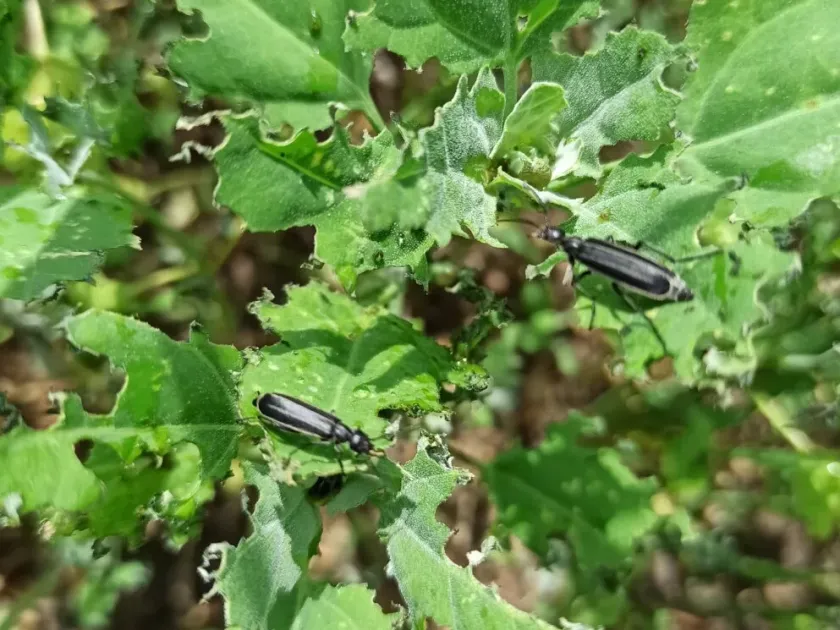
Adult beetles possess a slender, elongated body, typically matte black, and are known for their ability to secrete cantharidin from their joints.
The life cycle involves hypermetamorphosis, where larvae develop through several stages, primarily feeding on the eggs of grasshoppers in the soil.
Adults are highly mobile insects that are frequently observed in large aggregations, often attracted to blooming vegetation.
These beetles are easily identified by their solid dark color and lack of patterned markings compared to other species of the genus.
What it damages
This beetle causes significant damage to various crops, including potatoes, tomatoes, alfalfa, sugar beets, and various leguminous plants.
The primary damage is caused by adults feeding heavily on flowers, buds, and young fruit, which directly affects crop yields.
In cases of high infestation, they can completely defoliate plants, eating through leaves and leaving only the main veins and stems behind.
Economic losses are severe when populations swarm during the flowering stage, as the loss of reproductive organs precludes plant productivity.
Furthermore, their presence can deter pollinators, causing secondary negative effects on the overall harvest quality and quantity.
When it appears
Adult activity of Epicauta corvina is predominantly observed during the warmer summer months, correlating with high ambient temperatures.
The emergence of adults from the soil is staggered, leading to a prolonged period of infestation potential throughout the growing season.
Beetles exhibit peak activity during the day, particularly when temperatures are high, as they engage in feeding and mating rituals.
Their population size is often influenced by the abundance of grasshopper prey, which is essential for the survival of their larval stages.
As the season progresses toward autumn, the adult population declines, and the species persists in the soil as larvae until the next cycle.
Signs of infestation
Visual identification of infestation involves spotting swarms of black beetles actively skeletonizing leaves or consuming floral parts.
Significant defoliation and the sudden loss of blossoms in specific sections of the field are primary indicators of their feeding activity.
Affected plants often show stunted growth or necrosis at the sites where the beetles have damaged the vegetative tissues.
The presence of beetle aggregations can often be detected by the visual damage of concentrated holes in the foliage across the crop canopy.
One should be cautious, as handling these beetles or brushing against them can result in skin irritation due to their defensive chemical secretions.
Control measures
Effective management requires the application of registered insecticides that target coleopteran pests, applied during peak adult activity.
Cultural practices such as deep fall tillage can help disturb soil-dwelling larvae and pupae, thereby reducing overwintering populations.
Monitoring the population dynamics of grasshoppers in adjacent fields can serve as an early warning for potential blister beetle outbreaks.
Spot treatments are often more efficient than broad-spectrum spraying, provided that infestations are identified early enough in the cycle.
Safety is paramount; operators must use protective gear, including gloves and long sleeves, to prevent chemical burns when interacting with infested crops.
Taxonomy
- Latin name
- Epicauta corvina
- Order
- Coleoptera (beetles)
- Family
- Meloidae
- EPPO code
- EPIACO
Discussion
No discussions yet — be the first.