
Ash-gray blister beetle
Epicauta cinerea
Description
How to identify
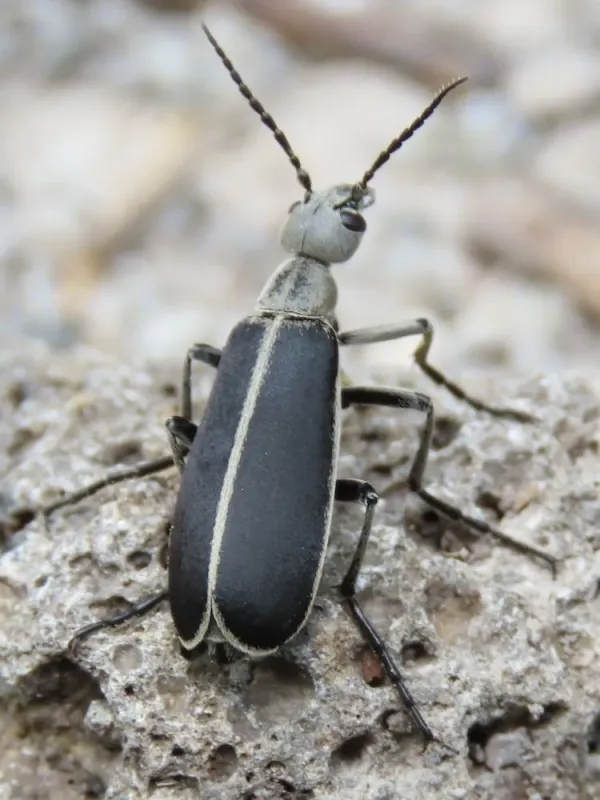
The Ash-gray blister beetle (Epicauta cinerea) is a member of the Meloidae family, commonly known as blister beetles. These insects are recognized by their elongated bodies and dense covering of short, ash-gray or blackish hairs.
A distinctive biological feature of this species is the presence of cantharidin in their hemolymph. This chemical is a potent blistering agent that protects the beetle from predators but can cause skin irritation in humans upon contact.
The adults feature a distinct head, slender antennae, and long, agile legs that enable them to move quickly across the foliage of host plants.
Their life cycle involves hypermetamorphosis, where larvae pass through several stages, including a highly mobile triungulin phase, before settling into a parasitic lifestyle.
These beetles are primarily found in fields and open areas where vegetation is abundant and where populations of grasshoppers reside, which serve as hosts for their larvae.
What it damages
Adult beetles are the primary life stage causing damage to agricultural crops. They are voracious feeders that consume leaves, flowers, and even tender stems of various plants.
They have a strong preference for Solanaceous crops, including potatoes, tomatoes, and eggplants. Leguminous crops like alfalfa and soybeans are also frequently targeted.
Feeding typically results in skeletonized leaves where only the major veins remain, drastically reducing the photosynthetic capacity of the affected plants.
When present in large numbers, these beetles can strip a plant of its foliage in a very short time, leading to significant yield loss or complete destruction of the crop.
Interestingly, the larval stage does not damage crops; instead, they are predators of grasshopper eggs, making the beetle's relationship with agriculture complex and somewhat beneficial in specific ecological contexts.
When it appears
Adult Ash-gray blister beetles usually emerge in mid-to-late summer, coinciding with the flowering and fruiting stages of many vegetable crops.
They are highly active during warm, sunny days, which facilitates their movement and feeding habits across the fields.
The population peaks during the hottest months, after which adults complete their life cycle, mate, and deposit eggs into the soil.
Local weather patterns, such as temperature fluctuations and rainfall, significantly influence the timing and intensity of the beetle emergence each season.
Farmers should monitor their fields during this critical summer window to detect early signs of infestation before the population reaches economic threshold levels.
Signs of infestation
The most evident sign of an infestation is sudden defoliation or the presence of jagged holes in the leaves of susceptible crops.
Visual inspection often reveals groups of gray-colored beetles congregating on flower clusters or the tops of plants, where they feed most actively.
Plants affected by the beetle may show signs of wilting or stunted growth due to the extensive loss of photosynthetic tissue.
The presence of frass (insect excrement) on the leaves is another indicator of recent feeding activity by the beetles.
- Ragged leaf margins or skeletonized foliage.
- Aggregations of adult beetles on flowers.
- Stunted plant development.
- Reduced yield quality in fruit-bearing crops.
Control measures
The most effective management strategy involves the timely application of approved insecticides specifically targeting adult beetles.
Integrated Pest Management (IPM) practices, such as maintaining healthy soil and implementing proper crop rotation, can discourage the survival of larval stages in the soil.
Hand-picking is an option for small garden plots, but it must be done with protective gloves to avoid contact with the beetle's caustic hemolymph.
Border treatments of fields are often recommended, as these beetles frequently migrate into crops from adjacent wild grasses and pastures.
Because the larvae prey on grasshopper eggs, broad-spectrum insecticide use should be managed carefully to avoid disrupting natural biocontrol cycles within the local ecosystem.
Taxonomy
- Latin name
- Epicauta cinerea
- Order
- Coleoptera (beetles)
- Family
- Meloidae
- EPPO code
- EPIACI
Discussion
No discussions yet — be the first.