
Blister beetle
Epicauta
Description
How to identify
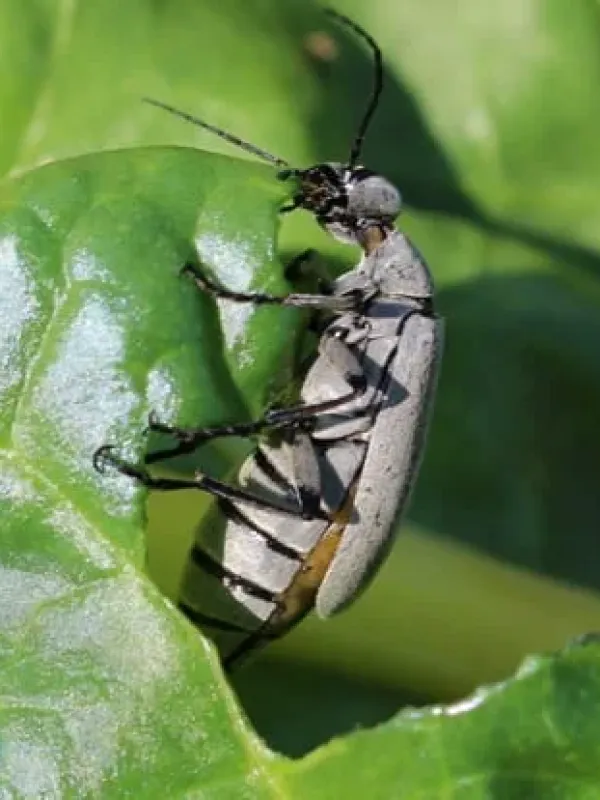
Blister beetles, belonging to the genus Epicauta and the family Meloidae, are well-known insects characterized by their elongated bodies and potent chemical defenses. They are easily recognizable by their bright or contrasting coloration, which warns predators of their toxicity.
The defining trait of these beetles is the presence of cantharidin in their hemolymph. This substance is a powerful vesicant; when the beetle is crushed or disturbed, it releases a fluid that can cause painful blisters upon contact with human skin.
Morphologically, they possess soft, leathery elytra and a distinct head separated from the thorax by a noticeable neck. Their antennae are often thread-like or slightly thickened at the tips, which helps in differentiating species during field scouting.
Their life cycle involves hypermetamorphosis, a complex development process where the larvae go through several distinct stages, including a highly mobile first-instar larva known as a triungulin, designed to locate hosts.
These beetles are diurnal insects that prefer sunny, open areas. They often congregate in large groups, making them highly visible during the peak of the growing season when environmental conditions are ideal for their activity.
What it damages
Blister beetles are polyphagous pests capable of attacking a wide variety of plants. They are particularly devastating to solanaceous crops, such as potatoes, tomatoes, and eggplants, where they can rapidly defoliate entire plants.
Legumes, including alfalfa, soybeans, and peas, are also highly susceptible. During the flowering stage, these beetles often feed on blossoms and tender pods, causing significant losses in seed production and total yield.
The adult beetle is the primary destructive stage, possessing robust chewing mouthparts. When occurring in swarms, they can consume massive amounts of foliage in a very short period, leaving only the primary leaf veins behind.
While the larvae act as beneficial parasites in the nests of wild bees or locust eggs, their ecological role is overshadowed by the damage caused by the adults to commercial agricultural crops.
Defoliation caused by feeding reduces the photosynthetic surface area of the crops, leading to stunted growth, reduced stress tolerance, and eventual yield failure if left unmanaged during high-infestation years.
When it appears
Adult blister beetles typically emerge in mid-summer, coinciding with hot, dry weather patterns. Their emergence timing is often synchronized with the blooming stages of major field crops, increasing their threat level.
Their population dynamics are heavily influenced by climate; prolonged droughts often favor the survival of overwintering larvae in the soil, leading to larger adult populations during the subsequent summer months.
Adults exhibit peak feeding activity during the heat of the day, congregating on the upper parts of the plants to bask in the sun. In cooler temperatures or at night, they descend to the lower foliage or seek cover in the soil.
There is typically one generation per year, though in warmer southern climates, a partial second generation can occur. The adult feeding window lasts for several weeks, during which they can move between fields looking for optimal food sources.
Overwintering occurs in the soil, where the larvae wait until the next spring to pupate. Field monitoring for the first sightings of adults is essential for implementing timely interventions before swarms establish themselves.
Signs of infestation
The first sign of an infestation is the sudden appearance of beetle aggregations on the foliage. The leaves will display a skeletonized appearance, with only the major veins remaining, which is a classic symptom of blister beetle feeding.
Affected fields may have a distinct odor, and care should be taken as the beetles may leave toxic residues on the foliage. Observing plants in the morning is the best way to spot them before they become highly active.
In cases of severe infestation, apical growth points may appear wilted or stripped due to heavy feeding. Secondary effects include stunted plant development and premature yellowing of the foliage across entire sections of the crop.
Using a sweep net is the most effective method for scouting. Beetles are gregarious, so finding a few individuals usually suggests the presence of a much larger cluster nearby that requires immediate attention.
The rapid rate of defoliation on sensitive crops like alfalfa or potatoes serves as a critical warning. If thresholds are met, control measures must be deployed immediately to prevent economic losses.
Control measures
Managing blister beetles requires a combination of insecticide applications and proactive monitoring. Chemical control using contact insecticides is the most effective method for immediate reduction of swarms.
Applications should ideally be timed for late afternoon or evening when beetles are feeding on the foliage. Always select products labeled for the specific crop to ensure efficacy and minimize impact on beneficial pollinators.
Cultural control includes deep tillage in the fall to disturb overwintering larvae and destroy their subterranean habitats. Keeping field edges free of weeds also reduces the initial food supply that attracts beetles early in the season.
Crop rotation is another vital strategy to prevent the buildup of soil-dwelling larvae. By moving susceptible crops away from last year's infestation sites, growers can significantly decrease the likelihood of localized swarms.
- Perform perimeter sprays to intercept migrating swarms.
- Use pheromone-based monitoring to track population peaks.
- Implement early harvest if the crop is close to maturity to mitigate losses.
- Avoid manual handling of infested plants due to cantharidin toxicity.
Taxonomy
- Latin name
- Epicauta
- Order
- Coleoptera (beetles)
- Family
- Meloidae
- EPPO code
- EPIASP
Discussion
No discussions yet — be the first.