
Wide-chested click beetle
Selatosomus amplicollis
Description
How to identify
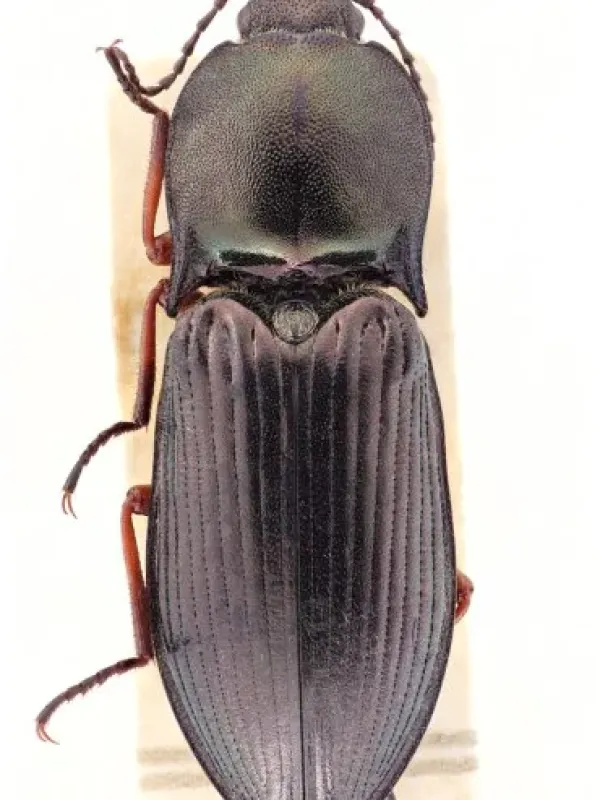
The wide-chested click beetle (Selatosomus amplicollis) is a member of the Elateridae family, order Coleoptera. Adult beetles possess the family's characteristic ability to flip themselves into the air with a clicking sound if they land on their backs.
The adult beetle has a black body, often with a metallic sheen, and typically measures 10–15 mm in length. Its surface is covered with dense, fine hairs, and the pronotum is noticeably wide, which is the defining characteristic of this species.
Its larvae, widely known as wireworms, are characterized by a long, cylindrical, and hardened body with a yellowish-brown color. Their strong, chitinous exoskeleton makes them highly resistant to mechanical pressure in the soil.
The life cycle involves complete metamorphosis, including egg, larval, pupal, and adult stages. The insect spends most of its life cycle underground as a larva, feeding on plant parts.
These insects prefer moderately moist soils rich in organic matter. During periods of drought or extreme cold, wireworms have the ability to migrate vertically to deeper soil layers to survive.
What it damages
The larvae are the primary source of economic damage. They feed on planted seeds, cut off the roots of seedlings, and gnaw at the underground parts of stems, often destroying crops entirely.
They infest a wide range of crops, including cereals (wheat, rye, barley), corn, sunflowers, and root crops like potatoes. In root crops, larvae bore deep tunnels, rendering the harvest unmarketable.
In cereal and corn fields, the infestation leads to thin and uneven stands, resulting in significant yield losses during the early stages of plant development.
The most severe damage occurs in regions with high soil moisture and in fields infested with weeds like quackgrass, which provide an excellent food source for the developing larvae.
Adult beetles feed primarily on foliage and pollen and do not cause significant economic damage compared to the destructive feeding habits of the soil-dwelling larvae.
When it appears
Adult beetles emerge from the soil in the spring when soil temperatures reach 10–12 degrees Celsius. The peak flight period usually occurs between late spring and early summer.
Females lay eggs in small clusters near the roots of host plants in the upper soil layers. Development of the eggs is highly dependent on moisture levels and temperature conditions.
Young larvae feed on decaying organic matter, while older larvae transition to active feeding on the roots and underground stems of agricultural crops.
The most active period for larval damage coincides with seed germination and initial root system growth, making spring crops highly susceptible to infestation.
Pupation typically takes place during the summer inside earthen cells located at a depth of approximately 15–20 cm below the soil surface.
Signs of infestation
In the field, the presence of wireworms is often detected by uneven germination and empty spots in crop rows. Infested young plants typically wilt, turn yellow, and eventually die.
Upon excavating the soil around affected plants, growers can easily find the stiff, yellowish larvae attached to or near the damaged root systems.
Signs of infestation on potatoes and root crops include small circular entry holes on the skin, which lead into deep, winding tunnels bored through the inner flesh.
Damaged root vegetables are prone to secondary infections, such as rot and fungal diseases, which cause them to spoil rapidly during post-harvest storage.
Field monitoring is conducted using bait stations buried in the soil, which are inspected after several days to estimate the population density of the larvae.
Control measures
Effective management relies heavily on sound agronomic practices. Deep autumn plowing is a key strategy that exposes larvae and pupae to the surface, where they succumb to cold or predators.
Liming acidic soils is crucial, as these beetles prefer acidic environments; increasing the soil pH creates an unfavorable habitat for the larval stage of the pest.
Crop rotation incorporating legumes or other non-host crops helps reduce population density, as these plants are less suitable for larval development compared to cereals.
Chemical control via seed treatment with insecticides is highly effective, as it provides a protective zone around the seed and the developing seedling during the most vulnerable stage.
- Thorough weed control, especially the removal of quackgrass.
- Application of nitrogen fertilizers (ammonia forms) which have a repellent effect on larvae.
- Optimizing planting times to ensure rapid seedling establishment and root growth.
Taxonomy
- Latin name
- Selatosomus amplicollis
- Order
- Coleoptera (beetles)
- Family
- Elateridae
- EPPO code
- CORMAM
Discussion
No discussions yet — be the first.