
Shiny click beetle
Selatosomus aeneus
Description
How to identify
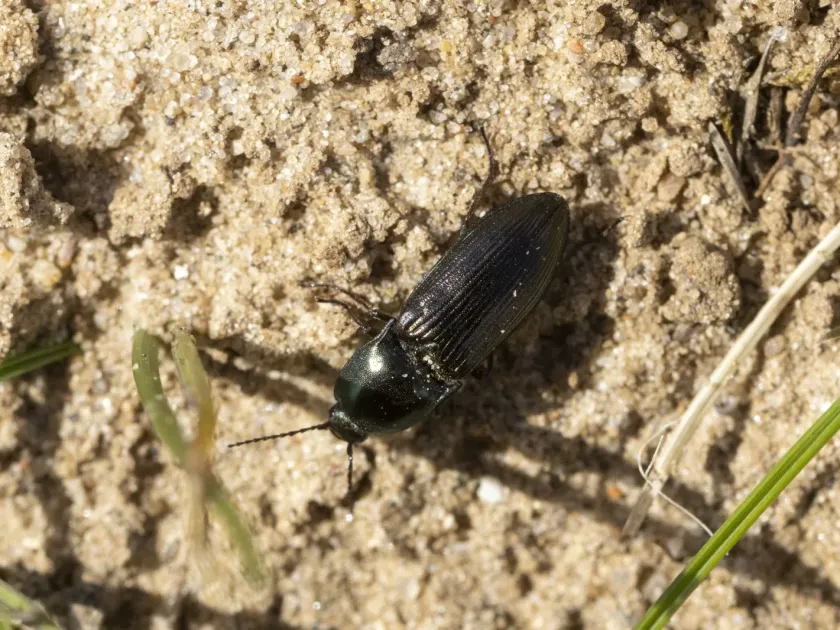
The shiny click beetle (Selatosomus aeneus) is a beetle belonging to the Elateridae family. Adult beetles typically have a metallic, bronze or greenish-black body, measuring between 10 to 15 mm in length.
These beetles are famous for their unique ability to launch themselves into the air with an audible click if they are turned upside down, a behavior that helps them escape from predators and regain their footing.
The larvae, commonly known as wireworms, possess a hard, cylindrical body that is yellow to brown in color. Their tough exoskeleton provides significant resistance to physical stress and pressure within the soil.
The life cycle of the shiny click beetle is prolonged, lasting between 3 to 5 years. The majority of this time is spent in the larval stage hidden within the soil, which complicates traditional pest monitoring.
Expert identification of the larvae relies on observing the specific features of the last abdominal segment, which helps differentiate this species from other soil-dwelling Coleoptera.
What it damages
Wireworms of this species are voracious polyphagous pests that target a wide range of agricultural crops, including cereals, root vegetables, and various industrial plants.
The larvae damage planted seeds, young sprouts, and subterranean stems. This feeding behavior frequently results in uneven stand emergence, causing significant reductions in crop density and overall yield.
Root crops such as potatoes, sugar beets, and carrots are especially vulnerable. Wireworms bore deep tunnels into these tubers and roots, rendering them aesthetically damaged and prone to subsequent decay.
Young seedlings often succumb to the damage, leading to withered stems that require re-seeding of affected areas, which increases production costs and labor demands.
Damage caused by wireworms also serves as an entry point for various plant pathogens, including bacteria and fungi, which can lead to rapid rotting of the entire root system.
When it appears
Adult beetles typically emerge in the spring, during April and May, when temperatures rise. This period is dedicated to feeding, mating, and searching for suitable egg-laying sites.
Females prefer to lay eggs in moist, well-vegetated soil. The development of larvae is highly dependent on local moisture levels and soil temperature, which dictate their movement patterns.
Wireworms are most active in the upper soil layers during spring and early autumn. Conversely, they migrate deeper into the soil profile during extreme summer heat or winter cold.
Monitoring for this pest is recommended before planting in spring or after harvest in autumn through systematic soil sampling to assess the population density of the larvae.
Vertical migration is a critical survival mechanism for the shiny click beetle, making localized treatments at the surface ineffective if the larvae have retreated deep into the soil profile.
Signs of infestation
Visual indicators of a wireworm infestation include thinning patches in crop fields. Affected plants may show signs of yellowing or sudden wilting even when irrigation or precipitation is sufficient.
Examining the soil around an affected plant often reveals the larvae present near the roots. In severe cases, the entire root zone of the crop may be compromised or stunted.
Harvested root crops often show clear evidence of infestation, characterized by circular tunnels or perforations. These sites often become mushy or darkened due to secondary infection.
Early spring observations of adult beetles moving on the soil surface suggest a healthy population, indicating a high risk of future larval damage that requires preventive action.
Using bait traps, such as burying pieces of potatoes in the soil, is a highly effective way to confirm the presence and concentration of wireworms in a specific field.
Control measures
Strategic crop rotation is the cornerstone of managing shiny click beetle populations. Rotating crops helps to disrupt the life cycle of the pest and reduces the success rate of larval development.
Deep autumn tillage is highly effective as it brings larvae to the surface, exposing them to bird predation and lethal temperature fluctuations that significantly reduce their survival rate.
Adjusting soil pH through liming on acidic fields can create an environment less favorable for the survival and growth of wireworm larvae, acting as a natural deterrent.
Chemical control usually involves seed treatment with systemic insecticides, providing early-season protection to the most vulnerable sprouts against subterranean feeding.
- Application of granular insecticides in the furrow during planting.
- Rigorous weed management, especially targeting rhizomatous weeds like couch grass.
- Regular soil cultivation during the beetle’s flight period to disrupt egg-laying.
- Utilization of biological control agents, such as entomopathogenic fungi.
Taxonomy
- Latin name
- Selatosomus aeneus
- Order
- Coleoptera (beetles)
- Family
- Elateridae
- EPPO code
- CORMAN
Discussion
No discussions yet — be the first.