
Tessellated click beetle
Prosternon tessellatum
Description
How to identify
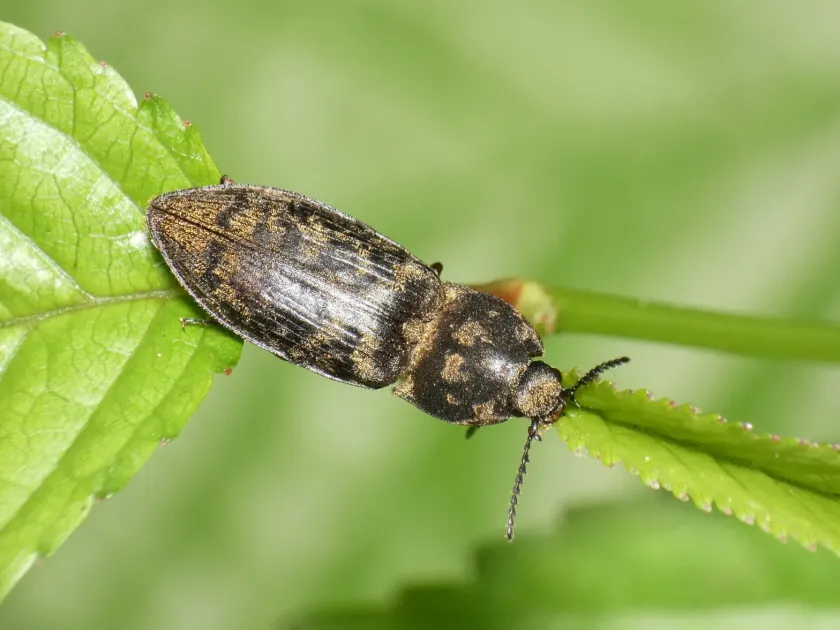
The tessellated click beetle (Prosternon tessellatum) belongs to the Elateridae family within the order Coleoptera. Adults are elongated, measuring 11–14 mm, with brown coloration and dense, golden pubescence.
The larvae, widely known as wireworms, are characterized by a hard, cylindrical, yellow-brown body. They possess three pairs of thoracic legs, which enable them to maneuver efficiently through the soil.
The defining trait of these beetles is their unique ability to right themselves when placed on their backs by performing a violent snap, emitting a distinct click sound.
The life cycle involves complete metamorphosis, with the larval stage being the most prolonged, often spanning several years depending on environmental conditions.
Adults are active flyers during the reproductive season, enabling them to colonize new fields and lay eggs in soil substrates suitable for larval survival.
What it damages
The primary economic damage is caused by the larvae (wireworms). They are highly polyphagous, feeding on the underground portions of various crops, including cereals, corn, and potatoes.
They consume germinating seeds, sever roots, and tunnel into tubers and rhizomes, which leads to significant losses in plant stand and reduced crop vigor.
By creating entry wounds in roots and tubers, wireworms facilitate the invasion of soil-borne pathogens, leading to fungal and bacterial rots in the crops.
Severe infestations can result in total crop failure for root vegetables, as the damage renders the product unmarketable due to unsightly holes and tissue breakdown.
The cumulative effect of larval feeding disrupts the plant's nutrient uptake, ultimately leading to stunted growth or premature wilting and death of the plant.
When it appears
Adult beetles emerge in late spring or early summer, with the mating period typically occurring between May and June depending on the regional climate.
Eggs are deposited in small clusters in the upper layers of the soil, often favoring moist environments or fields with heavy vegetative cover such as pastures or weeds.
As the larvae develop, they exhibit vertical migration within the soil profile, moving to deeper layers in response to temperature changes and moisture fluctuations.
Wireworms are most damaging during the spring and early autumn when they migrate towards the rhizosphere to feed on the most active root growth.
Temperature serves as a key driver for activity; during extremely dry or hot spells, larvae retreat deeper into the soil to escape desiccation.
Signs of infestation
Visual indicators of infestation include sparse plant emergence, where seedlings appear yellowed, wilted, or fail to emerge entirely due to seed damage.
Upon examination of the root system, one can see severed roots or tunnel-like holes in the base of the stems, often directly associated with the presence of larvae.
Root crops like potatoes or beets may exhibit characteristic narrow, deep tunnels that penetrate the tissue, significantly degrading the quality of the vegetable.
Field scouting using bait stations, such as buried starch-rich traps, is a standard agronomic practice to determine the density of the wireworm population.
The presence of adult beetles in the field during the evening, particularly in grassy or weedy areas, is a strong indicator of potential future pressure.
Control measures
Strategic crop rotation is the most effective cultural method to break the life cycle, as wireworms thrive in undisturbed soils and perennial grass fields.
Tillage operations, especially deep autumn plowing, expose larvae to natural predators like birds and subject them to lethal surface environmental conditions.
Weed management, particularly the removal of perennial grasses like couch grass, is crucial to eliminate alternative food sources and nesting sites for adults.
The use of insecticide-treated seeds is a standard protective measure to prevent wireworm damage during the critical early stages of crop establishment.
- Application of soil-applied granular insecticides in the furrow.
- Soil pH adjustment to create less favorable conditions for larvae.
- Monitoring pest density prior to planting high-risk crops.
- Optimizing planting dates to avoid peak larval activity periods.
Taxonomy
- Latin name
- Prosternon tessellatum
- Order
- Coleoptera (beetles)
- Family
- Elateridae
- EPPO code
- PRTNTE
Discussion
No discussions yet — be the first.