
Grey click beetle
Melanotus senilis
Description
How to identify
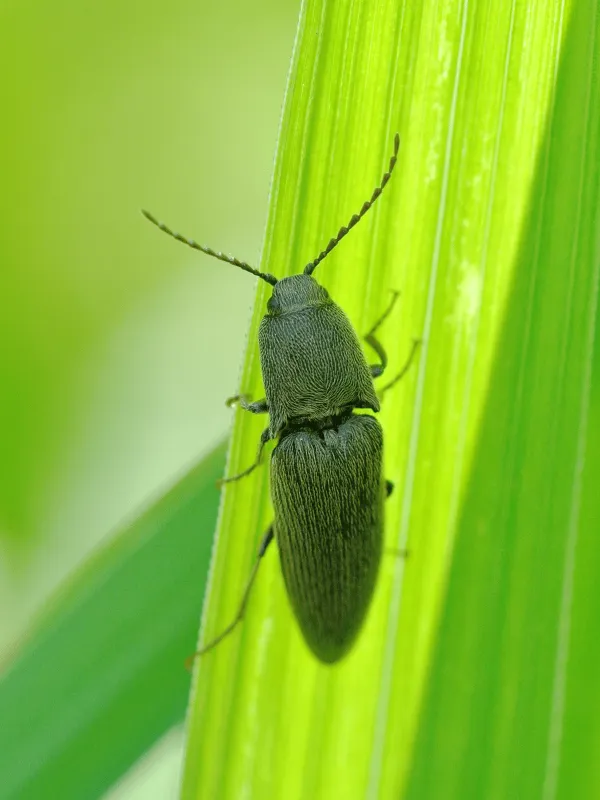
The grey click beetle (Melanotus senilis) is a member of the Elateridae family. Adult beetles have an elongated body, typically reaching 15–20 mm in length, with a dark brown or black coloration.
The body is densely covered with short grey hairs, which gives the species its common name. The pronotum is convex, and the elytra show distinct longitudinal grooves, a feature characteristic of this group.
The larvae, widely known as wireworms, are easily recognizable by their hard, cylindrical, and chitinous bodies. Their color ranges from yellow to brownish, which allows them to blend in with the soil particles.
The larvae possess a strong chewing mouthpart, enabling them to tunnel through tough plant roots and tubers. They also have three pairs of short, sturdy thoracic legs, allowing for quick movement through the soil profile.
Like other click beetles, the adults have a unique mechanism for righting themselves if they fall on their backs, accompanied by an audible clicking sound and a sudden jump.
What it damages
The damage to crops is caused almost exclusively by the larvae living in the soil. They are generalist feeders, meaning they attack a wide range of agricultural crops.
Cereal crops like wheat, maize, oats, and barley are highly susceptible. The wireworms frequently consume the seeds after sowing, destroying the embryo and leading to poor crop stands.
Young plants are heavily affected as the larvae feed on the roots and the subterranean portion of the stems. This feeding results in sudden wilting and often leads to the death of the seedling.
Root crops and tubers, especially potatoes and sugar beets, are primary targets. The larvae bore deep holes into the roots and tubers, significantly reducing crop quality and making the produce prone to storage rot.
The economic impact of Melanotus senilis is significant in fields where the soil moisture is adequate, as the larvae thrive in stable environmental conditions near their food source.
When it appears
The life cycle of the grey click beetle is lengthy, typically spanning 3 to 4 years, depending on regional temperatures and the moisture content of the soil.
Both adults and larvae overwinter deep in the soil to avoid freezing temperatures. As the soil warms up in the spring, the larvae migrate toward the surface to find fresh roots.
The flight period for the adults usually begins in late spring or early summer. Following mating, females lay eggs in the surface layer of the soil, often in areas with dense vegetation.
First-instar larvae feed on organic matter, but as they age, they shift their diet toward the living roots of agricultural crops, reaching their peak activity in the spring and early summer months.
Pupation occurs in the summer within earthen cells constructed in the soil. The newly emerged adults remain in the soil, overwintering until the following spring flight.
Signs of infestation
The primary visual sign of a wireworm infestation is the appearance of thin patches or empty gaps in crop rows where seedlings have failed to establish or have withered prematurely.
If you examine the soil around a dying plant, you will often find the wireworm larvae actively feeding on the damaged roots or crown area.
For tuber crops, the telltale sign is the presence of small, deep, circular holes that penetrate deep into the flesh of the potato or beet.
Farmers can monitor populations using subterranean bait stations filled with germinating grains or carrot slices to detect the level of pest pressure before sowing.
- Uneven crop emergence and thin stands.
- Sudden yellowing or wilting of individual plants.
- Hollowed-out seeds found when digging in rows.
- Deep tunnel marks on harvested roots or tubers.
Control measures
Effective management of Melanotus senilis requires an integrated pest management (IPM) strategy that combines cultural practices with chemical protection.
Deep autumn plowing is a fundamental control measure, as it disrupts the life cycle by bringing larvae to the surface, exposing them to desiccation and natural predators like birds.
Strategic crop rotation, particularly rotating cereals with non-host crops such as legumes or mustards, can significantly lower the larvae population density in the soil.
Seed treatment with systemic insecticides is the standard and most effective method for protecting seeds and seedlings during the critical early growth phases.
In cases of severe infestation, the application of granular soil insecticides during planting helps maintain a protective chemical barrier around the developing root system.
Taxonomy
- Latin name
- Melanotus senilis
- Order
- Coleoptera (beetles)
- Family
- Elateridae
- EPPO code
- MELNSE
Discussion
No discussions yet — be the first.