
Melanotus opacicollis
Melanotus opacicollis
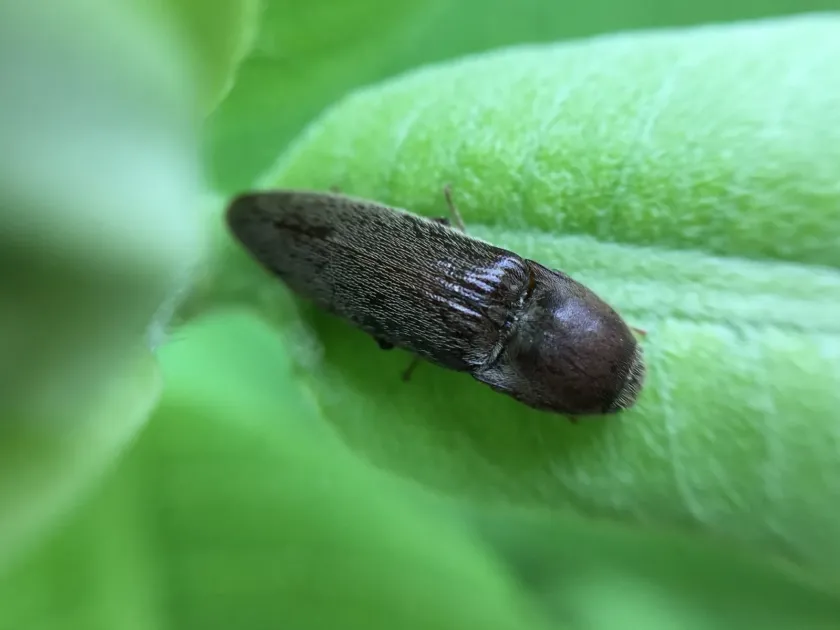
Description
How to identify
Melanotus opacicollis belongs to the order Coleoptera and the family Elateridae. The adult beetles are elongated, measuring about 12–17 mm in length, with a distinct dark brown or black matte coloration.
The larvae, widely known as wireworms, are characterized by a highly sclerotized, rigid body. They are cylindrical, glossy, and yellowish-brown in color, reaching 20–25 mm in length during their late stages.
The common name "click beetle" comes from their unique ability to flip themselves into the air with an audible clicking sound when placed on their backs. This mechanism serves as a defensive behavior against predators.
The life cycle of this species is complex and long, typically lasting between 3 to 5 years. The vast majority of this time is spent underground in the larval stage, which makes monitoring and control efforts particularly challenging.
Females lay small, oval-shaped white or yellowish eggs in the upper soil layers, usually near the roots of weeds or crops, which provides the initial food source for the newly hatched larvae.
What it damages
The larval stage is responsible for significant damage to a wide range of agricultural crops, including cereals, corn, sunflower, and various root vegetables. They act as soil-dwelling pests that attack plant parts below the ground.
Wireworms feed on germinating seeds and embryos, often resulting in sparse stands and significant losses in field density. This frequently necessitates replanting efforts by farmers.
They consume the roots and the bases of plant stems, leading to stunted growth, rapid wilting, and eventually the death of young seedlings. Mature plants may survive but suffer from reduced vigor and increased susceptibility to diseases.
In root crops such as potatoes, carrots, and beets, wireworms bore deep, irregular galleries. This damage significantly reduces market value and promotes the development of rot during storage.
The severity of the damage is often tied to soil conditions; high humidity and the presence of organic debris attract the larvae, making poorly drained or recently cultivated pasture land particularly vulnerable.
When it appears
Adult beetles are most active during late spring and early summer, which corresponds with their mating and egg-laying period. They can be found moving on the soil surface during this time.
The eggs are laid throughout the summer months. Larvae are sensitive to soil moisture; during periods of extreme drought, they migrate deeper into the soil profile to find suitable environmental conditions.
In the autumn, larvae continue feeding until temperatures drop significantly. They then migrate to lower soil horizons to hibernate through the winter, emerging back to the surface as soil temperatures rise in spring.
The peak of damage occurs in the spring when larvae move into the upper soil layers (0-15 cm) to feed on the root systems of emerging spring-sown crops.
During the summer, the level of crop damage may decrease if alternative food sources, such as grass weeds, are abundant in the field, as larvae may focus on those instead.
Signs of infestation
One of the primary indicators of a wireworm infestation is an uneven or thin plant stand, with individual plants wilting or dying unexpectedly without an obvious cause.
Digging into the soil around a withered plant often reveals one or more wireworms attached to the roots or feeding on the stem base.
The presence of dense infestations of couch grass or other perennial weeds is a reliable indicator that the soil conditions are favorable for click beetle populations.
During harvest, identifying boreholes or tunnels in root crops like potatoes or carrots confirms the presence of wireworm larvae within the field.
If soil sampling during the spring or autumn reveals the larvae, farmers should anticipate potential damage and plan appropriate intervention strategies.
Control measures
Effective management begins with crop rotation. Avoid planting susceptible crops immediately following perennial grasses or set-aside land, as these are primary breeding grounds for click beetles.
Mechanical control through autumn plowing is highly effective, as it brings larvae to the surface, exposing them to desiccation, predators like birds, and lethal winter temperatures.
Consistent weed management, particularly targeting perennial grasses, removes both the shelter and the alternative food source that wireworms rely on.
Treating seeds with systemic insecticides is a standard preventative measure that protects young seedlings during the most critical stage of development.
- Application of soil-applied insecticides at planting.
- Liming of acidic soils, as click beetles prefer lower pH environments.
- Use of trap crops (e.g., oats or barley) to draw larvae out before the main crop is sown.
Taxonomy
- Latin name
- Melanotus opacicollis
- Order
- Coleoptera (beetles)
- Family
- Elateridae
- EPPO code
- MELNOP
Discussion
No discussions yet — be the first.