
Melanotus longulus
Melanotus longulus
Description
How to identify
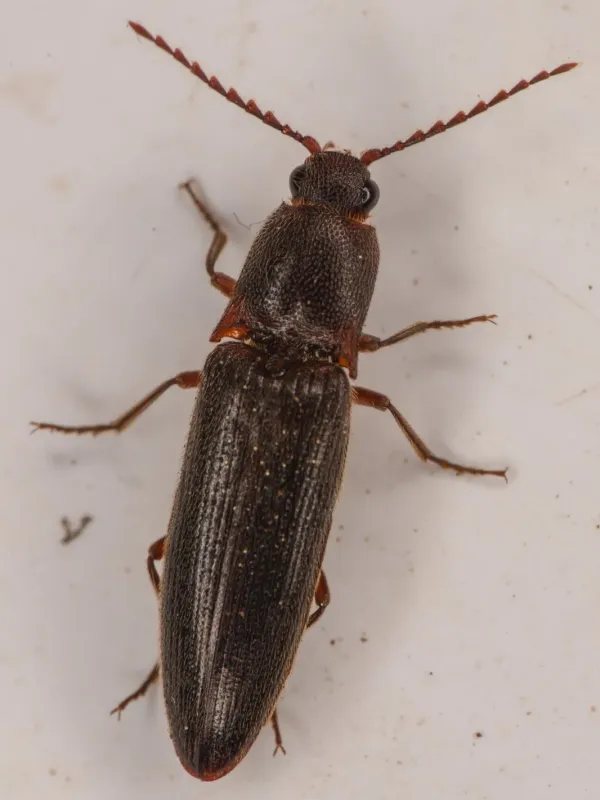
The adult click beetle Melanotus longulus has an elongated body ranging from 12 to 18 mm in length, typically colored in dark brown or black with a slight metallic sheen.
It is covered with fine, dense hairs, and its common name, click beetle, comes from its unique thoracic mechanism that allows it to flip into the air with a clicking sound.
The larval stage, commonly known as a wireworm, is characterized by a hard, cylindrical body that is yellow to brownish in color and very firm to the touch.
These larvae are extremely agile in the soil, possessing a pair of powerful mandibles adapted for gnawing through plant roots, seeds, and stems.
The life cycle of this species is complex and usually spans several years, making it a persistent problem for agricultural landscapes if not monitored properly.
What it damages
Melanotus longulus is a polyphagous pest, meaning it attacks a wide variety of crops including maize, cereals, potatoes, sunflowers, and sugar beets.
The primary damage occurs underground, where wireworms feed on germinating seeds and young root systems, often destroying the plant before it emerges.
Plants affected by wireworms show signs of wilting, stunted growth, or sudden death, especially during the spring season when the larvae are most active near the surface.
Beyond direct feeding, the tunnels created by the larvae serve as entry points for soil-borne pathogens, leading to secondary fungal infections and rot in tubers.
Economic impact is significant because the larvae are difficult to detect until the damage to the stand density has already become irreversible.
When it appears
Adult beetles typically emerge in spring, usually in April or May, once the soil temperatures have risen sufficiently to trigger their activity above ground.
Females deposit eggs in moist soil rich in organic matter or overgrown with weeds, which provides the necessary habitat for the hatching larvae to thrive.
Larval feeding peaks in the spring when moisture levels are high, allowing them to remain in the upper layers of the soil where roots are most abundant.
During the heat of mid-summer, when the surface soil becomes dry, wireworms migrate deeper into the soil profile to maintain their metabolic balance.
As temperatures drop in autumn, larvae prepare for overwintering by burrowing deeper into the soil, where they survive until the following spring season.
Signs of infestation
Inconsistent crop emergence and patches of dead plants are the most common field indicators of a wireworm infestation on a commercial scale.
Excavating the soil around symptomatic plants will reveal damaged roots that look chewed or gnawed, often accompanied by the presence of the wireworms themselves.
Seed damage is another clear sign; seeds will often have circular, hollowed-out holes while the outer husk might appear relatively intact.
A high density of couch grass and other perennial weeds in the field is a strong biological indicator that conditions are ideal for this pest species.
In root crops, such as potatoes, the presence of surface pitting or deeper tunnels is a definitive sign of feeding activity by the Melanotus longulus larvae.
Control measures
Effective management begins with robust crop rotation, avoiding the placement of susceptible crops following perennial grasses or abandoned, weedy fields.
Deep autumn plowing is a highly effective mechanical method that brings the larvae to the surface, exposing them to bird predation and desiccation.
Weed control is essential, particularly targeting rhizomatous grasses, which serve as a primary refuge and food source for wireworms during the off-season.
Seed treatment with systemic insecticides is the standard approach for ensuring protection during the critical period of germination and seedling establishment.
- Use of trapping crops like oats or barley in localized areas to attract larvae for subsequent chemical treatment or removal.
- Application of entomopathogenic fungi as a biological control strategy to suppress wireworm populations in the soil profile.
Taxonomy
- Latin name
- Melanotus longulus
- Order
- Coleoptera (beetles)
- Family
- Elateridae
- EPPO code
- MELNLO
Discussion
No discussions yet — be the first.