
Click beetle
Melanotus
Description
How to identify
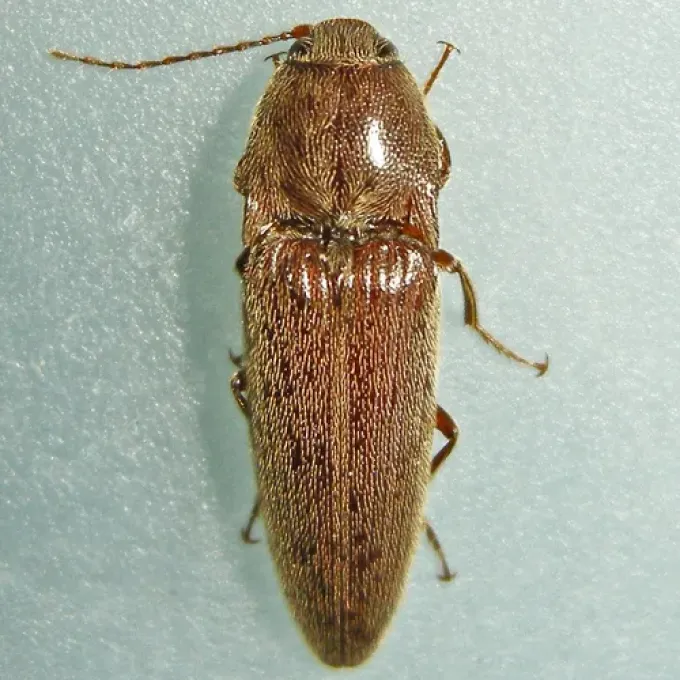
Adult click beetles (Elateridae) are medium-sized beetles with an elongated body shape, typically coloured in dark brown or black, often with a metallic sheen.
They are named after their unique ability to flick their bodies upward with a clicking sound when placed on their backs, enabling them to right themselves quickly.
Their larvae, commonly known as wireworms, are characterised by a stiff, cylindrical, and hard body. They are typically yellow or reddish-brown and possess three pairs of small legs.
The genus Melanotus contains large species of click beetles, whose larvae can reach significant sizes and cause substantial damage to root systems of various crops.
Identifying the pest correctly requires digging in the soil near damaged plants to reveal the larvae, which are almost always found in the upper soil horizons.
What it damages
Click beetles are significant pests because their larvae, the wireworms, are polyphagous, attacking a wide range of field crops like corn, wheat, potatoes, and beets.
Wireworms damage crops by feeding on seeds, preventing germination, or by chewing through roots and the base of young stems, leading to severe plant loss.
Infested plants often exhibit wilting, yellowing of leaves, and poor development, ultimately leading to thin, irregular stands that require replanting.
Direct damage to roots and underground stems creates entry points for soil-borne pathogens, leading to secondary fungal or bacterial infections and root rot.
In fields with high infestations, wireworm damage can significantly reduce total yield, especially in crops that are sensitive to root zone disturbance.
When it appears
Adult beetles typically emerge in spring when soil temperatures reach about 10-12 degrees Celsius, with activity levels peaking throughout May and June.
Females lay eggs in the soil, favoring moist areas with heavy vegetation or crop residues, which provide optimal conditions for the emerging larvae.
The life cycle of wireworms is remarkably long, usually spanning from three to five years, during which the larvae go through several developmental stages.
Wireworms exhibit vertical migration patterns in response to environmental conditions, moving to the surface in spring and autumn and retreating deeper in summer.
Winter survival is ensured by the larvae moving to deeper soil layers, where they remain dormant and resilient to cold temperatures until the return of spring.
Signs of infestation
The most noticeable sign of a wireworm infestation is the appearance of patches of dying or wilted seedlings within a crop field during the early growth stage.
Plants affected by wireworms can be easily pulled out of the ground, and their roots will show clear signs of gnawing, with narrow, irregular channels often visible.
The presence of adult click beetles in flight or hiding under debris during spring is a strong indicator of an established population in the local soil.
Weedy fields, especially those infested with perennial grasses, are prime breeding grounds for wireworms, often showing higher levels of damage in following seasons.
In root crops such as carrots or potatoes, infestations are identified by deep, dry holes or tunnels drilled by larvae, which can render the crop unmarketable.
Control measures
Successful management of wireworms relies primarily on crop rotation, avoiding susceptible crops following perennial grasses or small grains that harbor high populations.
Deep fall ploughing is a highly effective cultural practice, as it exposes larvae to predators such as birds and to cold temperatures, significantly reducing the population.
- Maintain clean fields by eradicating perennial weeds and grassy debris.
- Apply balanced mineral fertilisers to create soil conditions unfavorable for larval development.
- Use systemic insecticide seed treatments to protect crops during the vulnerable germination phase.
- Implement trap crops, such as corn or oats, to aggregate larvae for targeted removal or control.
Soil-applied insecticides during the planting process provide essential protection for high-value crops, ensuring the root zone remains free from wireworm attacks.
Regular soil monitoring using traps or systematic digging is crucial for determining the necessity of chemical control and optimizing the timing of applications.
Taxonomy
- Latin name
- Melanotus
- Order
- Coleoptera (beetles)
- Family
- Elateridae
- EPPO code
- MELNSP
Discussion
No discussions yet — be the first.