
Brown click beetle
Limonius infuscatus
Description
How to identify
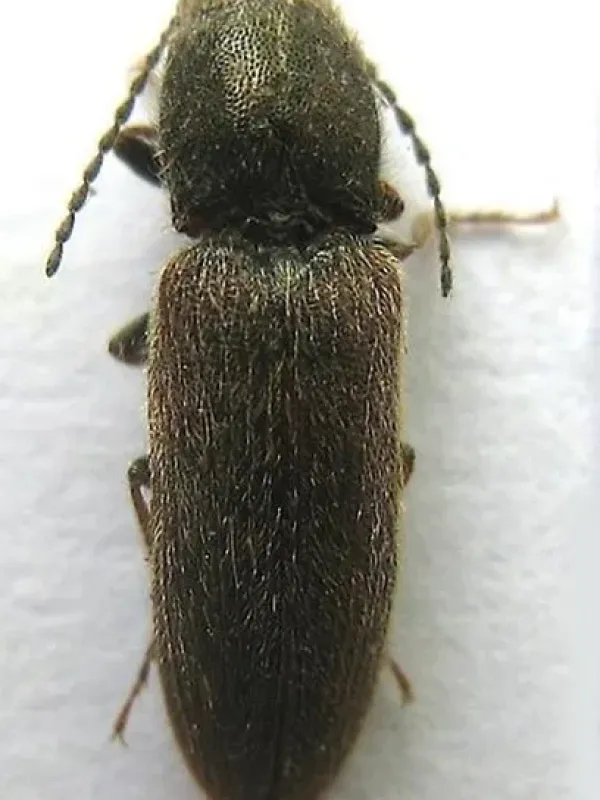
The adult brown click beetle, Limonius infuscatus, is a beetle typically measuring 7 to 9 mm in length. Its body is dark brown or nearly black, covered with short, dense hairs that give it a matte appearance.
The larvae of this species, widely known as wireworms, possess a characteristic cylindrical, heavily sclerotized body. Their color ranges from yellow to dark brown, and they have a smooth, shiny, and hard-to-the-touch surface.
A distinctive feature of click beetles is their ability to produce a clicking sound when attempting to flip themselves upright from their backs. This jumping mechanism helps them escape predators and regain their normal position.
The life cycle of the beetle spans several years, with the majority of its life spent in the soil during the larval stage. Adults emerge on the surface in spring and actively feed on the vegetative parts of plants.
The eggs of the click beetle are tiny, milk-white, and are laid by females in the top layer of soil, primarily near the roots of host plants, ensuring the larvae have immediate access to food upon hatching.
What it damages
The brown click beetle and its larvae are polyphagous, causing significant damage to a wide range of agricultural crops. Both grain and row crops are at risk.
Crops such as potatoes, sugar beets, corn, and sunflowers are particularly vulnerable. The larvae damage sown seeds, seedlings, and the root systems of mature plants.
In cereal crops, wireworms can sever the underground part of the stem, leading to massive thinning of seedlings and the death of young plants before the tillering phase.
In tubers and root crops, the larvae bore deep, winding tunnels, which not only degrades the market quality of the produce but also facilitates the development of secondary infections like rot.
Damage to the root system leads to stunted growth, reduced plant immunity, and a significant decrease in overall yield, making this pest one of the most dangerous soil-dwelling parasites.
When it appears
The emergence of brown click beetle adults begins in April or May, depending on the temperature regime of the specific region and the rate of soil warming.
Peak activity of the adult beetles occurs on warm, sunny days. During this time, they mate and proceed to lay eggs in moist soil.
Younger larvae appear in June-July and primarily feed on humus and small weed roots during their first year, causing little damage to cultivated crops.
The greatest threat is posed by larvae in their second and subsequent years of life, when their size increases and their nutritional requirements grow substantially.
In the autumn, as soil temperatures drop, wireworms migrate to deeper soil horizons, where they remain to overwinter until the following spring.
Signs of infestation
The first sign of wireworm infestation in a field is the appearance of patchy spots, where crop germination has failed or seedlings have died off in clusters.
Inspecting dead plants often reveals chewed or damaged roots and underground stems, inside which larvae are frequently found hiding.
Potato tubers or beet root crops show characteristic circular holes leading deep into the vegetable. In cases of severe infestation, these tunnels may intersect, destroying the internal structure.
Wilting of plants despite adequate soil moisture is another strong indicator that the root system has been compromised by soil-dwelling pests.
The presence of the pest can be verified by using bait traps buried in the soil (e.g., pieces of potato or germinated seeds), which wireworms are readily attracted to.
Control measures
Effective management of the brown click beetle relies on a combination of cultural and chemical control measures aimed at reducing the pest population in the soil.
Crop rotation is a critical practice. It is highly discouraged to plant susceptible crops immediately after perennial grasses, which serve as a primary habitat for wireworms.
Deep autumn plowing of the soil brings larvae to the surface, where they succumb to low temperatures and predation by birds, significantly reducing their density.
To combat wireworms during the planting season, the use of systemic insecticidal seed treatments is recommended to provide protection for the emerging seedlings.
- Systematic eradication of weeds, particularly couch grass (Elymus repens).
- Liming of acidic soils, as click beetles prefer moist and acidic environments.
- Application of soil-applied insecticides in the seed furrow.
- Frequent inter-row cultivation during the spring and summer periods.
Taxonomy
- Latin name
- Limonius infuscatus
- Order
- Coleoptera (beetles)
- Family
- Elateridae
- EPPO code
- LIMOIN
Discussion
No discussions yet — be the first.