
Grey click beetle
Limonius canus
Description
How to identify
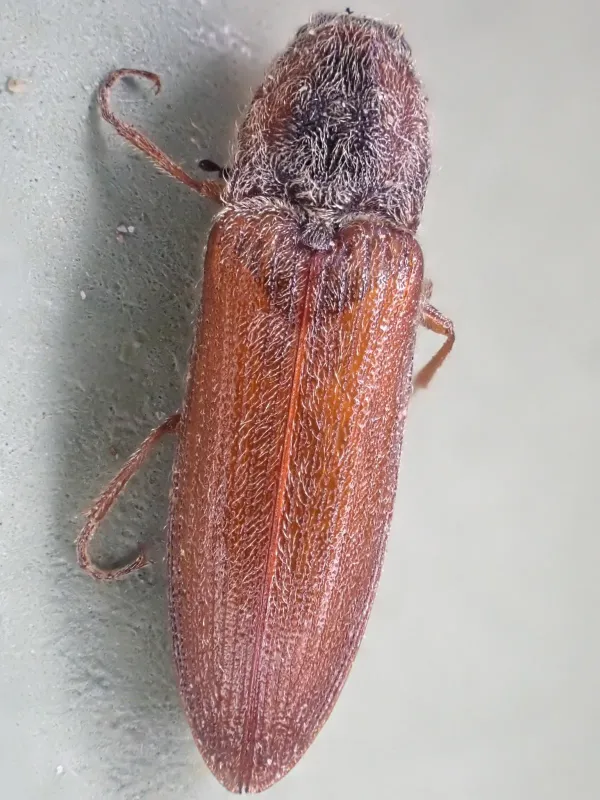
The grey click beetle (Limonius canus) belongs to the order Coleoptera and the family Elateridae. Adults have an elongated body, approximately 10–12 mm long, covered in fine greyish-brown hairs.
The larval stage, commonly known as the wireworm, has a rigid, cylindrical, yellow-to-brown body. It possesses three pairs of short legs, which allow it to maneuver efficiently through the soil layers.
These insects undergo complete metamorphosis, which includes the egg, larva, pupa, and adult stages. The larval stage is particularly long, often lasting several years, making the pest persistent in agricultural fields.
The name "click beetle" comes from the unique ability of adults to flip themselves over by snapping a specific thoracic mechanism, producing an audible clicking sound.
While adults are primarily pollen feeders, they pose little threat compared to the destructive power of the subterranean larvae, which are responsible for the vast majority of economic damage.
What it damages
Wireworms of the Limonius canus species are polyphagous, meaning they feed on a diverse array of crops, including cereals, vegetables, potatoes, and various technical crops.
They cause severe damage by feeding on seeds, roots, and subterranean stems. This leads to poor crop establishment, stunted growth, and in many cases, total plant mortality shortly after germination.
Root crops, particularly potatoes and sugar beets, are highly vulnerable. Larvae bore deep, winding tunnels into the flesh, which significantly reduces commercial value and invites secondary diseases.
Because damage often occurs underground, it frequently goes unnoticed until significant crop loss is already visible on the surface, complicating the management process.
Fields with dense infestations can experience drastic yield losses, sometimes requiring replanting and resulting in increased costs for specialized pest control inputs.
When it appears
Adult activity usually begins in late spring, once soil temperatures at a depth of 10 cm exceed 10–12 degrees Celsius, prompting their emergence from hibernation.
Females lay eggs in clusters within the top layer of moist soil, specifically favoring fields with thick vegetation or cereal cover, which provides protection for the emerging larvae.
Larval movement is highly dictated by soil moisture and temperature. They tend to migrate vertically to deeper soil horizons to avoid excessive heat or moisture stress.
The greatest risk to crops occurs during the spring and early summer months, when larvae are concentrated in the topsoil and actively feeding on young roots and seeds.
As soil temperatures drop in the autumn, larvae retreat deeper into the ground, where they enter diapause and remain throughout the winter period.
Signs of infestation
The primary sign of infestation is sudden wilting or patchiness in young stands, often mistaken for nutritional deficiencies or moisture stress rather than pest damage.
Careful excavation of affected plants typically reveals hollowed-out or severed roots and stems, often with the wireworms still present in the immediate root zone.
Tuber crops show distinct, clean-cut circular entry holes that lead to deep, narrow tunnels, which are indicative of wireworm feeding activity.
A high density of perennial weeds, particularly couch grass (Elymus repens), is a strong indicator of suitable conditions for this pest to proliferate in a field.
Soil bait traps, using germinating grain, are commonly used by agronomists to determine the population density of larvae in the soil before planting decisions are made.
Control measures
Integrated pest management relies on diversified crop rotation, which breaks the pest's cycle by alternating host crops with non-host vegetation to starve the population.
Cultural practices, such as deep plowing and frequent shallow cultivation, are effective at bringing larvae to the surface, where they are exposed to predators and desiccating conditions.
Rigorous weed control is essential, as the removal of host weeds like couch grass eliminates the refuge and food supply for developing wireworm populations.
Seed treatments with systemic insecticides are a highly effective preventative measure, providing immediate protection to the developing seed and seedling during the critical establishment phase.
In cases of high wireworm pressure, applying soil-applied granular insecticides during the planting process can offer long-term protection for the crop root zone.
Taxonomy
- Latin name
- Limonius canus
- Order
- Coleoptera (beetles)
- Family
- Elateridae
- EPPO code
- LIMOCA
Discussion
No discussions yet — be the first.