
California click beetle
Limonius californicus
Description
How to identify
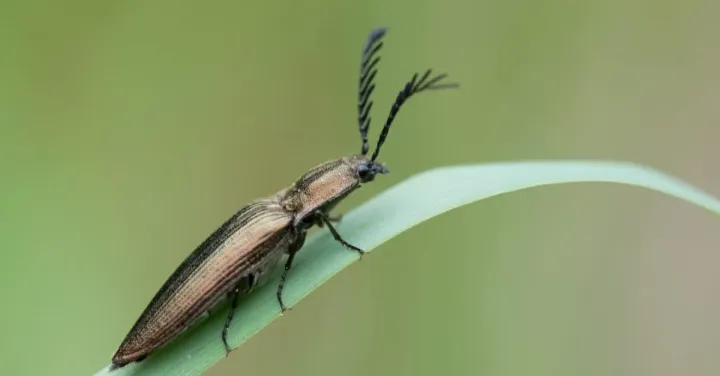
The California click beetle (Limonius californicus) is a member of the family Elateridae, order Coleoptera. Adult beetles are small, typically measuring 7 to 10 millimeters in length, with an elongated, dark brown or black body.
The immature stage, commonly known as the wireworm, is the most destructive phase. Wireworms are characterized by a hard, cylindrical, and yellowish-brown body that resembles a piece of stiff wire.
These insects have a long life cycle, often spanning three to five years, which is highly dependent on soil temperature, moisture levels, and the availability of suitable host plants.
Adult females typically lay their eggs in the upper layers of the soil near the roots of grasses or other vegetation, ensuring that the larvae have immediate access to food upon hatching.
Throughout their development, wireworms live entirely underground, molting multiple times as they increase in size and feeding intensity before eventually pupating in the soil.
What it damages
Wireworms of the California click beetle are polyphagous, meaning they feed on a wide range of agricultural crops, including cereals, potatoes, sugar beets, and various vegetable species.
They cause significant damage by boring into seeds, roots, tubers, and underground stems, which effectively disrupts the plant's nutrient and water uptake, leading to stunting or death.
The feeding damage caused by these larvae often facilitates the entry of soil-borne pathogens, leading to secondary infections, such as root rots and various fungal diseases.
The most critical period for damage is early in the growing season, as larvae feed aggressively on germinating seeds and young seedlings, which can lead to sparse plant stands.
Severe infestations can result in total crop failure, as wireworms are capable of moving from plant to plant, destroying root systems rapidly across entire sections of a field.
When it appears
The movement and activity of wireworms are dictated by the soil environment; they demonstrate clear vertical migration patterns based on the time of year and weather conditions.
During the spring, when the soil warms up, the larvae migrate to the upper 5–15 centimeters of soil to feed on emerging seedlings, making them most destructive during planting time.
In mid-summer, when the surface soil becomes hot and dry, the wireworms descend deeper into the soil profile to find more favorable, moisture-rich conditions.
As temperatures drop in the autumn, larvae may move back towards the surface before eventually retreating deep into the soil to overwinter and avoid extreme cold.
Because the life cycle overlaps, fields typically contain larvae of various ages simultaneously, leading to consistent pressure on crops year after year if not properly managed.
Signs of infestation
Visible signs of an infestation often include stunted growth, sudden wilting, or a lack of germination in specific areas of the field, suggesting feeding damage to the root systems.
When examining plants, you may find evidence of small, clean-cut, and deep holes in the roots or tubers, which are clear indicators of wireworm boring activity.
In potato fields, tubers may exhibit small, circular entry holes that reach deep into the flesh, significantly reducing the marketability and quality of the harvested crop.
Soil sampling is a primary diagnostic tool; digging up small soil sections or using bait stations (like cut potatoes) can effectively confirm the presence and density of the larvae.
The presence of adult click beetles in early spring, especially around field edges or near crop debris, serves as an indicator that a new generation may soon follow.
Control measures
Integrated pest management (IPM) is essential for controlling Limonius californicus, focusing on cultural practices such as crop rotation to disrupt the wireworm's life cycle.
Mechanical control through deep tillage can expose larvae to natural predators like birds and desiccating conditions on the surface, reducing their population levels significantly.
Good field hygiene, including the removal of grassy weeds like quackgrass that serve as alternative food sources, is a critical step in reducing wireworm populations.
Chemical control often involves the use of insecticide seed treatments or the application of granular formulations in the furrow at the time of planting for immediate protection.
- Implement diverse crop rotations.
- Maintain soil moisture and nutrient balance.
- Use pheromone traps to monitor adult beetle activity.
- Apply biological controls, including entomopathogenic fungi.
- Perform deep plowing to disturb larval soil habitats.
Taxonomy
- Latin name
- Limonius californicus
- Order
- Coleoptera (beetles)
- Family
- Elateridae
- EPPO code
- LIMOCF
Discussion
No discussions yet — be the first.