
Lacon musculus
Lacon musculus
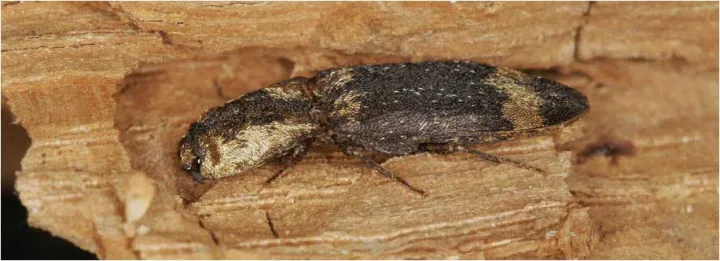
Description
How to identify
Lacon musculus is a species of click beetle belonging to the Elateridae family. These beetles are generally small, measuring between 7 and 9 millimeters, and are covered with fine, dense hairs giving them a brownish or greyish appearance.
The name "click beetle" comes from their unique defensive behavior; when placed on their back, they can snap their thoracic joint to jump into the air, producing a distinctive clicking sound.
Their larvae, commonly known as wireworms, are characterized by a cylindrical, hard-bodied structure. They have a shiny, golden-brown, or yellow chitinous exoskeleton, making them very resistant to environmental stressors.
The larval stage is the most critical for agricultural impact, as they can spend several years developing in the soil before pupating into adult beetles.
Identifying the species accurately often requires microscopic examination of the terminal abdominal segment of the larva to distinguish it from other related click beetle species.
What it damages
The primary damage is caused by the wireworms (larvae), which reside in the soil and feed on underground plant tissues, causing significant physiological stress to crops.
They feed on germinating seeds, often destroying the embryo and preventing emergence. This results in patchy stands and necessitates field replanting, leading to economic losses.
Beyond seeds, the larvae feed on the roots and the base of stems, leading to the yellowing, wilting, and eventually the death of young seedlings in various crops including corn and small grains.
For tuber and root crops like potatoes and sugar beets, wireworms create deep tunnels in the flesh. This direct physical damage degrades crop quality and makes the produce unmarketable.
Furthermore, the tunnels created by larvae allow soil-borne pathogens and fungi to enter the plant tissues, leading to secondary infections and rot in root crops.
When it appears
Adult beetles emerge from the soil in early spring when temperatures consistently rise above 10 degrees Celsius, marking the start of their active season.
During the summer months, adult Lacon musculus are primarily nocturnal or active in the twilight, hiding in cool, shaded areas during the heat of the day.
The larvae are active in the soil profile throughout the entire growing season, performing vertical migrations to maintain their preferred humidity and temperature levels.
As autumn approaches and soil temperatures drop, the larvae move deeper into the soil profile to overwinter, remaining inactive until the following spring thaw.
The overall generation time for this pest is long, typically spanning three to five years, which makes the population cycles relatively stable but difficult to eradicate entirely.
Signs of infestation
The most visible sign of an infestation in fields is the presence of thinning crop stands or gaps where seedlings have failed to emerge or have wilted suddenly.
A closer inspection of wilted plants often reveals shredded or severed roots, or small, round entry holes at the base of the stem where the larva has been feeding.
Excavating the soil around the base of affected plants usually uncovers the stiff, wire-like larvae that are often curled in a characteristic defensive posture.
In root crops, the telltale signs are irregular, deep, and narrow channels bored into the skin and interior of the harvestable product, often seen at harvest time.
Heavy infestations are often correlated with fields that have high populations of grassy weeds like couch grass (Elymus repens), which provide a food source for the larvae.
Control measures
Crop rotation is a fundamental management strategy. Rotating host crops with non-host crops like legumes can help reduce wireworm populations in the soil over time.
Deep autumn tillage is highly effective as it disturbs the soil, exposing the larvae to freezing temperatures, desiccation, and predatory birds that feed on them.
Effective weed management is crucial, as keeping fields clear of grassy weeds prevents the larvae from having a stable food source and nesting environment during the off-season.
Chemical control often involves seed treatments with systemic insecticides, providing a protective barrier around the seed during the critical period of germination and emergence.
For severe infestations, soil-applied granular insecticides can be used at planting. Monitoring with bait traps made of grain buried in the soil can help determine the necessity of treatment.
Taxonomy
- Latin name
- Lacon musculus
- Order
- Coleoptera (beetles)
- Family
- Elateridae
- EPPO code
- LACOMS
Discussion
No discussions yet — be the first.