
Click beetle
Lacon
Description
How to identify
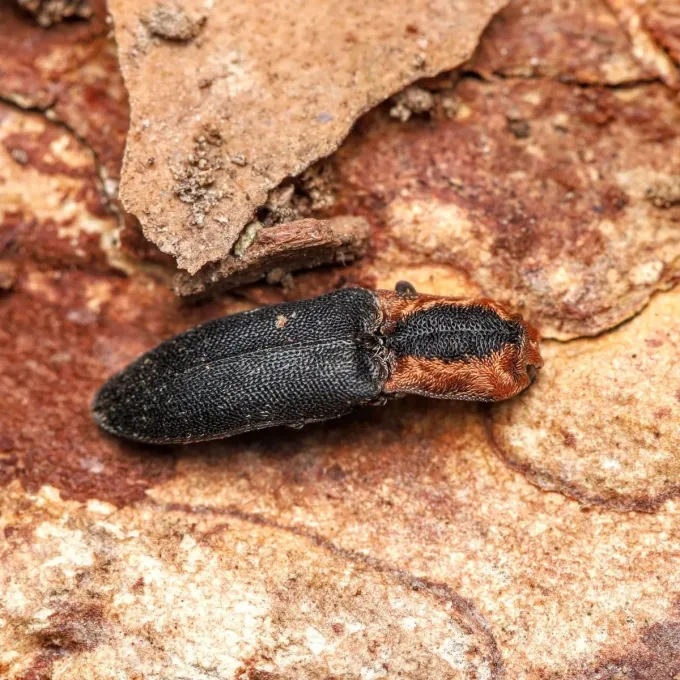
The genus Lacon belongs to the family Elateridae within the order Coleoptera. Adult beetles are characterized by a unique prosternal spine mechanism that allows them to perform a "click" jump if they land on their backs.
The bodies of these beetles are elongated and covered with dense hairs or scales, which often provide camouflage against soil or bark. Unlike many other Elateridae, adults of the genus Lacon are frequently found in leaf litter, on decaying wood, or in the soil.
The larvae, commonly known as wireworms, possess a rigid, cylindrical, and highly sclerotized exoskeleton, usually yellow or brown in color. It is this life stage that causes the primary economic damage to the agricultural sector.
Morphologically, click beetle larvae are easily recognized by their three pairs of short but powerful thoracic legs, which enable rapid movement through the soil profile. Their heads are equipped with strong, chewing mouthparts.
The life cycle of the click beetle ranges from 3 to 5 years, depending on the specific species and environmental conditions. The vast majority of this time is spent underground, actively feeding on subterranean plant parts.
What it damages
Click beetle larvae are polyphagous and attack almost all types of agricultural crops. Cereals, row crops, and vegetable plants are considered the most vulnerable.
These pests are particularly destructive to corn, sunflowers, sugar beets, and potatoes. Wireworms bore into seeds, roots, tubers, and the base of stems, leading to seedling death.
Root system damage results in stunted plant growth, reduced water and nutrient uptake, and often causes thin, irregular plant stands in the field.
In potatoes and root crops, the larvae create deep, narrow tunnels, which not only ruin the market value of the produce but also create entry points for secondary fungal and bacterial pathogens.
In areas with high population density, wireworms can destroy up to 50% of the root crop harvest or cause total crop failure, particularly in moist, poorly drained soils.
When it appears
Adult activity begins in the spring when soil temperatures reach 10–12 degrees Celsius. During this period, the beetles emerge to the surface for mating.
Egg-laying occurs in the upper soil layers, typically near weeds or dense vegetation where moisture levels are maintained. Egg development lasts from two to four weeks.
Larvae exhibit vertical migration within the soil profile: during spring and autumn, at moderate temperatures, they move to the topsoil layer to feed on plant roots. During hot summer weather or soil freezing, they retreat to deeper, more stable layers.
The most significant damage to crops occurs in the spring during germination and early seedling emergence, when the plants are most susceptible to attack.
Pupation typically occurs in the latter half of summer within earthen cells, and the adults that emerge in the autumn overwinter in the soil until the following spring.
Signs of infestation
A primary indicator of wireworm presence is widespread seedling thinning without obvious surface-level causes.
When inspecting wilted or dead plants, look for boreholes or damage to the roots or stem at the soil line, which often appear as clean, circular entry points.
For potatoes or sugar beets, a characteristic symptom is the presence of "holes" in the tubers or roots, which often feature winding tunnels that extend deep into the flesh.
Wireworm presence can be confirmed using soil sampling or the installation of bait stations: bury pieces of moist grain or potato in the soil and check them for larvae after 3–5 days.
The presence of couch grass (Elymus repens) in the field is an indirect warning of a high risk of infestation, as this weed provides an ideal habitat and food source for click beetles.
Control measures
Crucial agrotechnical control methods include regular crop rotation and deep autumn plowing, which exposes larvae to the surface, making them vulnerable to frost and natural predators.
Weed management, especially the control of couch grass, significantly reduces the pest's food supply. Liming acidic soils is also effective, as wireworms prefer habitats with higher soil acidity.
Chemical control strategies include seed treatments with systemic insecticides, which provide long-lasting protection during the early seedling stage.
Applying granular insecticides to the soil at planting time is a reliable method for localized root protection during the first few weeks of crop growth.
- Timely mechanical soil cultivation.
- Balanced application of nitrogen fertilizers.
- Use of manual traps on smaller plots.
- Application of bio-insecticides based on entomopathogenic fungi.
Taxonomy
- Latin name
- Lacon
- Order
- Coleoptera (beetles)
- Family
- Elateridae
- EPPO code
- LACOSP
Discussion
No discussions yet — be the first.