
Two-colored click beetle
Hypnoidus bicolor
Description
How to identify
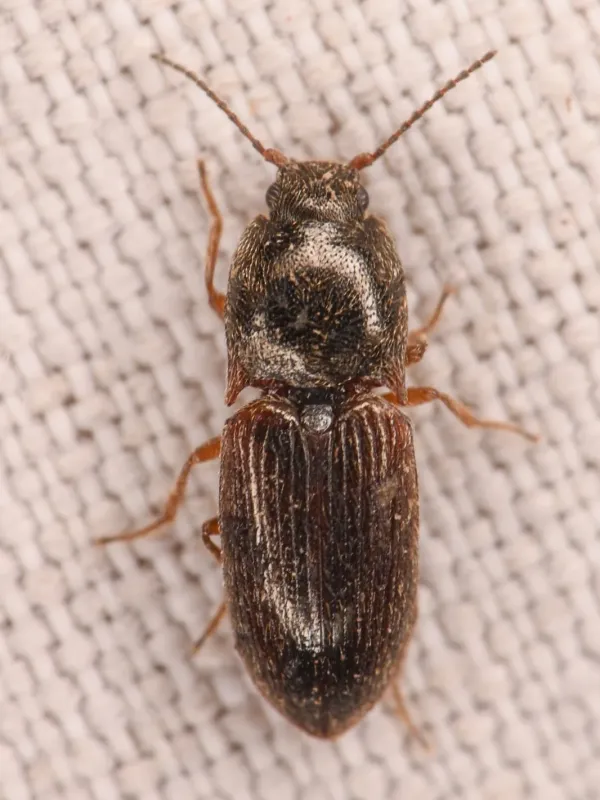
The two-colored click beetle Hypnoidus bicolor is a member of the Elateridae family, order Coleoptera. Adult beetles are relatively small, typically measuring between 6 and 8 mm in length.
Adults exhibit a dark brown to black coloration, often with lighter pubescence on the pronotum and elytra. The species is known for the characteristic clicking mechanism that allows it to flip upright when turned on its back.
The larvae, commonly known as wireworms, possess a cylindrical, firm, and heavily sclerotized body. This tough outer shell provides significant protection against environmental stressors and predators.
The larva features a well-developed chewing mouthpart designed for feeding on roots and germinating seeds within the soil profile. The life cycle is complex and often spans multiple years.
Development involves several stages including egg, larva, pupa, and adult, with the larval stage being the most prolonged and destructive phase in the insect's life cycle.
What it damages
The primary damage is caused by the wireworm larvae, which live in the soil and attack seeds, sprouts, and roots of various cultivated crops.
Cereals such as wheat, barley, and corn are among the most frequently attacked crops, especially during the crucial germination and seedling establishment phases.
Larvae feed by boring into seeds, consuming the embryo, which prevents germination and causes significant thinning of plant stands in the field.
Root damage leads to reduced nutrient and water uptake, resulting in stunted plant growth, chlorosis, and eventual death of the young plant.
Heavy infestations can lead to substantial yield losses, as entire sections of a crop field may be decimated by the continuous feeding of larval populations.
When it appears
Adult activity of Hypnoidus bicolor typically commences in early spring as soil temperatures reach 8–10 degrees Celsius.
Larvae show the highest levels of feeding activity in the upper soil layers during the spring planting season, when young roots and seeds are readily available.
During dry summer months, larvae tend to migrate to deeper, more humid soil horizons to avoid desiccation, becoming less accessible for control measures.
Autumn brings a second peak of surface-level activity before the population moves deeper into the soil profile to overwinter and survive freezing temperatures.
Adult beetles are most commonly observed during their mating and egg-laying period in late spring and early summer, often near vegetation and debris.
Signs of infestation
The most prominent sign of an infestation is the irregular emergence of seedlings, resulting in gaps or bare patches throughout the agricultural field.
Upon inspecting affected plants, growers will often find damaged or hollowed-out subterranean stems and chewed root systems, which are telltale signs of wireworm presence.
Systematic soil sampling and excavation are the most effective ways to confirm the presence and density of wireworms in a field prior to planting.
- Wilting of young plants during hot, sunny days despite adequate soil moisture levels.
- Distinctive boreholes at the base of stems, leading to sudden plant collapse.
- Increased bird activity in the field during tillage, as they often forage for exposed soil larvae.
Monitoring adult beetle populations with traps in the spring helps predict potential larval pressure for the upcoming growing season.
Control measures
Managing the two-colored click beetle requires an integrated pest management (IPM) approach combining cultural, mechanical, and chemical control methods.
Deep autumn plowing is a highly effective mechanical measure, as it exposes larvae to colder temperatures and avian predators, significantly reducing their survival rate.
Crop rotation serves as a fundamental cultural practice; rotating host crops with non-preferred species like certain legumes or mustard can interrupt the life cycle.
Chemical control focuses on the use of insecticidal seed treatments to provide a localized zone of protection for germinating seeds against soil-borne pests.
In cases of severe infestation, the application of granular soil insecticides at the time of planting is recommended to lower larval density and protect plant stands.
Taxonomy
- Latin name
- Hypnoidus bicolor
- Order
- Coleoptera (beetles)
- Family
- Elateridae
- EPPO code
- HPNDBI
Discussion
No discussions yet — be the first.