
Black click beetle
Hemicrepidius niger
Description
How to identify
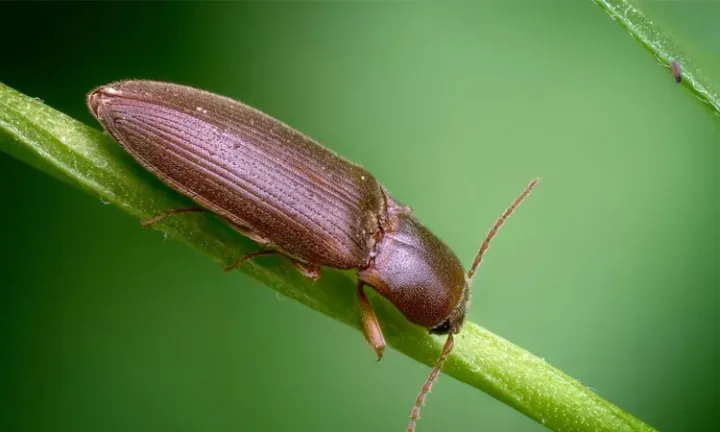
The Black click beetle (Hemicrepidius niger) belongs to the order Coleoptera and the family Elateridae. Adult beetles reach 10–15 mm in length and are characterized by an elongated, slightly convex body with a dense black pubescence.
The name "click beetle" comes from a unique mechanism found in the thorax. A spine on the prosternum fits into a groove on the mesosternum, allowing the beetle to produce a clicking sound and jump when it needs to right itself after landing on its back.
The larval stage, commonly known as a wireworm, is more significant for farmers. These larvae have a cylindrical, hard-shelled body with a yellowish-brown color, which is highly resistant to mechanical pressure and environmental stress.
Their biology is deeply integrated into the soil ecosystem. While adults are mobile and can fly to disperse, the larval stage remains underground, moving through soil layers to find moisture and food sources throughout their several-year life cycle.
Morphological identification focuses on the antennae structure and specific pronotal features, distinguishing H. niger from other common click beetle species found in similar temperate climatic zones.
What it damages
Wireworms cause substantial damage to the underground parts of agricultural plants, including roots, seeds, tubers, and the lower stems of seedlings. Major crops at risk include corn, cereals, potatoes, and sugar beets.
In early spring, wireworms can cause severe losses by feeding on the germinating seeds and young sprouts. This leads to gaps in plant stands, often requiring farmers to perform expensive reseeding of the fields.
For root crops like potatoes, wireworms create deep, narrow tunnels. This damage not only degrades the quality of the produce, making it unsellable, but also facilitates the entry of pathogens that cause rot and fungal diseases.
In cereal fields, feeding on the crown area of the plant results in stunting, yellowing, and eventual death of the tillers. High populations of larvae can reduce yields by a significant percentage in a single growing season.
The intensity of the damage is often higher in fields with high moisture content and those that have been improperly managed, such as abandoned plots with abundant wild grasses.
When it appears
The life cycle of the Black click beetle is multi-year, which makes its population management challenging. Adult beetles typically emerge and fly from May to June to locate mates and suitable egg-laying sites.
Females prefer to lay eggs in moist soil, especially near roots of grasses or in fields with abundant crop residue. A single female can produce a large number of eggs, ensuring a persistent population over time.
Larvae develop over 3–4 years, moving vertically through the soil profile. They are highly sensitive to soil moisture and will retreat to deeper layers when the surface soil becomes too dry or hot.
During the spring and autumn, larvae move to the upper 10–15 cm of the soil, where they actively seek out food. This behavior coincides with the emergence of many crops, creating the peak damage window.
Pupation occurs in special chambers in the soil during the second half of summer. Once pupation is complete, the new adult beetles often remain in the soil over the winter before emerging the following spring.
Signs of infestation
The presence of wireworms is often first noticed through uneven or patchy emergence of crops across the field, with some seedlings failing to survive the initial stages of growth.
Wilted plants that appear yellow despite adequate irrigation are strong indicators of root damage caused by larval feeding. When pulled, these plants often separate from their roots easily.
If you suspect an infestation, inspecting the soil around the roots will reveal the hard, shiny, yellowish larvae. Their ability to wiggle vigorously is a classic identifier for wireworms.
Potato tubers affected by wireworms exhibit characteristic holes or tunnels that might be dark or filled with decay, which serves as a visible sign of pest activity.
For systematic monitoring, agronomists use bait traps containing moistened grain or potato slices. These are buried in the field to attract larvae, allowing for an accurate count to determine the need for intervention.
Control measures
An effective management strategy for Hemicrepidius niger combines cultural practices with targeted chemical control to maintain population numbers below the economic injury level.
Crop rotation is the most critical cultural practice. Avoid planting highly susceptible crops in fields immediately after perennial grasses or sod, as these are preferred environments for the beetle to lay eggs.
Deep fall tillage is effective because it disrupts the soil, exposing the larvae to predators like birds and subjecting them to lethal temperature and moisture fluctuations on the surface.
Weed management, particularly controlling couch grass (Elymus repens), is essential. Removing alternate food sources makes the field less hospitable for both larvae and egg-laying adults.
For high-risk areas, the use of insecticide-treated seeds or soil-applied granular pesticides at planting is recommended. Always ensure treatments are applied according to the specific regulations for the crop and region.
Taxonomy
- Latin name
- Hemicrepidius niger
- Order
- Coleoptera (beetles)
- Family
- Elateridae
- EPPO code
- ATHONI
Discussion
No discussions yet — be the first.