
Hemicrepidius hirtus
Hemicrepidius hirtus
Description
How to identify
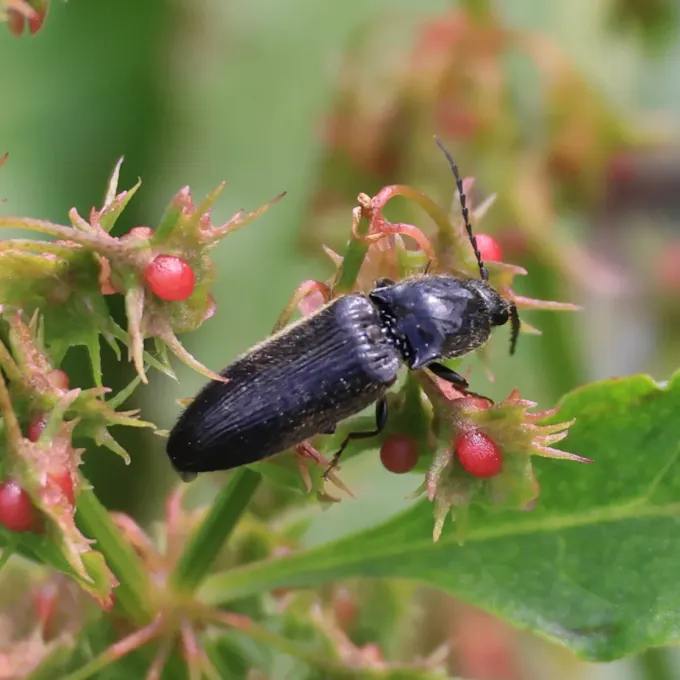
Hemicrepidius hirtus, commonly known as a type of click beetle, belongs to the order Coleoptera and the family Elateridae. The adult beetle is characterized by a body length of approximately 9–12 mm, covered in dense, fine hairs, which gives it a distinct appearance.
The coloration of the adult usually ranges from dark brown to black, with lighter reddish-brown legs and antennae. As a member of the Elateridae family, it possesses a unique mechanism on its prothorax that allows the beetle to flip itself into the air with a snapping sound if it is placed on its back.
The larval stage, widely recognized as a wireworm, is cylindrical, elongated, and possesses a tough, yellowish-brown chitinous exoskeleton. This structure allows the larvae to move efficiently through the soil profile to reach plant roots.
The life cycle involves complete metamorphosis, consisting of four stages: egg, larva, pupa, and adult. The development from egg to adult often takes several years, depending on environmental conditions and soil quality.
These insects favor moist soil environments rich in organic matter. They are frequently encountered in forest and grassland ecosystems, where they adapt well to both wild vegetation and cultivated agricultural fields.
What it damages
The primary economic damage is caused by the wireworm larvae living in the soil. They are opportunistic feeders that tunnel into the root systems, seeds, and stem bases of various agricultural crops, leading to severe physiological stress.
Host plants include cereals, maize, potatoes, sugar beets, sunflowers, and many vegetable crops. The most vulnerable period is during germination and early seedling development, where even minor root damage can prove fatal to the plant.
By consuming the vascular tissues of the roots, wireworms effectively disrupt the plant's ability to uptake water and nutrients, resulting in chlorosis, stunted growth, or sudden wilting. Severe infestations often lead to complete crop stand loss.
Furthermore, the physical wounds created by feeding larvae act as entry points for soil-borne pathogens, including bacteria and fungi. This secondary infection often leads to root or tuber rot, further decreasing both yield and product quality.
In potato cultivation, the damage is particularly evident as deep, irregular tunnels in the tubers, which makes them unmarketable and susceptible to rot during long-term storage in warehouses.
When it appears
Adult Hemicrepidius hirtus are typically active during late spring and throughout the summer months, usually from May to July. During this time, they move to the soil surface to feed on pollen and nectar from various flowers.
Egg-laying occurs in the upper layers of the soil. Females are particularly attracted to areas with dense vegetation or weeds, as these provide the necessary moisture and cover required for the eggs to develop successfully.
Larvae remain in the soil for several years, passing through multiple larval stages. As temperatures drop in autumn, they migrate deeper into the soil profile to escape freezing temperatures and enter a period of inactivity.
In spring, once the soil temperature warms up to about 10–12 degrees Celsius, the wireworms migrate back to the upper layers of the soil where the roots of spring-planted crops are developing, initiating a new cycle of feeding.
This early-season migration coincides with the planting of many important crops, making early spring the most critical window for implementing pest management strategies to protect vulnerable young plants.
Signs of infestation
The most visible sign of an infestation is the appearance of gaps in plant rows where seedlings have failed or suddenly collapsed. These plants are often easy to pull from the ground, revealing partially eaten or severed roots.
Careful inspection of the soil around the base of affected plants often reveals the wireworms themselves. Their brownish, tough bodies make them distinct once the soil is carefully crumbled or sifted.
In root crops and potatoes, internal tunneling is the definitive sign of wireworm activity. These tunnels may be narrow and winding, often leading to internal decay or hollowed-out sections of the root structure.
The presence of perennial weeds, such as couch grass (Elymus repens), in a field is a strong indicator of suitable habitat for wireworms. These weeds maintain the larvae population even when no crops are present.
Overall field appearance, such as uneven growth patterns and patches of withered plants, combined with the presence of holes in harvested tubers, provides clear evidence that the population density of wireworms has reached an economic threshold.
Control measures
The foundation of effective wireworm control is good agricultural practice. Deep autumn plowing (tillage) is highly effective as it brings larvae and pupae to the surface, exposing them to bird predation and desiccation by wind and cold.
Rigorous weed control, particularly of perennial species, is essential. Removing weeds eliminates the larvae's primary food source and breeding sites, significantly reducing the pest pressure in subsequent seasons.
Implementing crop rotation is a vital strategy. Planting non-host crops or those that are less susceptible can break the wireworm life cycle, preventing the buildup of larvae populations that usually occurs under continuous monocropping.
Chemical control methods include the use of seed treatments with systemic insecticides or the application of granular soil insecticides at the time of planting. These methods provide a critical zone of protection around the germinating seeds.
- Adjusting planting dates to avoid peak larval activity.
- Applying lime to acidic soils, which is often unfavorable for wireworms.
- Using bait traps (e.g., grain or bran) to monitor population density before planting.
- Ensuring proper soil drainage to avoid overly wet conditions preferred by the pests.
Taxonomy
- Latin name
- Hemicrepidius hirtus
- Order
- Coleoptera (beetles)
- Family
- Elateridae
- EPPO code
- ATHOHI
Discussion
No discussions yet — be the first.