
Dark-winged click beetle
Ctenicera aeripennis
Description
How to identify
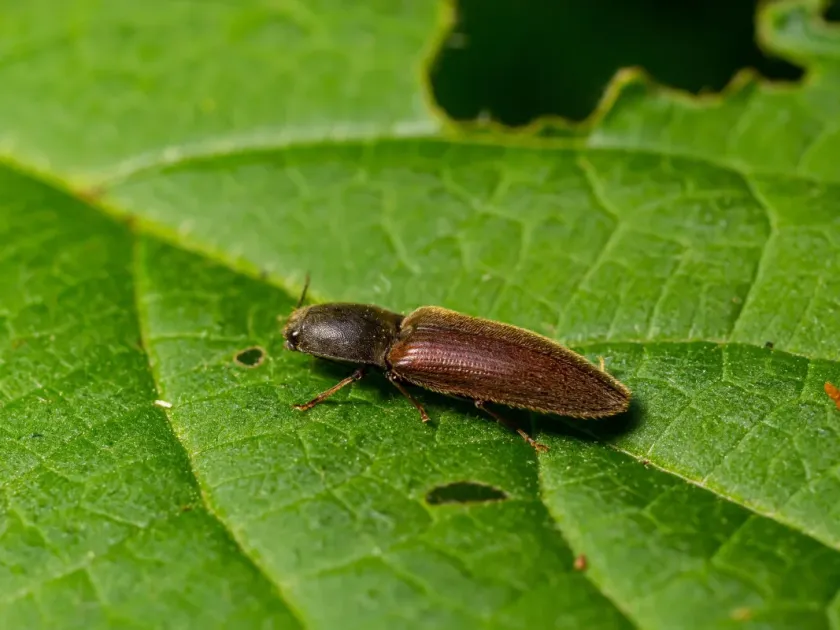
The adult dark-winged click beetle, Ctenicera aeripennis, is an elongated insect measuring approximately 10 to 15 mm. Its color ranges from dark brown to black, often featuring a subtle bronze sheen that blends well with soil and organic matter.
The larvae, universally known as wireworms, are the primary damaging stage of the life cycle. They have a characteristic cylindrical, rigid, and highly sclerotized body, giving them a glossy, wire-like appearance that makes them quite tough to crush.
Taxonomically, this species is a member of the Coleoptera order and the Elateridae family. It is a highly adaptable pest capable of thriving in various soil conditions, which contributes to its wide distribution across agricultural regions.
The complete life cycle typically lasts several years, with the majority of this time spent as a larva within the soil profile. This extended subterranean phase makes it a persistent threat to crop health year after year.
Females lay eggs in the soil, usually in clusters, preferring areas with dense vegetation or moist organic matter. After hatching, the larvae go through several developmental instars, becoming increasingly destructive as they grow in size.
What it damages
The dark-winged click beetle is a polyphagous pest, meaning it feeds on a wide range of agricultural crops, including cereals, maize, potatoes, sugar beets, and various vegetables. The larvae feed primarily on roots, seeds, and stems.
During the seedling stage, wireworms often consume the germinating seeds, leading to poor crop stands and significant yield losses. This often necessitates costly re-seeding or re-planting operations in affected fields.
As the plants grow, larvae feed on the roots, which stunts development, reduces nutrient uptake, and causes the plants to wilt. Damaged plants are also significantly more susceptible to secondary soil-borne pathogens.
Root crops and potatoes are particularly vulnerable to wireworm feeding. Larvae bore deep, meandering tunnels into the tubers, which severely compromises the marketability of the crop and invites opportunistic rot.
Fields that have recently been converted from pasture or grassland are at the highest risk, as these areas often harbor large, established populations of wireworms that thrive in the undisturbed soil environment.
When it appears
Adult beetles typically emerge in the early spring as soil temperatures rise. Their peak activity usually coincides with the critical early stages of crop emergence and establishment.
Larvae remain active throughout the growing season but are highly sensitive to soil moisture. During prolonged dry spells, they migrate deeper into the soil profile to find suitable moisture levels, effectively escaping surface-level controls.
As autumn arrives and soil temperatures drop, both adults and larvae migrate deep into the soil to overwinter. This deep-soil behavior provides a robust defense against freezing temperatures, allowing the population to persist.
Early spring is considered the most critical season for damage, as overwintered larvae are highly hungry and congregate around the emerging roots and seeds of newly planted crops.
The activity patterns are strictly governed by environmental cues, meaning a moist and warm spring often leads to a more pronounced and synchronized attack on young agricultural crops.
Signs of infestation
The most visible sign of an infestation is the presence of thinning patches or gaps in crop rows. Affected plants often display sudden wilting and are easily pulled from the ground because their root systems have been consumed.
When inspecting damaged plants, agronomists can often find the stiff, yellow-brown larvae nestled near the base of the stem or buried within the root zone. Characteristic feeding punctures will be present on stems.
A heavy infestation of quackgrass is a strong indicator of high wireworm pressure. The grass provides an ideal food source for the larvae, sustaining the population even in the absence of primary crops.
Potatoes and root vegetables damaged by wireworms display irregular holes and tunnels. In severe cases, the entire surface of the vegetable can be pockmarked, rendering it unsuitable for fresh market sale.
Field scouting for this pest is often conducted using bait traps, such as buried grain or potato pieces, which are checked periodically to assess larval density before making management decisions.
Control measures
Effective management requires a multi-faceted approach. Crop rotation is paramount, specifically rotating susceptible crops with those that are less attractive or even suppressive to wireworms, such as certain mustard species.
Good agricultural practices, such as intensive tillage, are highly effective. Tilling fields in the late summer or autumn exposes the larvae to predators, desiccation by the sun, and temperature fluctuations, significantly reducing population numbers.
Chemical control is often necessary in high-pressure environments, focusing on the use of seed treatments or in-furrow insecticide applications at planting to create a protective barrier for emerging roots.
Integrated Pest Management (IPM) strategies emphasize regular monitoring to determine if threshold levels have been reached, avoiding unnecessary insecticide applications while ensuring the crop remains protected.
- Implement strategic crop rotation.
- Practice thorough weed management.
- Utilize deep autumn tillage.
- Apply insecticide seed treatments.
- Conduct regular population monitoring with bait traps.
Taxonomy
- Latin name
- Ctenicera aeripennis
- Order
- Coleoptera (beetles)
- Family
- Elateridae
- EPPO code
- CORMAD
Discussion
No discussions yet — be the first.