
Click beetle
Ctenicera
Description
How to identify
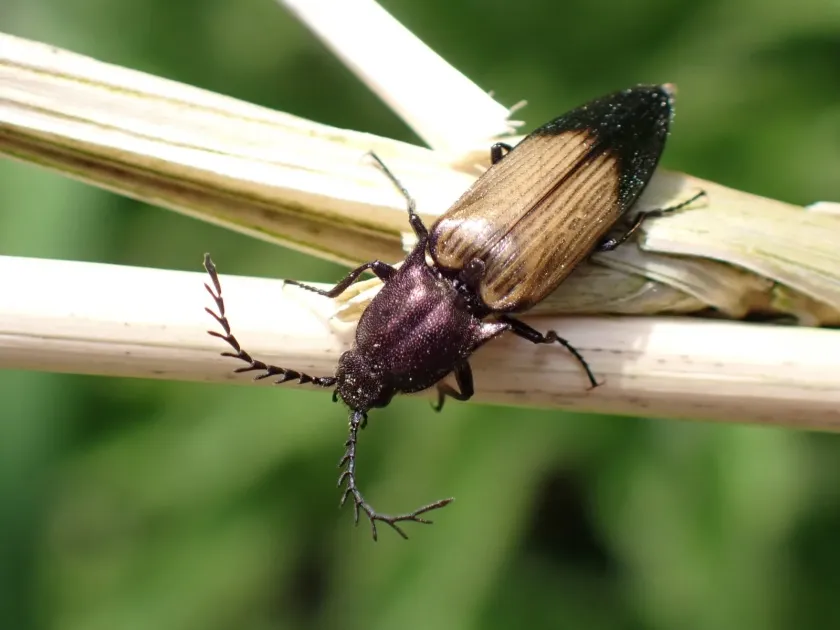
Adult click beetles (family Elateridae) are named for their ability to flip themselves into the air with a clicking sound when they are turned upside down.
Their bodies are elongated, flattened, and generally dark brown or black in color, typically ranging from 7 to 20 millimeters in length.
The larval stage, commonly known as the wireworm, has a smooth, cylindrical, and hard-skinned body that makes them very resilient in the soil environment.
Wireworms vary in color from yellowish to reddish-brown, allowing them to blend into the soil while they feed on subterranean plant parts.
The life cycle of these insects is notably long, often spanning several years, with the larval stage spent entirely within the soil profile.
What it damages
Wireworms are notorious polyphagous pests that cause extensive damage to a wide variety of field crops, vegetables, and ornamental plants.
They predominantly attack root systems, tubers, and seeds, frequently boring into vegetables like potatoes and carrots, rendering them unmarketable.
In cereal crops, wireworms consume the germ of sown seeds or chew through the base of young stems, leading to severe stand thinning.
The economic impact of heavy infestations can be devastating, sometimes requiring the replanting of entire fields due to excessive plant loss.
In addition to direct feeding damage, the wounds created by wireworms often serve as entry points for various soil-borne pathogens and decay-causing bacteria.
When it appears
Adult beetles typically emerge from the soil in early spring, usually when temperatures become suitable for their mating and reproductive activities.
Egg-laying occurs in late spring and early summer, with females choosing sites with sufficient moisture and vegetation to ensure larval survival.
Larval activity is highest during the moist spring and autumn months when the insects move into the root zone to feed aggressively.
During the peak of summer heat or winter cold, wireworms retreat into deeper soil horizons to protect themselves from environmental stress.
Understanding these migration patterns is essential for growers to time their monitoring and intervention strategies effectively throughout the season.
Signs of infestation
The primary symptom of a wireworm infestation is the wilting and eventual death of young plants despite adequate irrigation or rainfall.
Careful examination of the plant base often reveals chewed roots or stems, with small holes indicating the recent presence of wireworm larvae.
Visible damage to tubers or root vegetables includes small, rounded holes that lead into deep, tunnel-like passages within the vegetable flesh.
Irregular patches of missing or stunted plants in a crop field are a common sign that wireworms have been actively feeding in those specific areas.
To confirm presence, growers can place potato or carrot traps in the soil, which serve as excellent bait to attract larvae for accurate population counting.
Control measures
Frequent and deep cultivation of the soil helps expose larvae to the surface, making them vulnerable to desiccation and natural predators like birds.
Liming acidic soils can significantly reduce wireworm populations, as these pests prefer lower pH environments and are less active in neutral or alkaline soils.
Crop rotation incorporating non-host plants or cover crops can disrupt the lifecycle and naturally lower the number of larvae present in the field.
Biological control using entomopathogenic fungi is becoming an increasingly popular and sustainable method to suppress wireworm populations.
In severe cases, targeted soil insecticides or seed treatments may be necessary to ensure crop survival and maintain economic yield levels.
Taxonomy
- Latin name
- Ctenicera
- Order
- Coleoptera (beetles)
- Family
- Elateridae
- EPPO code
- CTENSP
Discussion
No discussions yet — be the first.